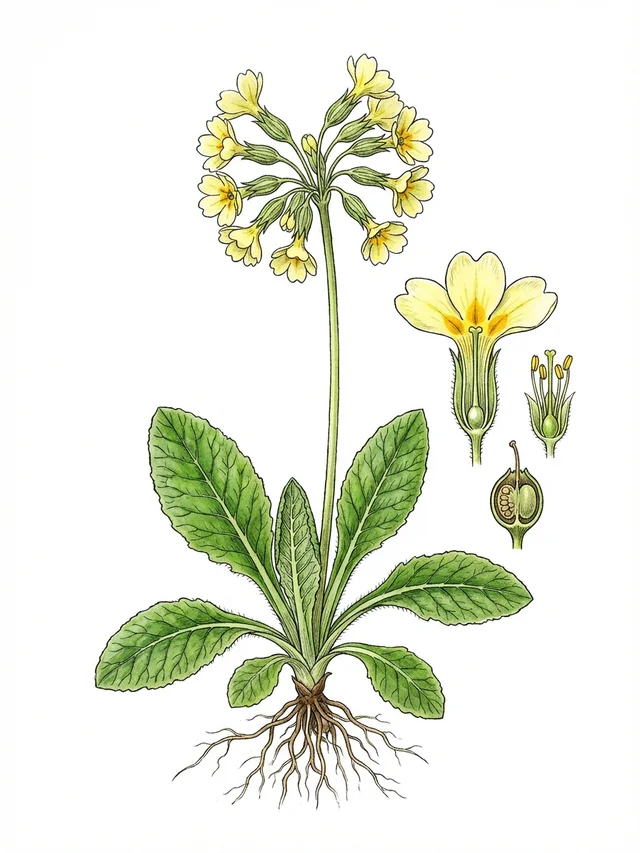
 Image to followAI-generated illustration
Rudbeckia hirta
Rudbeckia hirta
FamilyGenus: Rudbeckianative in Germany
🌿
31
Species
interact
🔗
59
Interactions
documented
About this species
Rudbeckia hirta is an introduced and established herbaceous plant in Great Britain. It reaches about 0.5 m in height, bears broad leaves and produces daisy-like flowers from July to September. It thrives in full sun on moderately moist, normal soils and provides low nectar and pollen value for insects.
Ecological network
Click to highlight connections · Click again to open the species page
Loading network...
PollinationFlower visit
Ecological significance
Rudbeckia hirta provides low-value nectar and pollen resources for insects (nectar 2, pollen 2). It forms arbuscular mycorrhizal associations with soil fungi. It is introduced and established in Great Britain and is not currently listed as invasive in the region.
Annual cycle
A herbaceous plant flowering from July to September.
Safety note
No safety information is documented.
Standort & Merkmale
Light
Sonne
Moisture
Frisch (Mäßig feucht)
Soil
Mittelzehrer (Normaler Boden)
Flowering period
Jul – Sep
Soil reaction
Basisch / Kalkhold
Bioregion
Continental
Nectar value
2
Pollen value
2
Growth form
Krautige Pflanze
Woodiness
Nicht verholzt
Leaf type
Breitblättrig
Plant height
0.52 m
Morphological traits: TRY ID3 (CC BY 3.0) & TRY ID81 (CC BY)
Pflege & Anbau
Grow in full sun in moderately moist, well-drained soil of normal fertility. The plant flowers from July to September.
Scientific profile
Rudbeckia hirta is a non-woody, broad-leaved herbaceous plant that grows to around 0.52 m tall. Its leaves have an average area of 466 mm², and its diaspores are minute, weighing about 0.38 mg. The species is a neophyte in Great Britain, where it is introduced and established. Ecologically it prefers full sun, moderately warm temperatures, and fresh, moderately moist soils that are alkaline to basic and of medium fertility. Typical habitats include fertilised meadows and intensive grasslands, and secondarily arable weed communities. The plant forms arbuscular mycorrhizal associations. Flowering occurs from July to September; the blooms offer low nectar and low pollen (both rated 2). It is not currently listed as invasive in Great Britain.
Pollinators & visitors
23 Arten interagieren mit dieser Pflanze
Halictus rubicundusPieris rapaeLasioglossum leucozoniumApis melliferaAgriades glandonMegachile centuncularisVanessa carduiVanessa atalantaHalictus confususPolistes dominulaBombus soroeensisEnoplognatha ovataPseudoanthidium nanumAraneus diadematusHalictus scabiosaeSceliphron caementariumEpirrhoe alternataAncistrocerus gazellaAnthidium manicatumAndrena wilkellaArgynnis paphiaThymelicus lineolaSeladonia subaurata
Other flower visitors
8 other species visit the flowers
Plutella xylostellaHippodamia variegataMisumena vatiaHarmonia axyridisFormica fuscaCoccinella septempunctataSitona hispidulusSalticus scenicus
Sources & data origin
•Interaktionsdaten via GloBI (CC-BY 4.0)
•pollinator_interactions
•FloraWeb / BfN
•EIVE 1.0 — Dengler et al. (2023), DOI: 10.3897/VCS.98324 (CC BY 4.0)
•EuPPollNet — Kuppler et al. (2025), DOI: 10.1111/geb.70000 (CC BY 4.0)
•Database of Pollinator Interactions (DoPI) — Pocock et al. (2022), DOI: 10.1002/ecy.3801 (CC BY)
•GBIF Backbone Taxonomy — GBIF Secretariat (2024), DOI: 10.15468/39omei (CC BY 4.0)
•TRY Categorical Traits (ID3) — Kattge et al. (2012), DOI: 10.17871/TRY.3 (CC BY 3.0)
•TRY Global Spectrum (ID81) — Díaz et al. (2016/2021), DOI: 10.17871/TRY.81 (CC BY)
•Checklist Alien Plants Belgium — Verloove F (2023), Botanic Garden Meise (CC BY 4.0)
•Govaerts R et al. (2025) — World Checklist of Vascular Plants (WCVP) v14. Royal Botanic Gardens, Kew. DOI: 10.34885/xs7h-ze42 (CC BY 4.0)
All data is licensed under CC BY 4.0, CC0, or compatible terms. Attribution according to license conditions. Full source overview →