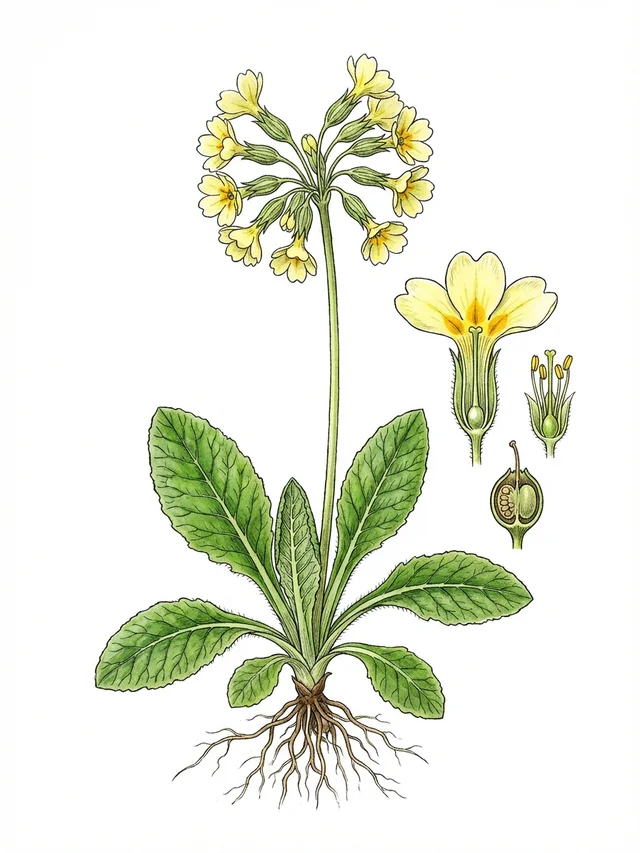
 Image to followAI-generated illustration
Rumex conglomeratus
Rumex conglomeratus
FamilyGenus: Rumexnative in Germany
🌿
2
Species
interact
🔗
3
Interactions
documented
About this species
A native wild dock of sunny, damp, fertile places. This herbaceous perennial bears broad leaves and produces flowers from June to August, reaching around 55 cm in height.
Ecological network
Click to highlight connections · Click again to open the species page
Loading network...
Flower visit
Ecological significance
As part of the native flora of damp, nutrient-rich sites, Rumex conglomeratus contributes to the structural diversity of these habitats. Its foliage and seeds may support local invertebrate wildlife, though no specific associations are recorded.
Annual cycle
New foliage emerges in spring, with flowering taking place from June through to August. Seed is set in late summer and the aerial growth dies back in autumn, the plant overwintering as a perennial rootstock.
Standort & Merkmale
Light
Sonne
Moisture
Frisch (Mäßig feucht)
Soil
Starkzehrer (Nährstoffreicher/Fetter Boden)
Flowering period
Jun – Aug
Soil reaction
Basisch / Kalkhold
Bioregion
Continental
Growth form
Krautige Pflanze
Woodiness
Nicht verholzt
Leaf type
Breitblättrig
Plant height
0.553 m
Morphological traits: TRY ID3 (CC BY 3.0) & TRY ID81 (CC BY)
Pflege & Anbau
If grown, this dock requires a sunny position and consistently moist, fertile, preferably calcareous soil. It is a plant of low-disturbance habitats and will perform best where the ground is not heavily worked.
Scientific profile
Rumex conglomeratus is a terrestrial perennial herb, native in Great Britain. It has a non-woody, broad-leaved growth form and typically attains a height of about 55 cm, with individual leaf areas around 4190 mm². The plant favours sunny positions and moist, nutrient-rich soils, showing a strong preference for calcareous or basic conditions and no tolerance of salinity. It is associated with habitats of low disturbance. Arbuscular mycorrhizal associations are present. Blooming occurs from June to August.
Sources & data origin
•Interaktionsdaten via GloBI (CC-BY 4.0)
•FloraWeb / BfN
•EIVE 1.0 — Dengler et al. (2023), DOI: 10.3897/VCS.98324 (CC BY 4.0)
•GBIF Backbone Taxonomy — GBIF Secretariat (2024), DOI: 10.15468/39omei (CC BY 4.0)
•TRY Categorical Traits (ID3) — Kattge et al. (2012), DOI: 10.17871/TRY.3 (CC BY 3.0)
•TRY Global Spectrum (ID81) — Díaz et al. (2016/2021), DOI: 10.17871/TRY.81 (CC BY)
•Govaerts R et al. (2025) — World Checklist of Vascular Plants (WCVP) v14. Royal Botanic Gardens, Kew. DOI: 10.34885/xs7h-ze42 (CC BY 4.0)
All data is licensed under CC BY 4.0, CC0, or compatible terms. Attribution according to license conditions. Full source overview →