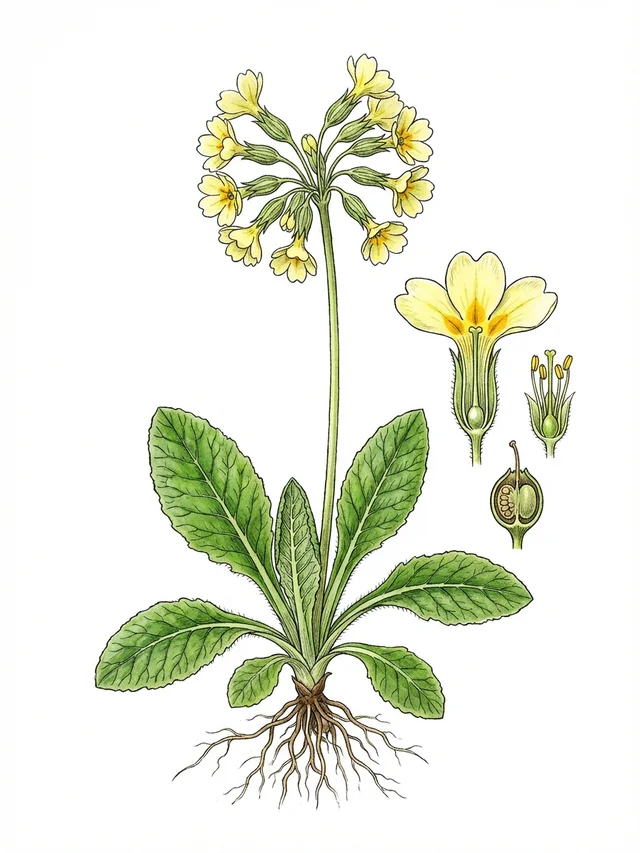
 Image to followAI-generated illustration
Sagittaria latifolia
Sagittaria latifolia
FamilyGenus: Pfeilkrautnative in Germany
🌿
5
Species
interact
🔗
6
Interactions
documented
About this species
Sagittaria latifolia is an introduced, established herbaceous perennial in Great Britain. It favours damp to wet, nutrient‑rich conditions in semi‑shade, producing broad leaves and reaching about 1.5 metres in height. The plant flowers from August to September.
Ecological network
Click to highlight connections · Click again to open the species page
Loading network...
PollinationFlower visit
Ecological significance
Sagittaria latifolia is a neophyte that has become established in Great Britain. Its ecological impact has not been assessed and no specific evidence of adverse effects is available.
Annual cycle
The plant grows actively through spring and summer, producing foliage and reaching full stature. Flowering occurs in August and September, after which the above‑ground parts die back in autumn, with the plant overwintering below the water or soil surface before resuming growth the following spring.
Safety note
No safety information is recorded for this species.
Standort & Merkmale
Light
Halbschatten
Moisture
Feucht
Soil
Starkzehrer (Nährstoffreicher/Fetter Boden)
Flowering period
Aug – Sep
Soil reaction
Basisch / Kalkhold
Bioregion
Continental
Growth form
Krautige Pflanze
Woodiness
Nicht verholzt
Leaf type
Breitblättrig
Plant height
1.49 m
Morphological traits: TRY ID3 (CC BY 3.0) & TRY ID81 (CC BY)
Pflege & Anbau
Grow in a position that mimics its natural wetland habitat: a semi‑shaded spot with permanently moist to wet, nutrient‑rich, calcareous soil. Pond margins, water garden edges or boggy areas are suitable. A heavy feeder, it benefits from fertile ground; avoid sites where the soil dries out for long periods. Although cultivated as an ornamental, care should be taken to prevent unwanted spread into natural water bodies, as the plant is known to have established wild populations in Britain.
Scientific profile
This aquatic, non‑woody perennial belongs to the water‑plantain family (Alismataceae). It develops broad, rather large leaves and can attain a height of roughly 1.5 metres. Its ecological preferences are for calcareous, highly fertile, consistently moist to wet soils in semi‑shaded situations, under moderately warm temperatures. The flowers appear between August and September, and the species forms arbuscular mycorrhizal associations. Morphological measurements record a leaf area of about 13 cm² and a diaspore mass of approximately 6.75 mg.
Pollinators & visitors
1 Arten interagieren mit dieser Pflanze
Apis mellifera
Other flower visitors
4 other species visit the flowers
Sources & data origin
•Interaktionsdaten via GloBI (CC-BY 4.0)
•FloraWeb / BfN
•EIVE 1.0 — Dengler et al. (2023), DOI: 10.3897/VCS.98324 (CC BY 4.0)
•GBIF Backbone Taxonomy — GBIF Secretariat (2024), DOI: 10.15468/39omei (CC BY 4.0)
•TRY Categorical Traits (ID3) — Kattge et al. (2012), DOI: 10.17871/TRY.3 (CC BY 3.0)
•TRY Global Spectrum (ID81) — Díaz et al. (2016/2021), DOI: 10.17871/TRY.81 (CC BY)
•Checklist Alien Plants Belgium — Verloove F (2023), Botanic Garden Meise (CC BY 4.0)
•Govaerts R et al. (2025) — World Checklist of Vascular Plants (WCVP) v14. Royal Botanic Gardens, Kew. DOI: 10.34885/xs7h-ze42 (CC BY 4.0)
All data is licensed under CC BY 4.0, CC0, or compatible terms. Attribution according to license conditions. Full source overview →