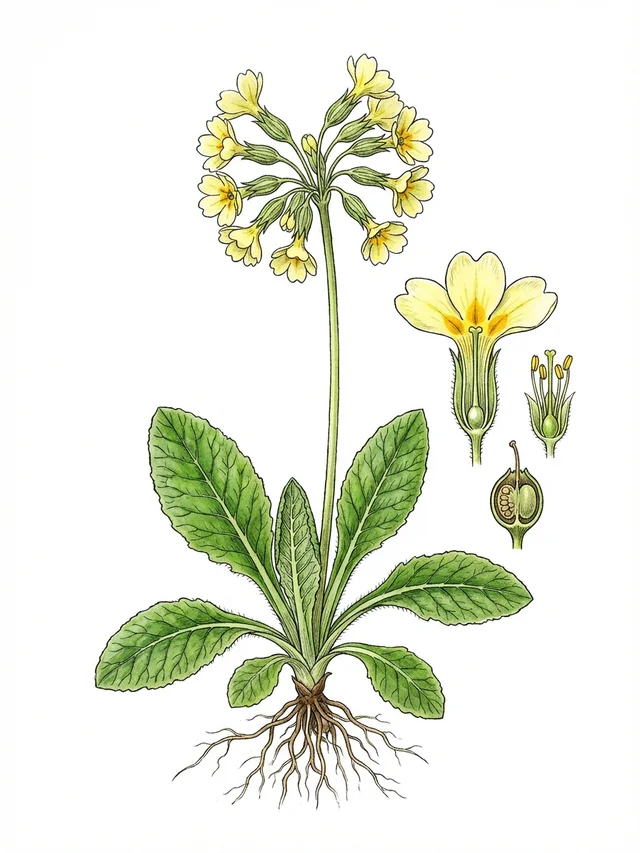
 Image to followAI-generated illustration
Salix cinerea
Salix cinerea
FamilyGenus: Salixnative in Germany
🌿
43
Species
interact
🔗
59
Interactions
documented
🐛
27
Host relationships
Species
About this species
Salix cinerea is a native deciduous shrub reaching about 3.5 m in height. It grows in sunny, moist locations on moderately fertile soil and produces catkins in spring. This broad-leaved willow contributes to wildlife habitat and is not threatened.
Ecological network
Click to highlight connections · Click again to open the species page
Loading network...
PollinationLarval host
Ecological significance
As a native shrub, Salix cinerea offers cover and forage for wildlife and contributes to local biodiversity.
Annual cycle
Flowering occurs from March to May, when catkins open before the leaves fully emerge. The broad leaves expand soon after and remain green through the summer, turning colour in autumn before falling. Bare branches persist throughout winter until new growth begins the following spring.
Standort & Merkmale
Light
Sonne
Moisture
Feucht
Soil
Mittelzehrer (Normaler Boden)
Flowering period
Mär – Mai
Soil reaction
Mäßig sauer bis neutral
Bioregion
Continental
Growth form
Strauch
Woodiness
Verholzt
Leaf type
Breitblättrig
Leaf phenology
Laubabwerfend
Plant height
3.456 m
Morphological traits: TRY ID3 (CC BY 3.0) & TRY ID81 (CC BY)
Pflege & Anbau
•
Light: Full sun
•
Moisture: Moist soil
•
Soil: Moderately fertile, neutral to slightly acid
Scientific profile
Salix cinerea is a woody, deciduous shrub with broad leaves, typically growing around 3.5 m tall. It is native in Great Britain and favours damp, sunny habitats. The root system forms ectomycorrhizal associations. Full sun is required, and the shrub thrives in moist conditions with a neutral to slightly acid soil reaction and mesotrophic nutrient levels. It tolerates moderately warm temperatures. The leaves have an average area of approximately 850 mm², and the minute, wind-borne seeds each weigh about 0.07 mg. Catkins appear from March to May before the foliage fully expands. The leaves are shed in autumn, leaving bare branches through winter. The species is not currently regarded as threatened under the German red list (status *).
Pollinators & visitors
16 Arten interagieren mit dieser Pflanze
Bombus pascuorumBombus lucorumBombus hypnorumBombus terrestrisBombus lapidariusBombus pratorumEarophila badiataOrthosia gothicaLithophane ornitopusAgriopis marginariaSelenia dentariaConistra ligulaAndrena flavipesVespa crabroOrthosia cerasiApis mellifera
Host relationships
27 species use this plant as a host
Apatura irisCelastrina argiolusLaothoe populiHydriomena ruberataEulithis populataDysstroma truncataEupithecia tenuiataMacaria notataCabera exanthemataClostera anachoretaLeucoma salicisPapestra birenXestia castaneaIpimorpha retusaNotodonta dromedariusEarias cloranaArctia cajaBrachylomia viminalisDicallomera fascelinaAcronicta leporinaArctia villicaFurcula furculaEupithecia virgaureataAcronicta tridensCyclophora pendulariaEriogaster lanestrisSpilosoma lutea
Sources & data origin
•Cook et al. (2025) UK Butterfly & Moth Traits (DOI: 10.5285/dbc7cc17-cbbd-49dd-bab4-8e8855768d66)
•pollinator_interactions
•FloraWeb / BfN
•EIVE 1.0 — Dengler et al. (2023), DOI: 10.3897/VCS.98324 (CC BY 4.0)
•GBIF Backbone Taxonomy — GBIF Secretariat (2024), DOI: 10.15468/39omei (CC BY 4.0)
•TRY Categorical Traits (ID3) — Kattge et al. (2012), DOI: 10.17871/TRY.3 (CC BY 3.0)
•TRY Global Spectrum (ID81) — Díaz et al. (2016/2021), DOI: 10.17871/TRY.81 (CC BY)
•Govaerts R et al. (2025) — World Checklist of Vascular Plants (WCVP) v14. Royal Botanic Gardens, Kew. DOI: 10.34885/xs7h-ze42 (CC BY 4.0)
All data is licensed under CC BY 4.0, CC0, or compatible terms. Attribution according to license conditions. Full source overview →