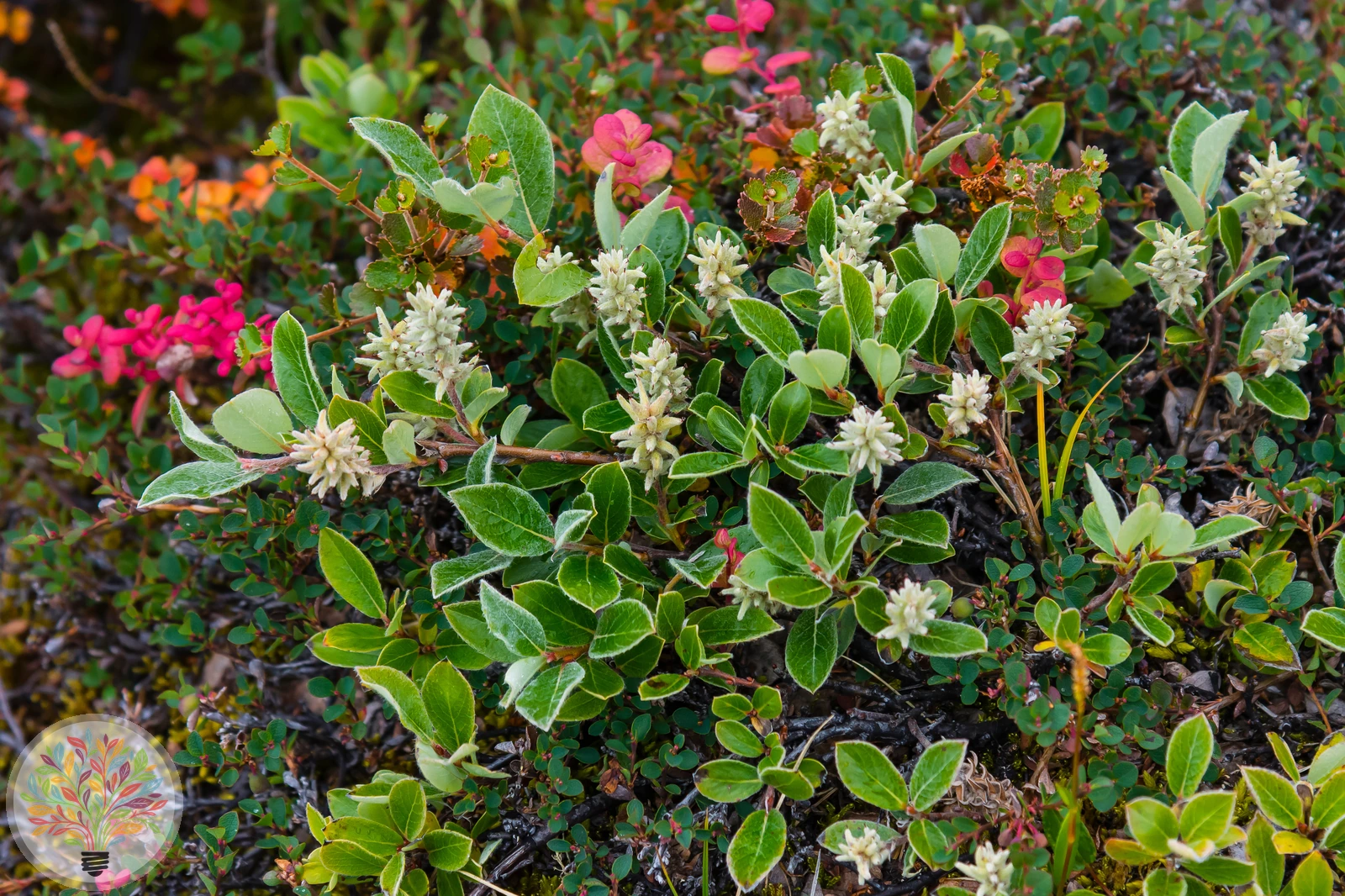
Salix herbacea
Salix herbacea
FamilyGenus: Salixnative in Germany
🌿
5
Species
interact
🔗
5
Interactions
documented
🐛
2
Host relationships
Species
About this species
Salix herbacea is a tiny deciduous shrub native to Great Britain, typically reaching only 3–4 cm in height. It flowers in summer and is found in cold, acidic, nutrient-poor situations.
Ecological network
Click to highlight connections · Click again to open the species page
Loading network...
PollinationLarval hostFlower visit
Ecological significance
Salix herbacea is a native component of Great Britain's montane flora and plays a role in its natural communities.
Annual cycle
Flowering occurs from June to August. The plant is deciduous, shedding its leaves in the autumn.
Safety note
No specific safety information is available for this species.
Standort & Merkmale
Light
Sonne
Moisture
Frisch (Mäßig feucht)
Soil
Schwachzehrer (Magerer Boden)
Flowering period
Jun – Aug
Soil reaction
Sauer (Säurezeiger)
Bioregion
Continental
Nectar value
1
Pollen value
1
Growth form
Strauch
Woodiness
Verholzt
Leaf type
Breitblättrig
Leaf phenology
Laubabwerfend
Plant height
0.036 m
Morphological traits: TRY ID3 (CC BY 3.0) & TRY ID81 (CC BY)
Pflege & Anbau
This dwarf willow thrives in full sun with consistently fresh to moist, nutrient-poor, acidic soils. It forms ectomycorrhizal associations.
Scientific profile
Salix herbacea is a deciduous, woody shrub of minute stature, generally achieving heights of about 4 cm. Its broad leaves have an average area of around 103 mm². The species flowers from June to August. It is a plant of full sun, favouring fresh to moist, strongly acidic, nutrient-poor substrates. It forms ectomycorrhizal associations. Indicator values place it in cold, alpine or northern climates (temperature value 2) with low levels of disturbance. The foliage is deciduous, and the seeds are very light, with an average diaspore mass of approximately 0.17 mg.
Pollinators & visitors
2 Arten interagieren mit dieser Pflanze
Colias palaenoBombus lapidarius
Host relationships
2 species use this plant as a host
Zygaena exulansBoloria titania
Sources & data origin
•Interaktionsdaten via GloBI (CC-BY 4.0)
•pollinator_interactions
•FloraWeb / BfN
•EIVE 1.0 — Dengler et al. (2023), DOI: 10.3897/VCS.98324 (CC BY 4.0)
•EuPPollNet — Kuppler et al. (2025), DOI: 10.1111/geb.70000 (CC BY 4.0)
•Database of Pollinator Interactions (DoPI) — Pocock et al. (2022), DOI: 10.1002/ecy.3801 (CC BY)
•GBIF Backbone Taxonomy — GBIF Secretariat (2024), DOI: 10.15468/39omei (CC BY 4.0)
•TRY Categorical Traits (ID3) — Kattge et al. (2012), DOI: 10.17871/TRY.3 (CC BY 3.0)
•TRY Global Spectrum (ID81) — Díaz et al. (2016/2021), DOI: 10.17871/TRY.81 (CC BY)
•Govaerts R et al. (2025) — World Checklist of Vascular Plants (WCVP) v14. Royal Botanic Gardens, Kew. DOI: 10.34885/xs7h-ze42 (CC BY 4.0)
•Foto: © © Inger Hogstrom / DanitaDelimont.com / Adobe Stock / AdobeStock_416160281
All data is licensed under CC BY 4.0, CC0, or compatible terms. Attribution according to license conditions. Full source overview →