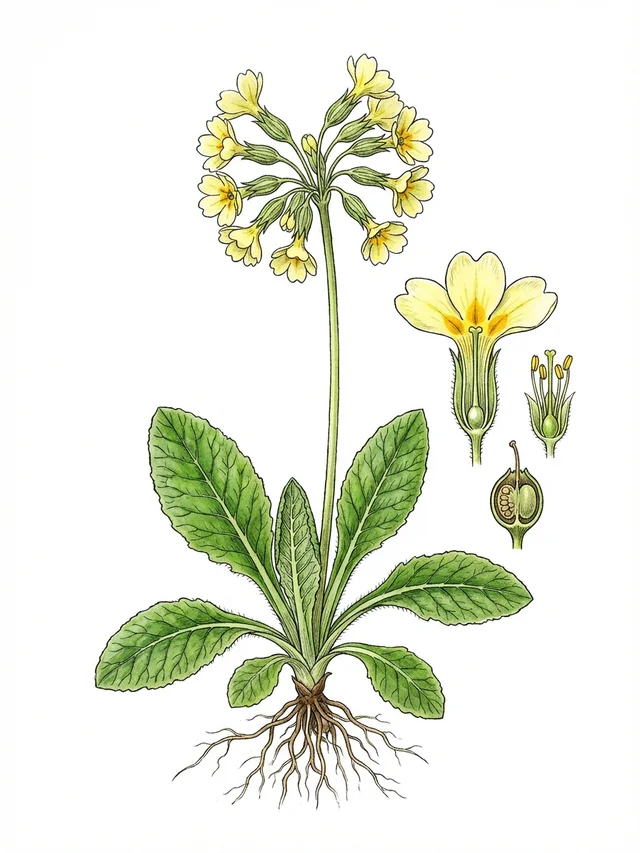
 Image to followAI-generated illustration
Sanicula europaea
Sanicula europaea
FamilyGenus: Saniculanative in Germany
🌿
9
Species
interact
🔗
14
Interactions
documented
About this species
Sanicula europaea is a native herbaceous plant of shaded, base-rich woodlands, producing small umbels of flowers from May to September.
Ecological network
Click to highlight connections · Click again to open the species page
Loading network...
PollinationFlower visit
Ecological significance
As a native herbaceous component of ancient woodland ground flora, Sanicula europaea contributes to the structural diversity of base-rich, shady habitats and is indicative of stable, low-disturbance environments.
Annual cycle
Sanicula europaea is a herbaceous species; its flowering period extends from May to September, with vegetative growth active during the warmer half of the year.
Standort & Merkmale
Light
Schatten
Moisture
Frisch (Mäßig feucht)
Soil
Mittelzehrer (Normaler Boden)
Flowering period
Mai – Sep
Soil reaction
Basisch / Kalkhold
Bioregion
Continental
Growth form
Krautige Pflanze
Woodiness
Nicht verholzt
Leaf type
Breitblättrig
Plant height
0.298 m
Morphological traits: TRY ID3 (CC BY 3.0) & TRY ID81 (CC BY)
Pflege & Anbau
This wild species naturally occurs in shaded, damp, alkaline woodlands. If introduced to a garden, it would require a sheltered shade position, persistently moist but well-drained soil rich in humus, with a preference for lime-rich substrates. It needs little disturbance and minimal additional nutrients.
Scientific profile
Sanicula europaea is a shade-tolerant, native herbaceous plant of the Apiaceae family, reaching approximately 30 cm in height. It bears broad, terrestrial leaves and small umbels of flowers. The species is characteristic of moist, calcareous soils in undisturbed woodland and hedgerow habitats. In Great Britain it is a native component of ancient woodlands, preferring consistently fresh, alkaline conditions and low levels of disturbance.
Pollinators & visitors
4 Arten interagieren mit dieser Pflanze
Other flower visitors
5 other species visit the flowers
Sources & data origin
•Interaktionsdaten via GloBI (CC-BY 4.0)
•pollinator_interactions
•FloraWeb / BfN
•EIVE 1.0 — Dengler et al. (2023), DOI: 10.3897/VCS.98324 (CC BY 4.0)
•GBIF Backbone Taxonomy — GBIF Secretariat (2024), DOI: 10.15468/39omei (CC BY 4.0)
•TRY Categorical Traits (ID3) — Kattge et al. (2012), DOI: 10.17871/TRY.3 (CC BY 3.0)
•TRY Global Spectrum (ID81) — Díaz et al. (2016/2021), DOI: 10.17871/TRY.81 (CC BY)
•Govaerts R et al. (2025) — World Checklist of Vascular Plants (WCVP) v14. Royal Botanic Gardens, Kew. DOI: 10.34885/xs7h-ze42 (CC BY 4.0)
All data is licensed under CC BY 4.0, CC0, or compatible terms. Attribution according to license conditions. Full source overview →