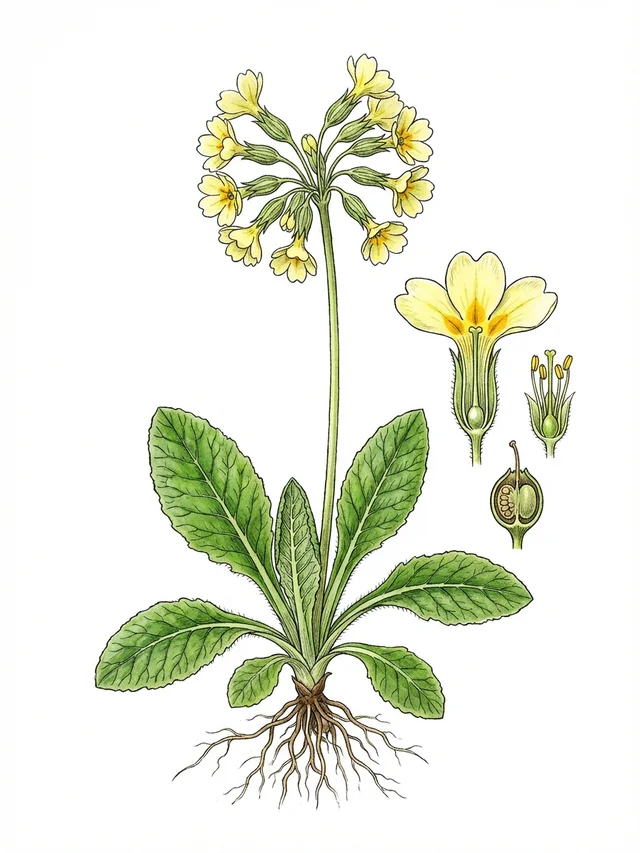
 Image to followAI-generated illustration
Scorzonera hispanica
Scorzonera hispanica
FamilyGenus: Schwarzwurzelnnative in Germany
🌿
8
Species
interact
🔗
9
Interactions
documented
About this species
Scorzonera hispanica is an introduced herbaceous plant that has become established in Great Britain. It bears yellow flower heads from June to August and can grow to nearly one metre in height.
Ecological network
Click to highlight connections · Click again to open the species page
Loading network...
PollinationFlower visit
Ecological significance
No specific ecological impacts are documented for this introduced species in Great Britain.
Annual cycle
Flowering takes place in summer, from June to August. Other aspects of the yearly cycle are not recorded.
Safety note
No safety information is available from the provided evidence.
Standort & Merkmale
Light
—
Moisture
—
Soil
—
Flowering period
Jun – Aug
Bioregion
Continental
Growth form
Krautige Pflanze
Woodiness
Nicht verholzt
Leaf type
Breitblättrig
Plant height
0.897 m
Morphological traits: TRY ID3 (CC BY 3.0) & TRY ID81 (CC BY)
Scientific profile
Scorzonera hispanica is an introduced and established member of the daisy family (Asteraceae). This non-woody, broad-leaved herbaceous plant reaches heights of about 0.9 metres, with individual leaf areas averaging around 2,700 mm². Flowering occurs from June through August, when it produces its typical yellow composite flower heads. The seeds (diaspores) have a mean mass of 9.6 mg. The root system forms arbuscular mycorrhizal associations.
Pollinators & visitors
7 Arten interagieren mit dieser Pflanze
Andrena bicolorBombus terrestrisVanessa virginiensisEuphydryas desfontainiiMelitaea aetherieMelitaea phoebeMelitaea varia
Sources & data origin
•Interaktionsdaten via GloBI (CC-BY 4.0)
•Middleton-Welling_2020
•FloraWeb / BfN
•GBIF Backbone Taxonomy — GBIF Secretariat (2024), DOI: 10.15468/39omei (CC BY 4.0)
•TRY Categorical Traits (ID3) — Kattge et al. (2012), DOI: 10.17871/TRY.3 (CC BY 3.0)
•TRY Global Spectrum (ID81) — Díaz et al. (2016/2021), DOI: 10.17871/TRY.81 (CC BY)
•Checklist Alien Plants Belgium — Verloove F (2023), Botanic Garden Meise (CC BY 4.0)
•Govaerts R et al. (2025) — World Checklist of Vascular Plants (WCVP) v14. Royal Botanic Gardens, Kew. DOI: 10.34885/xs7h-ze42 (CC BY 4.0)
All data is licensed under CC BY 4.0, CC0, or compatible terms. Attribution according to license conditions. Full source overview →