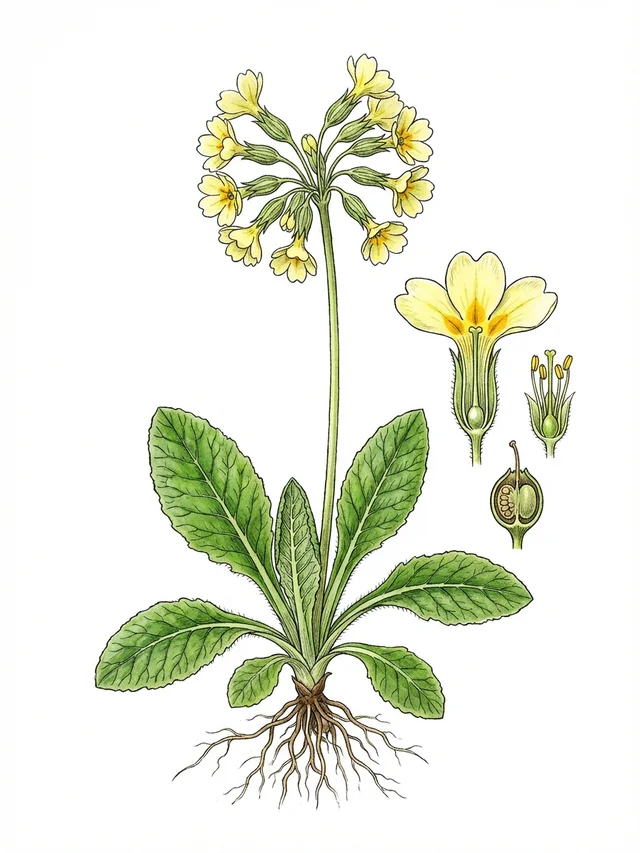
 Image to followAI-generated illustration
Scrophularia auriculata
Scrophularia auriculata
FamilyGenus: Braunwurzennative in Germany
🌿
20
Species
interact
🔗
40
Interactions
documented
🐛
2
Host relationships
Species
About this species
Scrophularia auriculata is a native herbaceous perennial that grows in damp, nutrient-rich habitats across Great Britain. Its broad leaves and early-summer flowers are characteristic of sunny, moist sites with calcareous soils. The plant forms part of the natural flora of streamsides, ditches and wet meadows.
Ecological network
Click to highlight connections · Click again to open the species page
Loading network...
PollinationLarval hostFlower visit
Ecological significance
As a native species of damp, base-rich habitats, Scrophularia auriculata contributes to the structure of streamside and meadow plant communities. It is not invasive and poses no known ecological threats. Its broad leaves add structural diversity, and its flowers appear in early summer.
Annual cycle
Herbaceous perennial. New growth appears in spring, followed by flowering from May to June. Seed is set in summer, after which aerial parts senesce and the plant overwinters as underground organs, re-emerging the following spring.
Safety note
No toxic or irritant properties are recorded for this species. As with all plants, handle with routine care and wash hands after contact.
Standort & Merkmale
Light
Sonne
Moisture
Feucht
Soil
Starkzehrer (Nährstoffreicher/Fetter Boden)
Flowering period
Mai – Jun
Soil reaction
Mäßig sauer bis neutral
Bioregion
Continental
Growth form
Krautige Pflanze
Woodiness
Nicht verholzt
Leaf type
Breitblättrig
Plant height
0.623 m
Morphological traits: TRY ID3 (CC BY 3.0) & TRY ID81 (CC BY)
Pflege & Anbau
Plant in full sun in moisture-retentive, fertile soil. Scrophularia auriculata is a heavy feeder and thrives in nutrient-rich ground that remains damp. It benefits from the presence of arbuscular mycorrhizal fungi in the soil. No routine pruning is needed, but cutting back after flowering can tidy the plant.
Scientific profile
Scrophularia auriculata is a perennial herb in the figwort family (Scrophulariaceae), native in Great Britain. It typically reaches a height of around 62 cm and bears broad leaves with a large average leaf area of 15,400 mm². The flowers open from May to June. Ellenberg-type indicator values place the species in full sun (light 8) on moist to wet, base-rich soils (moisture 8, reaction 7) of moderate nutrient status (nutrients 6). It is not salt tolerant and shows low disturbance preference (severity 0.51). The plant is a terrestrial, non-woody herb that forms arbuscular mycorrhizal associations. Diaspores are very small, with an average mass of 0.095 mg. In Great Britain, it is classified as unthreatened (*) and has a native wild status.
Pollinators & visitors
17 Arten interagieren mit dieser Pflanze
Andrena flavipesBombus sylvestrisBombus pratorumBombus hypnorumBombus pascuorumBombus muscorumLasioglossum morioDolichovespula sylvestrisTenthredo scrophulariaeEuphydryas auriniaEuphydryas idunaMelitaea triviaMelitaea didymaMelitaea celadussaMelitaea aureliaLasioglossum sexnotatumBombus terrestris
Host relationships
2 species use this plant as a host
Xestia sexstrigataHepialus humuli
Sources & data origin
•Interaktionsdaten via GloBI (CC-BY 4.0)
•Cook et al. (2025) UK Butterfly & Moth Traits (DOI: 10.5285/dbc7cc17-cbbd-49dd-bab4-8e8855768d66)
•Middleton-Welling_2020
•pollinator_interactions
•FloraWeb / BfN
•EIVE 1.0 — Dengler et al. (2023), DOI: 10.3897/VCS.98324 (CC BY 4.0)
•GBIF Backbone Taxonomy — GBIF Secretariat (2024), DOI: 10.15468/39omei (CC BY 4.0)
•TRY Categorical Traits (ID3) — Kattge et al. (2012), DOI: 10.17871/TRY.3 (CC BY 3.0)
•TRY Global Spectrum (ID81) — Díaz et al. (2016/2021), DOI: 10.17871/TRY.81 (CC BY)
•Govaerts R et al. (2025) — World Checklist of Vascular Plants (WCVP) v14. Royal Botanic Gardens, Kew. DOI: 10.34885/xs7h-ze42 (CC BY 4.0)
All data is licensed under CC BY 4.0, CC0, or compatible terms. Attribution according to license conditions. Full source overview →