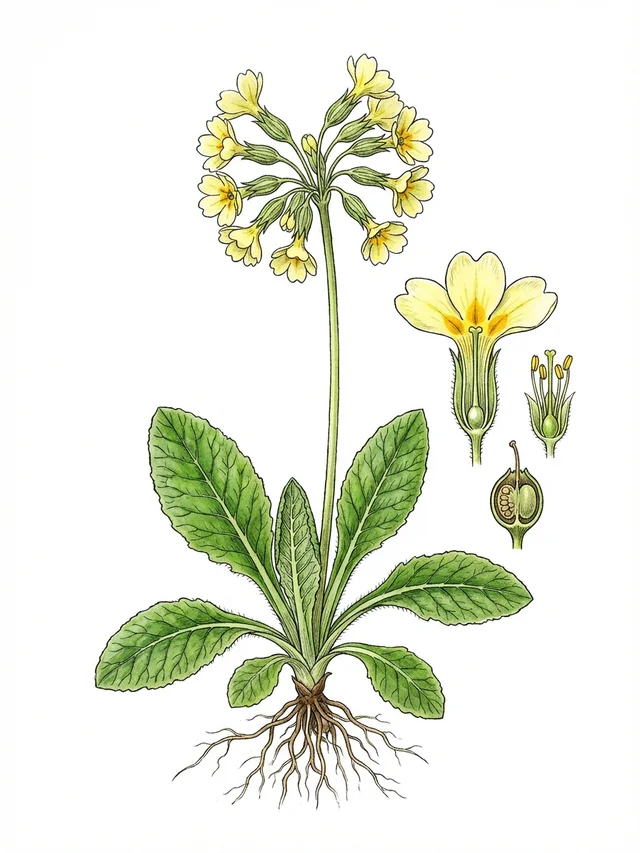
 Image to followAI-generated illustration
Sesleria caerulea
Sesleria caerulea
FamilyGenus: Blaugräsernative in Germany
🌿
41
Species
interact
🔗
47
Interactions
documented
🐛
3
Host relationships
Species
About this species
A low-growing perennial grass native to Great Britain, with broad leaves and flowering from March to September.
Ecological network
Click to highlight connections · Click again to open the species page
Loading network...
PollinationLarval host
Ecological significance
Forms arbuscular mycorrhizal (AM) associations, aiding nutrient uptake in nutrient-poor soils. It is a component of native calcareous grassland communities.
Annual cycle
Flowering takes place from March to September. New growth appears in early spring, reaching approximately 22 cm in height during the season.
Safety note
No specific hazards are recorded for this species.
Standort & Merkmale
Light
Sonne
Moisture
Frisch (Mäßig feucht)
Soil
—
Flowering period
Mär – Sep
Bioregion
Continental
Growth form
Gras
Woodiness
Nicht verholzt
Leaf type
Breitblättrig
Plant height
0.223 m
Morphological traits: TRY ID3 (CC BY 3.0) & TRY ID81 (CC BY)
Pflege & Anbau
Plant in full sun on moderately moist, well-drained, calcareous soil of low fertility. Avoid rich soils and excessive watering. Trim back dead leaves in early spring to encourage fresh growth. Suitable for rock gardens, scree beds and dry meadow plantings on alkaline substrates.
Scientific profile
Sesleria caerulea is a perennial grass native to Great Britain, of the family Poaceae. It forms dense tussocks of broad, linear leaves and reaches a height of approximately 22 cm. The flowering period extends from March to September. It typically grows in full sun on fresh, moderately moist soils that are calcareous or basic and low in nutrients. The species is adapted to cold, alpine or northern climates and tolerates low levels of disturbance. It forms arbuscular mycorrhizal (AM) associations.
Pollinators & visitors
38 Arten interagieren mit dieser Pflanze
Heteropterus morpheusCarterocephalus silvicolaCarterocephalus palaemonPelopidas thraxBorbo borbonicaGegenes nostrodamusOchlodes sylvanusHesperia commaThymelicus hyraxThymelicus sylvestrisThymelicus lineolaCoenonympha phryneCoenonympha oedippusCoenonympha dorusCoenonympha pamphilusCoenonympha amaryllisCoenonympha glycerionCoenonympha corinnaCoenonympha leanderCoenonympha heroCoenonympha arcaniaKirinia roxelanaKirinia climeneLopinga achinePararge xiphioidesPararge aegeriaLasiommata maeraLasiommata deidamiaLasiommata paramegaeraMelanargia russiaeMelanargia larissaMelanargia lachesisMelanargia galatheaMelanargia inesMelanargia pherusaMelanargia occitanicaHipparchia fatuaHipparchia statilinus
Host relationships
3 species use this plant as a host
Sources & data origin
•Cook et al. (2025) UK Butterfly & Moth Traits (DOI: 10.5285/dbc7cc17-cbbd-49dd-bab4-8e8855768d66)
•Middleton-Welling_2020
•FloraWeb / BfN
•EIVE 1.0 — Dengler et al. (2023), DOI: 10.3897/VCS.98324 (CC BY 4.0)
•GBIF Backbone Taxonomy — GBIF Secretariat (2024), DOI: 10.15468/39omei (CC BY 4.0)
•TRY Categorical Traits (ID3) — Kattge et al. (2012), DOI: 10.17871/TRY.3 (CC BY 3.0)
•TRY Global Spectrum (ID81) — Díaz et al. (2016/2021), DOI: 10.17871/TRY.81 (CC BY)
•Govaerts R et al. (2025) — World Checklist of Vascular Plants (WCVP) v14. Royal Botanic Gardens, Kew. DOI: 10.34885/xs7h-ze42 (CC BY 4.0)
All data is licensed under CC BY 4.0, CC0, or compatible terms. Attribution according to license conditions. Full source overview →