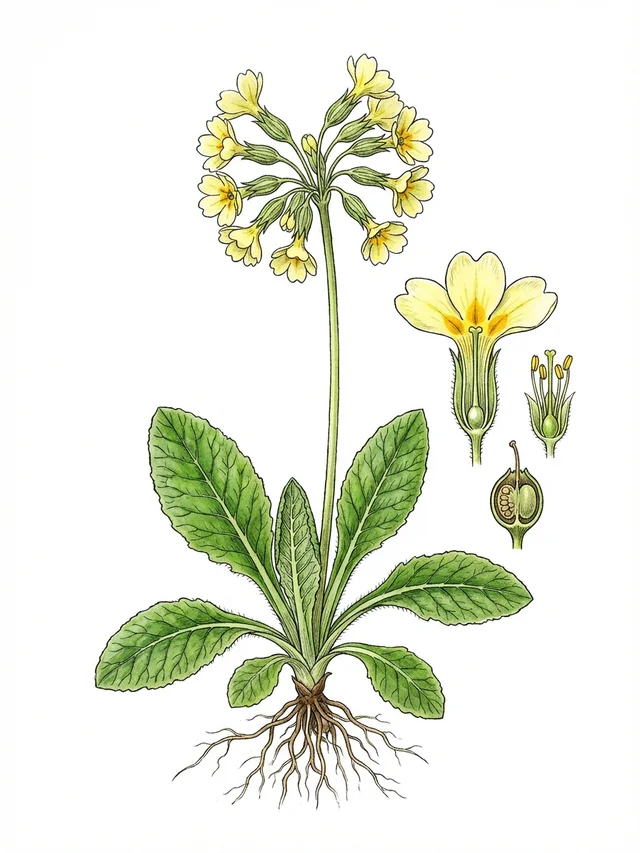
 Image to followAI-generated illustration
Stellaria media
Stellaria media subsp. media
FamilyGenus: Stellarianative in Germany
🌿
46
Species
interact
🔗
50
Interactions
documented
🐛
5
Host relationships
Species
About this species
Stellaria media is a native, low-growing annual herb that reaches about 15 cm and bears small white flowers all year. It thrives in sunny, moderately warm spots on fertile, moisture-retentive soil and is a familiar sight in gardens and cultivated ground across Great Britain.
Ecological network
Click to highlight connections · Click again to open the species page
Loading network...
PollinationLarval hostFlower visit
Ecological significance
As a native species of open, fertile habitats, it contributes to early successional ground cover and forms part of the natural weed flora. No specific documented interactions with fauna are available from the source data.
Annual cycle
Flowering occurs in all months, with no defined dormant period. As an annual, it completes its life cycle within one growing season.
Safety note
No toxicity or handling risks are recorded in the evidence.
Standort & Merkmale
Light
Sonne
Moisture
Frisch (Mäßig feucht)
Soil
Starkzehrer (Nährstoffreicher/Fetter Boden)
Flowering period
Jan – Dez
Soil reaction
Basisch / Kalkhold
Bioregion
Continental
Growth form
Krautige Pflanze
Woodiness
Nicht verholzt
Leaf type
Breitblättrig
Plant height
0.152 m
Morphological traits: TRY ID3 (CC BY 3.0) & TRY ID81 (CC BY)
Pflege & Anbau
•
Site: Full sun to light shade.
•
Soil: Fertile, moisture-retentive and well-drained, neutral to alkaline.
•
Watering: Keep the soil evenly moist; avoid drought.
•
Maintenance: An annual that self-sows freely; no pruning needed.
Scientific profile
Stellaria media is a non-woody, broad-leaved annual in the pink family (Caryophyllaceae). Typically 15 cm tall, it has leaves with an average area of about 260 mm². The tiny, star-like white flowers appear in any month, so the plant can be found in bloom during every season. Its diaspores are very light, averaging 0.37 mg, which aids dispersal. Ecologically, it grows best in full sun (light value 7) with moderately warm temperatures (value 6) and requires fresh to moderately moist, nutrient-rich soil. It shows a preference for calcareous or basic conditions (pH reaction value 7). Native to Great Britain and widely distributed across Europe, Northern Europe, Asia-Temperate and Northern America, it is a common component of disturbed and fertile habitats. Under the German Red List scheme it is rated as '*', meaning it is not considered threatened.
Pollinators & visitors
28 Arten interagieren mit dieser Pflanze
Pieris rapaeSphecodes geoffrellusSphecodes monilicornisLeptidea sinapisNomada lathburianaCoenonympha pamphilusNomada goodenianaAndrena praecoxAndrena labiataBombus pratorumBombus lapidariusAndrena flavipesErynnis tagesNomada fucataBombus pascuorumAndrena bicolorPolyommatus icarusSphecodes puncticepsBombus terrestrisBombus humilisLasioglossum laevigatumHalictus confususCelastrina argiolusApis melliferaAndrena fulvaPolistes dominulaLasiommata megeraMotacilla alba
Host relationships
5 species use this plant as a host
Other flower visitors
13 other species visit the flowers
Brassicogethes aeneusCarduelis carduelisEmberiza citrinellaPasser domesticusColumba palumbusMyodes glareolusFringilla coelebsChloris chlorisAnthus rubescensHaemorhous mexicanusLinaria cannabinaHarpalus rufipesHarpalus affinis
Sources & data origin
•Interaktionsdaten via GloBI (CC-BY 4.0)
•EIVE 1.0 — Dengler et al. (2023), DOI: 10.3897/VCS.98324 (CC BY 4.0)
•GBIF Backbone Taxonomy — GBIF Secretariat (2024), DOI: 10.15468/39omei (CC BY 4.0)
•TRY Categorical Traits (ID3) — Kattge et al. (2012), DOI: 10.17871/TRY.3 (CC BY 3.0)
•TRY Global Spectrum (ID81) — Díaz et al. (2016/2021), DOI: 10.17871/TRY.81 (CC BY)
•Checklist Alien Plants Belgium — Verloove F (2023), Botanic Garden Meise (CC BY 4.0)
•Govaerts R et al. (2025) — World Checklist of Vascular Plants (WCVP) v14. Royal Botanic Gardens, Kew. DOI: 10.34885/xs7h-ze42 (CC BY 4.0)
All data is licensed under CC BY 4.0, CC0, or compatible terms. Attribution according to license conditions. Full source overview →