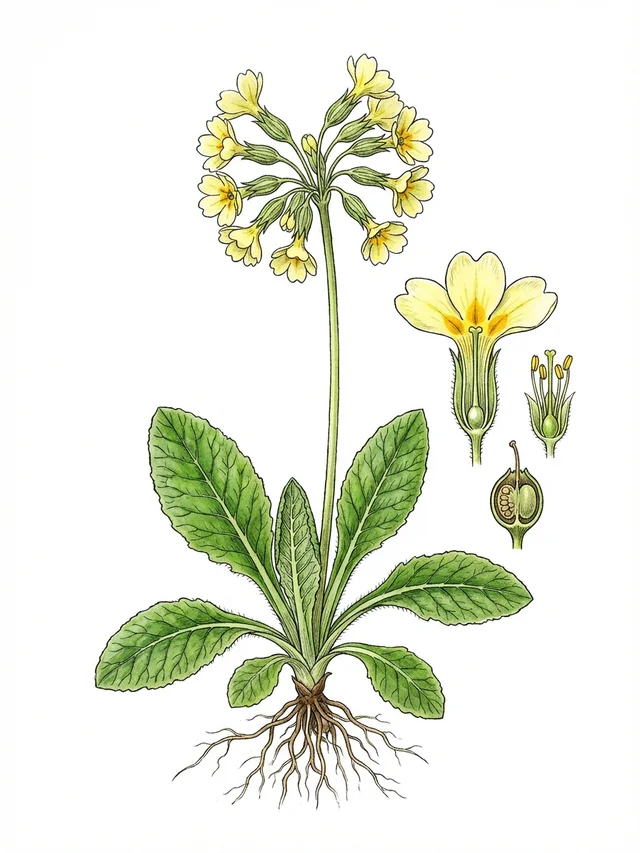
 Image to followAI-generated illustration
tanacetum parthenium
Tanacetum parthenium
FamilyGenus: Tanacetumnative in Germany
🌿
36
Species
interact
🔗
41
Interactions
documented
About this species
Tanacetum parthenium is a herbaceous plant from the daisy family, established in Great Britain as an archaeophyte. It thrives in sunny, moderately moist, nutrient-rich soils and flowers in June and July.
Ecological network
Click to highlight connections · Click again to open the species page
Loading network...
PollinationFlower visit
Ecological significance
No evidence of invasive behaviour is reported; as a long-established archaeophyte it occurs without recorded adverse impact.
Annual cycle
The plant blooms from June to July. Being herbaceous, its aerial parts die back seasonally, though precise life cycle duration is not specified in the data.
Safety note
No safety data are available from the provided evidence.
Standort & Merkmale
Light
Sonne
Moisture
Frisch (Mäßig feucht)
Soil
Starkzehrer (Nährstoffreicher/Fetter Boden)
Flowering period
Jun – Jul
Soil reaction
Mäßig sauer bis neutral
Bioregion
Continental
Growth form
Krautige Pflanze
Woodiness
Nicht verholzt
Leaf type
Breitblättrig
Plant height
0.244 m
Morphological traits: TRY ID3 (CC BY 3.0) & TRY ID81 (CC BY)
Pflege & Anbau
Position in full sun in moderately moist, fertile soil. Flowers appear in June and July. No further cultivation details are recorded in the available evidence.
Scientific profile
Tanacetum parthenium belongs to the Asteraceae family. This non-woody, broad-leaved herbaceous plant typically reaches a height of around 24 centimetres. Its leaf area averages 3,200 square millimetres, and the tiny diaspores weigh approximately 0.13 milligrams. The flowering period extends from June to July. It prefers sunny sites with fresh, nutrient-rich, neutral to slightly acid soils, and it is intolerant of salt. The species frequents habitats with low disturbance severity. In Great Britain it is an established archaeophyte, with a natural range covering Europe and temperate Asia.
Pollinators & visitors
29 Arten interagieren mit dieser Pflanze
Bombus lucorumPyronia tithonusPieris napiGonepteryx rhamniManiola jurtinaAglais urticaeLycaena phlaeasPararge aegeriaAphantopus hyperantusLasiommata megeraColletes similisCelastrina argiolusCoenonympha pamphilusPolygonia c-albumThymelicus sylvestrisPieris rapaePieris brassicaePlebejus argusColletes daviesanusApis melliferaHylaeus nigritusAricia agestisVanessa atalantaPolyommatus icarusPolistes gallicusSyrphus vitripennisHylaeus.nigritusEpisyrphus balteatusSyritta pipiens
Other flower visitors
7 other species visit the flowers
Sources & data origin
•Interaktionsdaten via GloBI (CC-BY 4.0)
•pollinator_interactions
•FloraWeb / BfN
•EIVE 1.0 — Dengler et al. (2023), DOI: 10.3897/VCS.98324 (CC BY 4.0)
•GBIF Backbone Taxonomy — GBIF Secretariat (2024), DOI: 10.15468/39omei (CC BY 4.0)
•TRY Categorical Traits (ID3) — Kattge et al. (2012), DOI: 10.17871/TRY.3 (CC BY 3.0)
•TRY Global Spectrum (ID81) — Díaz et al. (2016/2021), DOI: 10.17871/TRY.81 (CC BY)
•Checklist Alien Plants Belgium — Verloove F (2023), Botanic Garden Meise (CC BY 4.0)
•Govaerts R et al. (2025) — World Checklist of Vascular Plants (WCVP) v14. Royal Botanic Gardens, Kew. DOI: 10.34885/xs7h-ze42 (CC BY 4.0)
All data is licensed under CC BY 4.0, CC0, or compatible terms. Attribution according to license conditions. Full source overview →