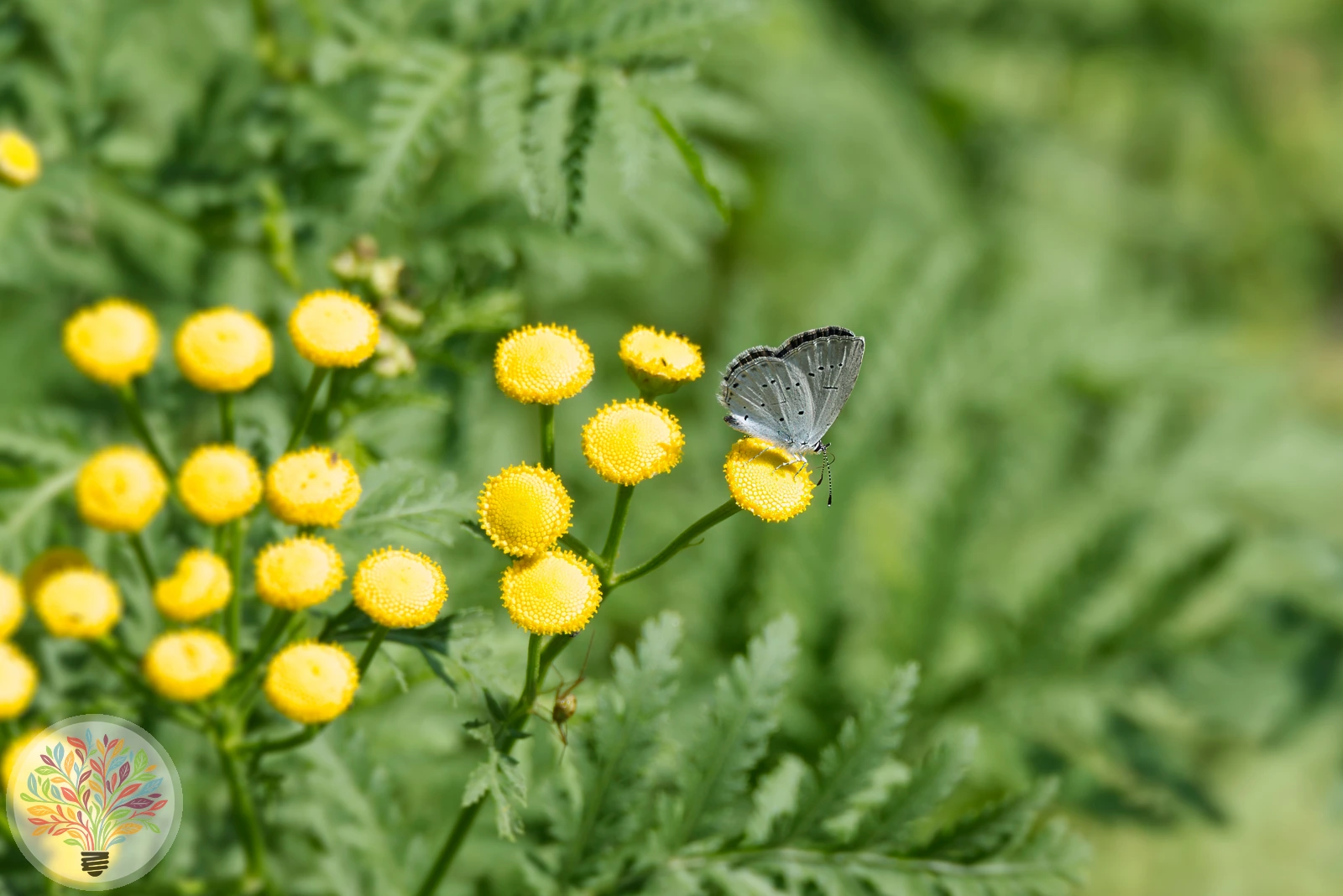
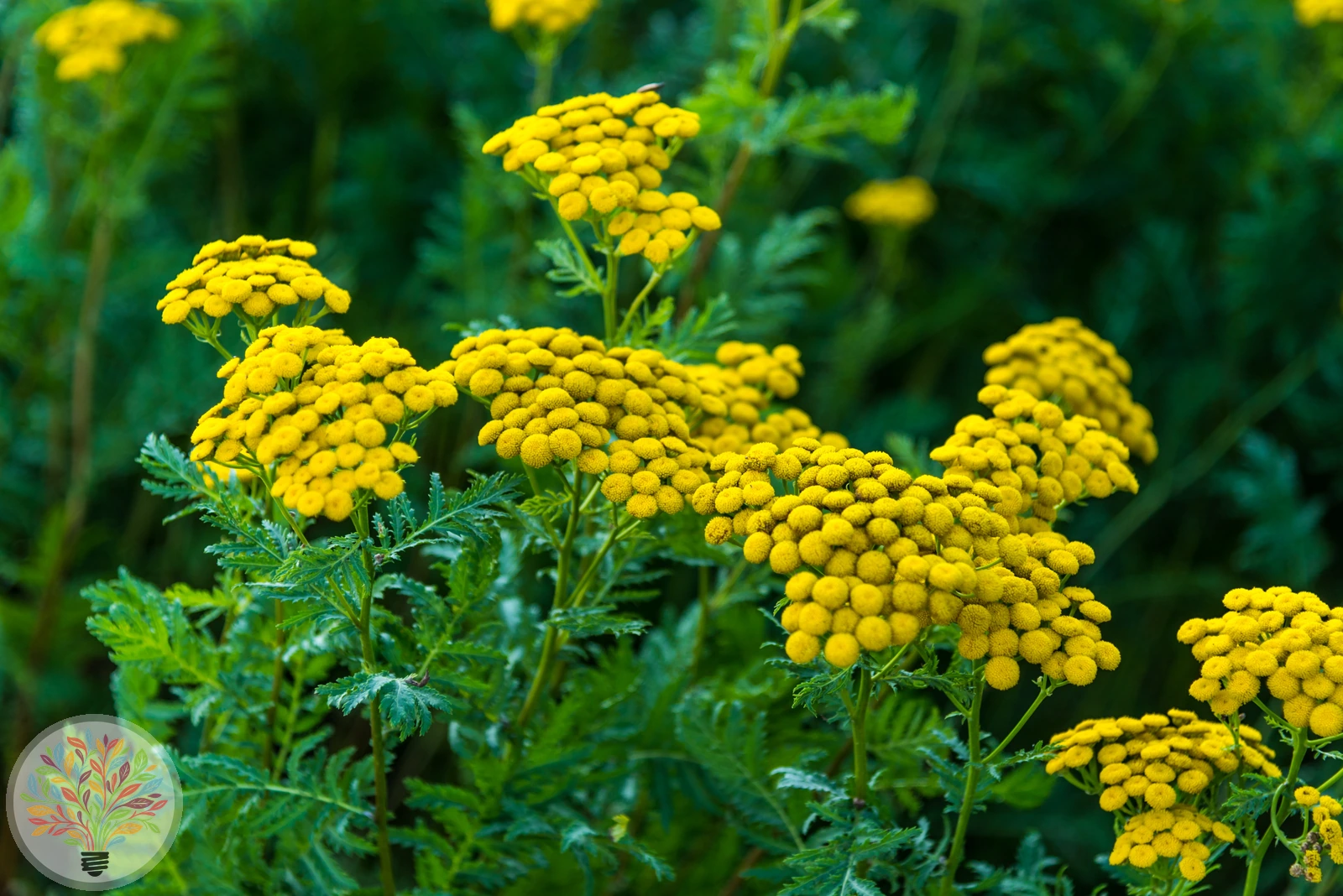
Tanacetum vulgare
Tanacetum vulgare
FamilyGenus: Tanacetumnative in Germany
🌿
143
Species
interact
🔗
508
Interactions
documented
🐛
9
Host relationships
Species
About this species
A native perennial of sunny, moderately moist sites, valued for its bright yellow flower heads and high insect-attracting qualities.
Ecological network
Click to highlight connections · Click again to open the species page
Loading network...
PollinationLarval hostFlower visit
Ecological significance
The flowers offer a rich source of nectar (scale 5) and pollen (scale 5) to insects, including bees and hoverflies. The species forms arbuscular mycorrhizal associations.
Annual cycle
Flowering occurs from June to September. The foliage dies back over winter, with new herbaceous growth re-emerging in spring.
Standort & Merkmale
Light
Sonne
Moisture
Frisch (Mäßig feucht)
Soil
Mittelzehrer (Normaler Boden)
Flowering period
Jun – Sep
Soil reaction
Basisch / Kalkhold
Bioregion
Continental
Nectar value
5
Pollen value
5
Growth form
Krautige Pflanze
Woodiness
Nicht verholzt
Leaf type
Breitblättrig
Plant height
0.704 m
Morphological traits: TRY ID3 (CC BY 3.0) & TRY ID81 (CC BY)
Pflege & Anbau
Grow in full sun in a moist but well-drained soil of moderate fertility. Tolerates calcareous conditions. Little intervention or disturbance is required once established.
Scientific profile
Tanacetum vulgare is a herbaceous perennial with broad leaves and button-like yellow flower heads borne from June through to September. It typically reaches around 0.7 m in height. The plant is native in Great Britain and is commonly found in open, sunny situations on fresh, moderately moist, neutral to calcareous soils of medium fertility. It shows low tolerance of disturbance and salinity. Tanacetum vulgare produces copious pollen and nectar, making it a high-value resource for a variety of flower-visiting insects, and it forms arbuscular mycorrhizal associations.
Pollinators & visitors
103 Arten interagieren mit dieser Pflanze
Colletes similisBombus lapidariusCelastrina argiolusAglais urticaeHalictus tumulorumPararge aegeriaColletes daviesanusApis melliferaBombus lucorumGymnoscelis rufifasciataCerceris rybyensisAcalymma vittatumPasser montanusThymelicus sylvestrisPolyommatus icarusLycaena phlaeasCamptogramma bilineataAmblyteles armatoriusThymelicus lineolaPhilanthus triangulumSphecodes albilabrisVanessa carduiTyria jacobaeaeArctia cajaManiola jurtinaAricia agestis (Denis & Schiffermüller), 1775Hedychrum rutilansAphantopus hyperantusEpirrhoe alternataTrichius fasciatusAcanthis flammeaThecla betulaeLycaena virgaureaeManulea complanaEuplagia quadripunctariaAncistrocerus gazellaVespula germanicaMythimna impuraHeriades truncorumRivula sericealisLindenius albilabrisEnoplognatha ovataPolistes dominulaAnthophila fabricianaChiasmia clathrataHalictus subauratusAcronicta rumicisMinois dryasVespula vulgarisIdaea biselata
Host relationships
9 species use this plant as a host
Xanthorhoe montanata (Denis & Schiffermüller), 1775Eupithecia succenturiataEupithecia absinthiataPolia bombycinaSiona lineataEmaturga atomariaEupithecia icterataAutographa gammaEupithecia subfuscata
Other flower visitors
31 other species visit the flowers
Coccinella septempunctataAnthonomus rubiChrysanthia geniculataHarpalus affinisGaleruca tanacetiRhagonycha fulvaMisumena vatiaCrambus perlellusOxythyrea funestaPyrausta despicataEbrechtella tricuspidataTytthaspis sedecimpunctataYponomeuta padellaStenurella melanuraProsternon tessellatumProtaetia cupreaPyrrhalta viburniOedemera nobilisAraneus diadematusAdalia bipunctataPlutella xylostellaCoccinella magnificaCoccinula quatuordecimpustulataHippodamia variegataHarmonia axyridisOedemera femorataOedemera podagrariaeCeratomegilla undecimnotataLeptinotarsa decemlineataHarpalus rufipesThecophora distincta
Sources & data origin
•Interaktionsdaten via GloBI (CC-BY 4.0)
•Cook et al. (2025) UK Butterfly & Moth Traits (DOI: 10.5285/dbc7cc17-cbbd-49dd-bab4-8e8855768d66)
•pollinator_interactions
•FloraWeb / BfN
•EIVE 1.0 — Dengler et al. (2023), DOI: 10.3897/VCS.98324 (CC BY 4.0)
•EuPPollNet — Kuppler et al. (2025), DOI: 10.1111/geb.70000 (CC BY 4.0)
•Database of Pollinator Interactions (DoPI) — Pocock et al. (2022), DOI: 10.1002/ecy.3801 (CC BY)
•GBIF Backbone Taxonomy — GBIF Secretariat (2024), DOI: 10.15468/39omei (CC BY 4.0)
•TRY Categorical Traits (ID3) — Kattge et al. (2012), DOI: 10.17871/TRY.3 (CC BY 3.0)
•TRY Global Spectrum (ID81) — Díaz et al. (2016/2021), DOI: 10.17871/TRY.81 (CC BY)
•Govaerts R et al. (2025) — World Checklist of Vascular Plants (WCVP) v14. Royal Botanic Gardens, Kew. DOI: 10.34885/xs7h-ze42 (CC BY 4.0)
•Foto: © Adobe Stock / AdobeStock_1793475409
All data is licensed under CC BY 4.0, CC0, or compatible terms. Attribution according to license conditions. Full source overview →