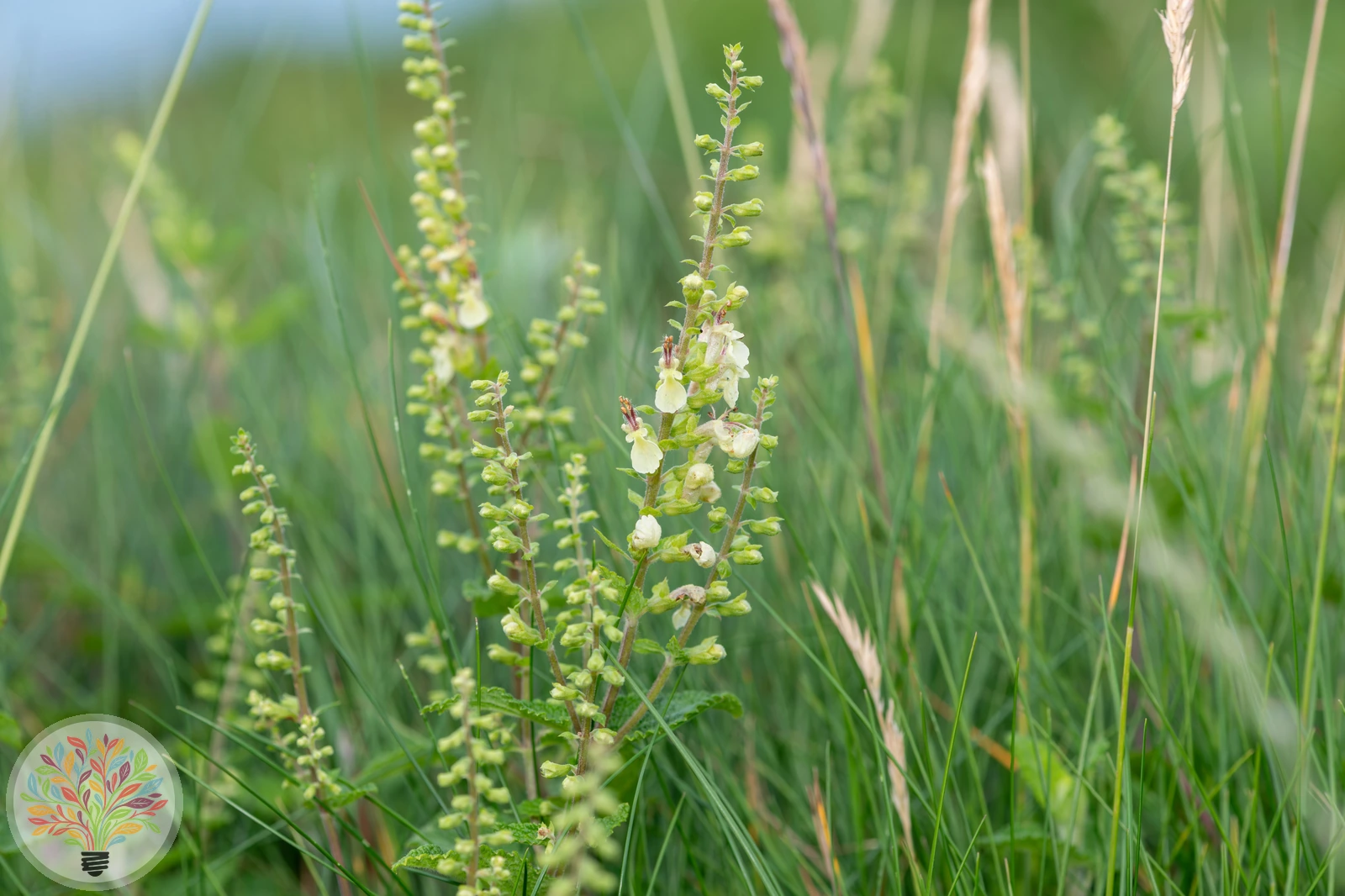
Teucrium scorodonia
Teucrium scorodonia
FamilyGenus: Teucriumnative in Germany
🌿
36
Species
interact
🔗
93
Interactions
documented
🐛
5
Host relationships
Species
About this species
A native herbaceous perennial of semi-shaded habitats, flowering in summer and providing nectar and pollen for insects.
Ecological network
Click to highlight connections · Click again to open the species page
Loading network...
PollinationLarval hostFlower visit
Ecological significance
The flowers provide nectar and pollen (value 2) for flower-visiting insects. The species associates with arbuscular mycorrhizal fungi, contributing to the herbaceous layer in its natural habitats.
Annual cycle
An evergreen herbaceous perennial, it flowers from July to August and keeps its leaves throughout the year.
Standort & Merkmale
Light
Halbschatten
Moisture
Frisch (Mäßig feucht)
Soil
Schwachzehrer (Magerer Boden)
Flowering period
Jul – Aug
Soil reaction
Sauer (Säurezeiger)
Bioregion
Continental
Nectar value
2
Pollen value
2
Growth form
Krautige Pflanze
Woodiness
Nicht verholzt
Leaf type
Breitblättrig
Leaf phenology
Immergrün
Plant height
0.302 m
Morphological traits: TRY ID3 (CC BY 3.0) & TRY ID81 (CC BY)
Scientific profile
Teucrium scorodonia is a herbaceous, non-woody, broad-leaved perennial in the Lamiaceae family, native in Great Britain. It typically reaches a height of around 0.3 metres and bears leaves averaging 977 square millimetres in area. The plant is terrestrial and forms arbuscular mycorrhizal relationships. It occupies moderately moist, nutrient-poor, acid soils in conditions of low disturbance, with a preference for semi-shade and a moderately warm temperature regime. Flowering occurs in July and August, producing a moderate supply of nectar and pollen (value 2 for each). The leaf phenology is evergreen, so the plant retains its foliage year-round. Diaspores are small, each weighing approximately 0.8 milligrams.
Pollinators & visitors
29 Arten interagieren mit dieser Pflanze
Anthophora bimaculataLasioglossum calceatumAphantopus hyperantusPyronia tithonusBombus sylvarumBombus ruderatusBombus pratorumBombus humilisBombus lucorumAnthophora furcataBombus muscorumBombus lapidariusBombus jonellusBombus campestrisBombus terrestrisBombus ruderariusHalictus tumulorumPolia bombycinaApis melliferaBombus pascuorumBombus sylvestrisMellicta athaliaOpisthograptis luteolataOchlodes venataBombus hortorumOchlodes sylvanusEpistrophe grossulariaeBombus vestalisBombus cryptarum
Host relationships
5 species use this plant as a host
Melitaea athalia Wachtelweizen-ScheckenfalterMacrothylacia rubiScopula marginepunctataPseudopanthera maculariaTyria jacobaeae
Other flower visitors
2 other species visit the flowers
Meligethes obscurusThricops semicinereus
Sources & data origin
•Interaktionsdaten via GloBI (CC-BY 4.0)
•Cook et al. (2025) UK Butterfly & Moth Traits (DOI: 10.5285/dbc7cc17-cbbd-49dd-bab4-8e8855768d66)
•pollinator_interactions
•FloraWeb / BfN
•EIVE 1.0 — Dengler et al. (2023), DOI: 10.3897/VCS.98324 (CC BY 4.0)
•EuPPollNet — Kuppler et al. (2025), DOI: 10.1111/geb.70000 (CC BY 4.0)
•Database of Pollinator Interactions (DoPI) — Pocock et al. (2022), DOI: 10.1002/ecy.3801 (CC BY)
•GBIF Backbone Taxonomy — GBIF Secretariat (2024), DOI: 10.15468/39omei (CC BY 4.0)
•TRY Categorical Traits (ID3) — Kattge et al. (2012), DOI: 10.17871/TRY.3 (CC BY 3.0)
•TRY Global Spectrum (ID81) — Díaz et al. (2016/2021), DOI: 10.17871/TRY.81 (CC BY)
•Govaerts R et al. (2025) — World Checklist of Vascular Plants (WCVP) v14. Royal Botanic Gardens, Kew. DOI: 10.34885/xs7h-ze42 (CC BY 4.0)
•Foto: © Adobe Stock / AdobeStock_1877028352
All data is licensed under CC BY 4.0, CC0, or compatible terms. Attribution according to license conditions. Full source overview →