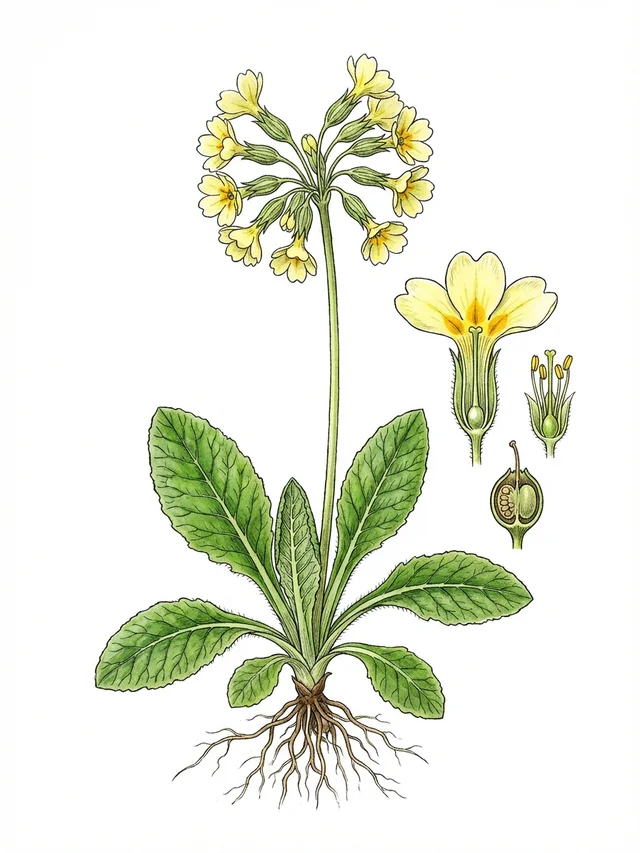
 Image to followAI-generated illustration
Trifolium aureum
Trifolium aureum
FamilyGenus: Trifoliumnative in Germany
🌿
5
Species
interact
🔗
7
Interactions
documented
About this species
Trifolium aureum is an introduced legume that has become established in Great Britain. It produces bright golden-yellow flower heads from late spring into early autumn and grows on dry, nutrient-poor soils in full sun. The plants reach about 30 cm in height, have broad leaflets, and behave as annuals or biennials.
Ecological network
Click to highlight connections · Click again to open the species page
Loading network...
Pollination
Ecological significance
As an introduced nitrogen-fixing legume, Trifolium aureum may alter local soil fertility on nutrient-poor sites, but detailed ecological impacts in Great Britain have not been documented.
Annual cycle
Flowering takes place from May through September. Seeds are set in late summer and autumn. Being an annual or biennial, individual plants die after fruiting, but populations can persist through self-seeding.
Safety note
The plant is considered safe around children and is not known to be toxic.
Standort & Merkmale
Light
Sonne
Moisture
Trocken
Soil
Schwachzehrer (Magerer Boden)
Flowering period
Mai – Sep
Soil reaction
Mäßig sauer bis neutral
Bioregion
Continental
Growth form
Krautige Pflanze
Woodiness
Nicht verholzt
Leaf type
Breitblättrig
Plant height
0.306 m
Morphological traits: TRY ID3 (CC BY 3.0) & TRY ID81 (CC BY)
Pflege & Anbau
**Light:** Full sun.
**Soil:** Poor, dry, well-drained soil.
**Watering:** Very low water requirement once established; tolerates drought.
**Maintenance:** No special feeding or pruning needed. May self-seed freely if conditions are suitable.
Scientific profile
Trifolium aureum is a herbaceous annual or biennial in the pea family (Fabaceae). It is an introduced plant in Great Britain, where it is considered established but not native. The plants are erect, slightly hairy, and typically grow to around 30 cm tall. The leaves are broad and consist of three leaflets; the flower heads are compact, ovoid, and composed of numerous small, vivid golden-yellow flowers that bloom from May to September. The species fixes atmospheric nitrogen through root nodules, a trait shared with other legumes. It typically occurs in full sun on dry, nutrient-poor soils.
Pollinators & visitors
5 Arten interagieren mit dieser Pflanze
Sources & data origin
•Interaktionsdaten via GloBI (CC-BY 4.0)
•pollinator_interactions
•FloraWeb / BfN
•EIVE 1.0 — Dengler et al. (2023), DOI: 10.3897/VCS.98324 (CC BY 4.0)
•GBIF Backbone Taxonomy — GBIF Secretariat (2024), DOI: 10.15468/39omei (CC BY 4.0)
•TRY Categorical Traits (ID3) — Kattge et al. (2012), DOI: 10.17871/TRY.3 (CC BY 3.0)
•TRY Global Spectrum (ID81) — Díaz et al. (2016/2021), DOI: 10.17871/TRY.81 (CC BY)
•Govaerts R et al. (2025) — World Checklist of Vascular Plants (WCVP) v14. Royal Botanic Gardens, Kew. DOI: 10.34885/xs7h-ze42 (CC BY 4.0)
All data is licensed under CC BY 4.0, CC0, or compatible terms. Attribution according to license conditions. Full source overview →