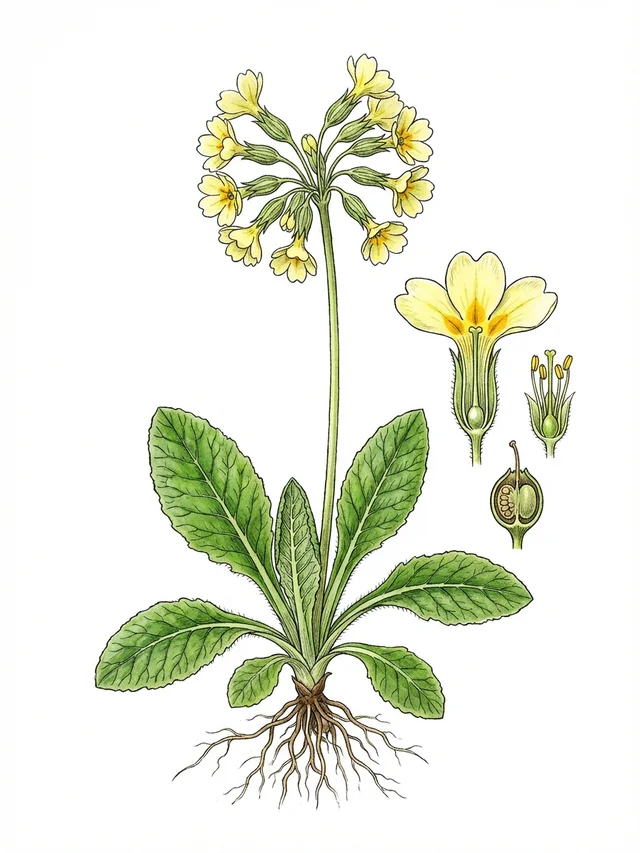
 Image to followAI-generated illustration
Ulex europaeus
Ulex europaeus
FamilyGenus: Ulexnative in Germany
🌿
60
Species
interact
🔗
118
Interactions
documented
🐛
17
Host relationships
Species
About this species
A native, evergreen shrub of heathlands and nutrient-poor grasslands, bearing fragrant yellow flowers in May that are a valuable nectar and pollen source for insects.
Ecological network
Click to highlight connections · Click again to open the species page
Loading network...
PollinationLarval hostFlower visit
Ecological significance
As a native shrub, Ulex europaeus is a structural element of heathland and acid grassland, providing dense cover and a substantial nectar resource for insects.
Annual cycle
Evergreen foliage and spines are present all year. The bright yellow flowers bloom in May, and pods develop through summer, releasing small seeds in late summer.
Standort & Merkmale
Light
Sonne
Moisture
Frisch (Mäßig feucht)
Soil
Schwachzehrer (Magerer Boden)
Flowering period
Mai – Mai
Soil reaction
Sauer (Säurezeiger)
Bioregion
Continental
Nectar value
3
Pollen value
3
Growth form
Strauch
Woodiness
Verholzt
Leaf type
Breitblättrig
Leaf phenology
Immergrün
Plant height
1.165 m
Morphological traits: TRY ID3 (CC BY 3.0) & TRY ID81 (CC BY)
Pflege & Anbau
Grow in full sun on well-drained, nutrient-poor, slightly acid soil. Water during the first season to keep the ground moderately moist; once established, avoid rich feeds and overwatering. Prune lightly after flowering to maintain a compact shape.
Scientific profile
Ulex europaeus is a woody, evergreen shrub typical of heathland and dwarf-shrub communities. It typically attains a height of approximately 1.2 m and forms dense, spiny thickets; the young branches bear stout, slightly curved spines 3–4 cm long. The small, dark green leaves are broad-leaved and persist year-round. In May the bush becomes covered with bright yellow, pea-like flowers, 13–20 mm long, which offer abundant nectar and pollen to bumblebees and other pollinators. The species is adapted to full sun and favours moderately moist, nutrient-poor, neutral to slightly acid soils. It forms arbuscular mycorrhizal associations and is a natural component of open, disturbance-poor habitats such as lowland heath.
Pollinators & visitors
29 Arten interagieren mit dieser Pflanze
Philanthus triangulumBombus hypnorumBombus humilisBombus hortorumBombus lapidariusBombus lucorumBombus pascuorumEristalis pertinaxBombus terrestrisApis melliferaAndrena nigroaeneaMelanostoma mellinumNeoascia podagricaBombus monticolaBombus cryptarumPlatycheirus clypeatusAndrena labialisAndrena wilkellaAndrena dorsataAndrena ovatulaBombus jonellusBombus muscorumEpisyrphus balteatusEristalis arbustorumEupeodes corollaeEupeodes lunigerHelophilus pendulusMyathropa floreaSericomyia silentis
Host relationships
17 species use this plant as a host
Callophrys rubiCelastrina argiolusPlebejus argusLasiocampa trifoliiScotopteryx mucronataScotopteryx luridataPerconia strigillariaPseudoterpna pruinataChlorissa viridataEilema complanaLacanobia contiguaLasiocampa quercusDicallomera fascelinaArctia villicaEilema lurideolaPeribatodes rhomboidaria (Denis & Schiffermüller), 1775Gymnoscelis rufifasciata
Other flower visitors
14 other species visit the flowers
Anaspis frontalisFormica rufaPollenia amentariaExapion ulicisLasius alienusSylvicola fenestralisBibio nigriventrisBicellaria pilosaCalliphora vicinaCoccinella septempunctataDelia platuraHelina reversioOdontothrips ulicisPolydrusus confluens
Sources & data origin
•Cook et al. (2025) UK Butterfly & Moth Traits (DOI: 10.5285/dbc7cc17-cbbd-49dd-bab4-8e8855768d66)
•pollinator_interactions
•FloraWeb / BfN
•EIVE 1.0 — Dengler et al. (2023), DOI: 10.3897/VCS.98324 (CC BY 4.0)
•EuPPollNet — Kuppler et al. (2025), DOI: 10.1111/geb.70000 (CC BY 4.0)
•Database of Pollinator Interactions (DoPI) — Pocock et al. (2022), DOI: 10.1002/ecy.3801 (CC BY)
•GBIF Backbone Taxonomy — GBIF Secretariat (2024), DOI: 10.15468/39omei (CC BY 4.0)
•TRY Categorical Traits (ID3) — Kattge et al. (2012), DOI: 10.17871/TRY.3 (CC BY 3.0)
•TRY Global Spectrum (ID81) — Díaz et al. (2016/2021), DOI: 10.17871/TRY.81 (CC BY)
•Govaerts R et al. (2025) — World Checklist of Vascular Plants (WCVP) v14. Royal Botanic Gardens, Kew. DOI: 10.34885/xs7h-ze42 (CC BY 4.0)
All data is licensed under CC BY 4.0, CC0, or compatible terms. Attribution according to license conditions. Full source overview →