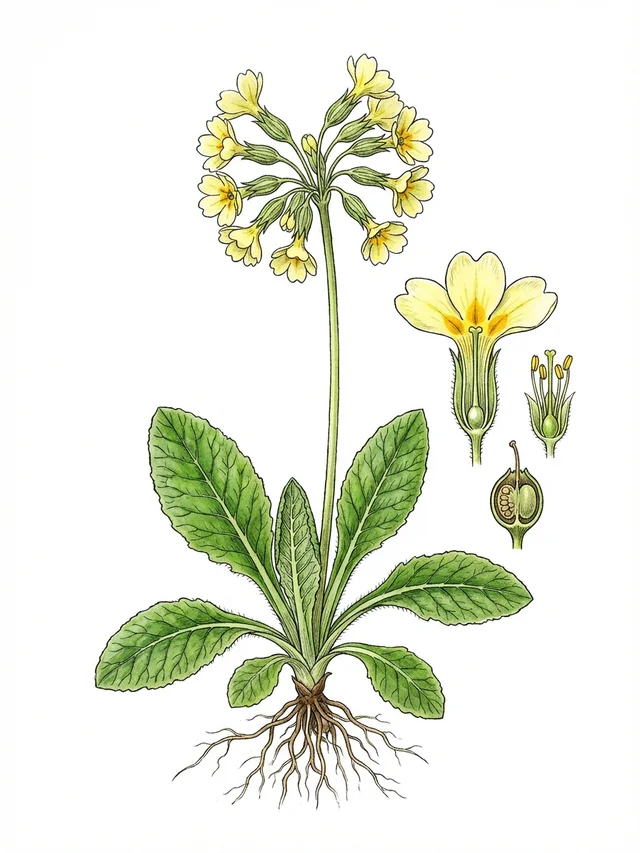
 Image to followAI-generated illustration
Verbena officinalis
Verbena officinalis
FamilyGenus: Verbenanative in Germany
🌿
64
Species
interact
🔗
409
Interactions
documented
About this species
A herbaceous perennial producing slender spikes of small, lilac flowers from June to October, favouring sunny and nutrient-rich sites.
Ecological network
Click to highlight connections · Click again to open the species page
Loading network...
PollinationFlower visit
Ecological significance
As a long-established archaeophyte in Great Britain, Verbena officinalis contributes to late-season forage for pollinators, its bloom period bridging summer and autumn when many other nectar sources are declining. The species is typically associated with stable, low-disturbance habitats and is not regarded as invasive.
Annual cycle
New herbaceous growth appears in spring; flowering spikes begin in June and continue through to October; top growth dies back after the first autumn frosts, overwintering as a perennial rootstock.
Safety note
Specific safety information is not available in the source data.
Standort & Merkmale
Light
Sonne
Moisture
Frisch (Mäßig feucht)
Soil
Starkzehrer (Nährstoffreicher/Fetter Boden)
Flowering period
Jun – Okt
Soil reaction
Basisch / Kalkhold
Bioregion
Continental
Growth form
Krautige Pflanze
Woodiness
Nicht verholzt
Leaf type
Breitblättrig
Plant height
0.466 m
Morphological traits: TRY ID3 (CC BY 3.0) & TRY ID81 (CC BY)
Pflege & Anbau
•
Light: full sun.
•
Soil: nutrient-rich, fresh (moderately moist) with a preference for calcareous conditions.
•
Watering: keep the soil evenly moist during the growing season, avoiding prolonged drought.
•
Aspect: best in sheltered, warm spots that mimic open, low-disturbance habitats.
Scientific profile
Verbena officinalis is a herbaceous, non-woody perennial in the verbena family (Verbenaceae) that typically reaches about 0.5 m in height and bears broad leaves. In Great Britain it is an archaeophyte, established before AD 1500, with a wide distribution across Europe, southwestern and southeastern Europe, Africa and temperate Asia. The plant prefers full sun and fresh, calcareous soils that are moderately fertile to nutrient-rich; it is intolerant of saline conditions and shows a preference for habitats with low levels of disturbance. Its leaves have an average area of 275 mm² and the tiny diaspores weigh approximately 0.4 mg. Arbuscular mycorrhizal associations are formed with the roots. Flowering extends from June into October, producing numerous small flowers on upright spikes.
Pollinators & visitors
62 Arten interagieren mit dieser Pflanze
Bombus pascuorumPolyommatus icarusXylocopa violaceaBombus sylvestrisBombus terrestrisBombus vestalisBombus lapidariusBombus pratorumBombus lucorumBombus muscorumPieris napiApis melliferaColias croceusBoloria diaAricia agestisAcronicta rumicisSphaerophoria scriptaLasioglossum glabriusculumSeladonia tumulorumLasioglossum leucozoniumHoplitis leucomelanaLasioglossum zonulumLasioglossum calceatumHalictus subauratusPieris rapaeCerceris sabulosaCeratina cucurbitinaMegachile versicolorHalictus scabiosaeOsmia spinulosaLasioglossum villosulumMegachile pilidensCeratina cyaneaHalictus compressusPseudoanthidium nanumHalictus simplex/langobardicus/compressusAnthidium oblongatumEristalinus aeneusHalictus maculatusMegachile rotundataLasioglossum medinaiParagus tibialisSyritta pipiensMegachile melanopygaHalictus simplexAnthidiellum strigatumSphecodes albilabrisMegachile centuncularisCoelioxys afraPasites maculatus
Sources & data origin
•Interaktionsdaten via GloBI (CC-BY 4.0)
•pollinator_interactions
•FloraWeb / BfN
•EIVE 1.0 — Dengler et al. (2023), DOI: 10.3897/VCS.98324 (CC BY 4.0)
•GBIF Backbone Taxonomy — GBIF Secretariat (2024), DOI: 10.15468/39omei (CC BY 4.0)
•TRY Categorical Traits (ID3) — Kattge et al. (2012), DOI: 10.17871/TRY.3 (CC BY 3.0)
•TRY Global Spectrum (ID81) — Díaz et al. (2016/2021), DOI: 10.17871/TRY.81 (CC BY)
•Govaerts R et al. (2025) — World Checklist of Vascular Plants (WCVP) v14. Royal Botanic Gardens, Kew. DOI: 10.34885/xs7h-ze42 (CC BY 4.0)
All data is licensed under CC BY 4.0, CC0, or compatible terms. Attribution according to license conditions. Full source overview →