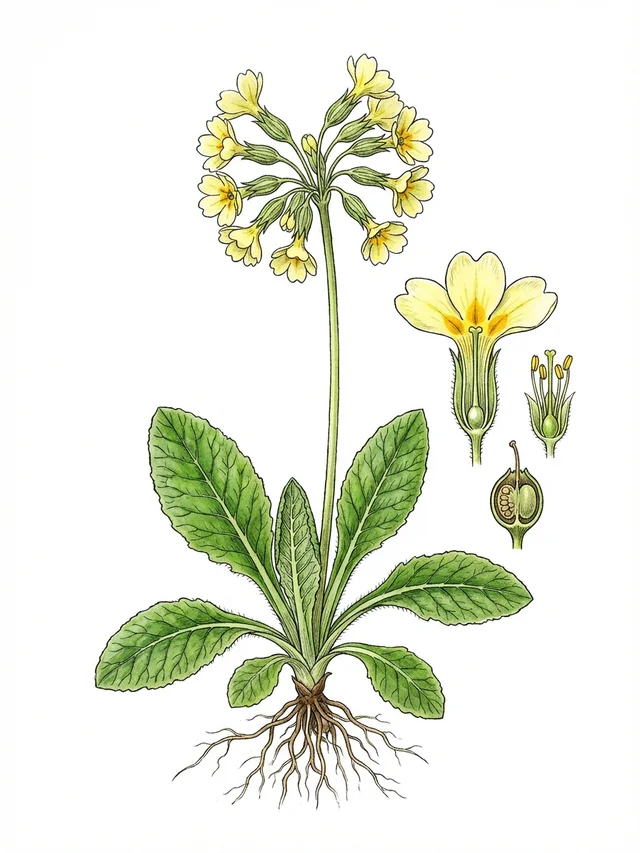
 Image to followAI-generated illustration
Veronica arvensis
Veronica arvensis
FamilyGenus: Veronicanative in Germany
🌿
27
Species
interact
🔗
186
Interactions
documented
About this species
A low-growing native wildflower, Veronica arvensis supplies nectar and pollen to insects through a long flowering season lasting from March to October. It is found in sunny, moderately moist, normal soils.
Ecological network
Click to highlight connections · Click again to open the species page
Loading network...
PollinationFlower visit
Ecological significance
The extended blooming period from early spring into autumn provides a reliable source of nectar and pollen for bees, flies and other pollinating insects. The species forms arbuscular mycorrhizal symbioses, which may aid nutrient uptake in the soil.
Annual cycle
An herbaceous plant, it produces flowers from March through to October, setting seed over the summer months. The seed germinates in the following growing season to repeat the annual cycle.
Safety note
No data on toxicity or other safety concerns are available for Veronica arvensis.
Standort & Merkmale
Light
Sonne
Moisture
Frisch (Mäßig feucht)
Soil
Mittelzehrer (Normaler Boden)
Flowering period
Mär – Okt
Soil reaction
Mäßig sauer bis neutral
Bioregion
Continental
Nectar value
5
Pollen value
5
Growth form
Krautige Pflanze
Woodiness
Nicht verholzt
Leaf type
Breitblättrig
Plant height
0.077 m
Morphological traits: TRY ID3 (CC BY 3.0) & TRY ID81 (CC BY)
Pflege & Anbau
This wild plant prospers in open, sunny sites with moderately moist, ordinary garden soil. It will self-seed naturally and requires no special maintenance in a wildlife-friendly setting.
Scientific profile
Veronica arvensis belongs to the plantain family (Plantaginaceae). It is a terrestrial, non-woody, broad-leaved annual that typically reaches about 8 cm in height. Native in Great Britain, it favours full sun, moderately fresh moisture, and soils that are neutral to slightly acid with medium nutrient status. The plant shows a preference for habitats experiencing low disturbance and forms arbuscular mycorrhizal associations. Its small blooms appear from March until October, offering both nectar and pollen (each rated 5) to visiting insects.
Pollinators & visitors
21 Arten interagieren mit dieser Pflanze
Polistes dominulaBombus lucorumBombus hypnorumBombus ruderariusBombus lapidariusAndrena nigroaeneaLasioglossum pauxillumLasioglossum xanthopusSeladonia tumulorumLasioglossum morioAndrena labiataEupeodes lunigerBombus pratorumBombus veteranusBombus subterraneusBombus pascuorumBombus soroeensisBrenthis inoApis melliferaBombus distinguendusBombus
Other flower visitors
6 other species visit the flowers
Sources & data origin
•Interaktionsdaten via GloBI (CC-BY 4.0)
•pollinator_interactions
•FloraWeb / BfN
•EIVE 1.0 — Dengler et al. (2023), DOI: 10.3897/VCS.98324 (CC BY 4.0)
•EuPPollNet — Kuppler et al. (2025), DOI: 10.1111/geb.70000 (CC BY 4.0)
•Database of Pollinator Interactions (DoPI) — Pocock et al. (2022), DOI: 10.1002/ecy.3801 (CC BY)
•GBIF Backbone Taxonomy — GBIF Secretariat (2024), DOI: 10.15468/39omei (CC BY 4.0)
•TRY Categorical Traits (ID3) — Kattge et al. (2012), DOI: 10.17871/TRY.3 (CC BY 3.0)
•TRY Global Spectrum (ID81) — Díaz et al. (2016/2021), DOI: 10.17871/TRY.81 (CC BY)
•Govaerts R et al. (2025) — World Checklist of Vascular Plants (WCVP) v14. Royal Botanic Gardens, Kew. DOI: 10.34885/xs7h-ze42 (CC BY 4.0)
All data is licensed under CC BY 4.0, CC0, or compatible terms. Attribution according to license conditions. Full source overview →