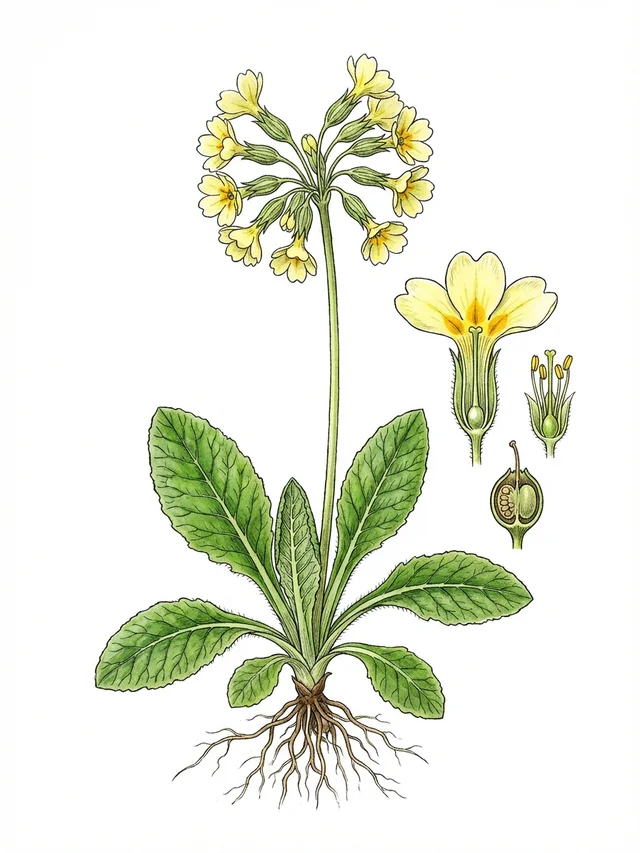
 Image to followAI-generated illustration
Veronica peregrina
Veronica peregrina
FamilyGenus: Veronicanative in Germany
🌿
1
Species
interact
🔗
1
Interactions
documented
About this species
An introduced herbaceous plant, Veronica peregrina reaches about 11 cm in height and bears small flowers from May to June. It favours sunny, moist, nutrient-rich sites.
Ecological network
Click to highlight connections · Click again to open the species page
Loading network...
Pollination
Ecological significance
As an introduced and established species, Veronica peregrina colonises damp, nutrient-rich, disturbed ground. No invasive impacts have been documented in Great Britain.
Annual cycle
Flowering takes place from May to June, followed by seed set. The tiny seeds (diaspore mass 0.03 mg) are dispersed close to the parent plant.
Safety note
No specific hazards have been recorded for this species.
Standort & Merkmale
Light
Sonne
Moisture
Frisch (Mäßig feucht)
Soil
Starkzehrer (Nährstoffreicher/Fetter Boden)
Flowering period
Mai – Jun
Soil reaction
Basisch / Kalkhold
Bioregion
Continental
Growth form
Krautige Pflanze
Woodiness
Nicht verholzt
Leaf type
Breitblättrig
Plant height
0.109 m
Morphological traits: TRY ID3 (CC BY 3.0) & TRY ID81 (CC BY)
Pflege & Anbau
To cultivate Veronica peregrina, provide a sunny position with consistently moist, well-drained, fertile, slightly alkaline soil. It requires little intervention once established and performs best with low disturbance. No special winter protection is needed in typical British conditions.
Scientific profile
Veronica peregrina is an introduced, established neophyte in Great Britain. It is a non-woody, broad-leaved herbaceous plant growing to approximately 11 cm. The leaves have an average area of 44 mm². Flowering occurs in May and June. The species prefers full sun and fresh to moist, calcareous, nutrient-rich soils, and is intolerant of salinity. It typically occupies low-disturbance, warm microsites. Indicator values assign a light score of 8 (full sun), moisture score of 7 (moist), reaction score of 7 (basic), nutrient score of 6 (moderate), and temperature score of 7 (warmth-loving).
Sources & data origin
•Interaktionsdaten via GloBI (CC-BY 4.0)
•FloraWeb / BfN
•EIVE 1.0 — Dengler et al. (2023), DOI: 10.3897/VCS.98324 (CC BY 4.0)
•GBIF Backbone Taxonomy — GBIF Secretariat (2024), DOI: 10.15468/39omei (CC BY 4.0)
•TRY Categorical Traits (ID3) — Kattge et al. (2012), DOI: 10.17871/TRY.3 (CC BY 3.0)
•TRY Global Spectrum (ID81) — Díaz et al. (2016/2021), DOI: 10.17871/TRY.81 (CC BY)
•Checklist Alien Plants Belgium — Verloove F (2023), Botanic Garden Meise (CC BY 4.0)
•Govaerts R et al. (2025) — World Checklist of Vascular Plants (WCVP) v14. Royal Botanic Gardens, Kew. DOI: 10.34885/xs7h-ze42 (CC BY 4.0)
All data is licensed under CC BY 4.0, CC0, or compatible terms. Attribution according to license conditions. Full source overview →