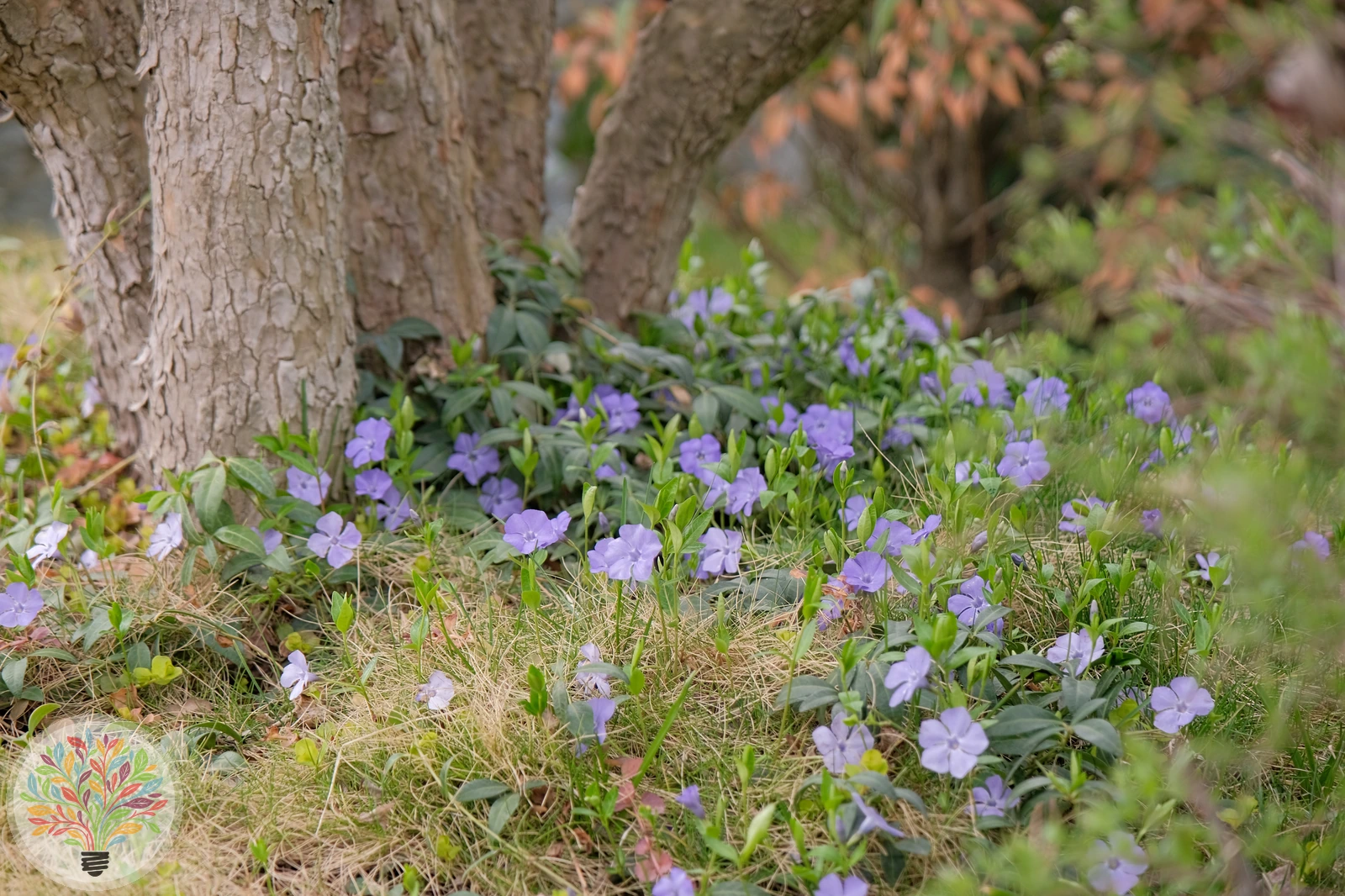
Vinca minor
Vinca minor
FamilyGenus: Vincanative in Germany
🌿
13
Species
interact
🔗
15
Interactions
documented
About this species
Vinca minor is an evergreen perennial with trailing, rooting stems that forms low mats of glossy, dark green, broad leaves. Its pale violet-blue flowers appear in April. A long-established archaeophyte in Great Britain, it thrives in shade and prefers fresh, calcareous, moderately fertile soils.
Ecological network
Click to highlight connections · Click again to open the species page
Loading network...
PollinationFlower visit
Ecological significance
Vinca minor forms dense, evergreen ground cover that can suppress other plants where it spreads vigorously. No specific ecological impact assessments are included in the source data.
Annual cycle
Evergreen foliage persists year-round. Flowering occurs in April. The trailing stems continue to elongate and root during the growing season, gradually extending the mat.
Safety note
No toxicological data are available in the source; however, many members of the Apocynaceae contain alkaloids and caution may be warranted.
Standort & Merkmale
Light
Schatten
Moisture
Frisch (Mäßig feucht)
Soil
Mittelzehrer (Normaler Boden)
Flowering period
Apr – Apr
Soil reaction
Basisch / Kalkhold
Bioregion
Continental
Growth form
Kletterpflanze
Woodiness
Nicht verholzt
Leaf type
Breitblättrig
Leaf phenology
Immergrün
Plant height
0.198 m
Morphological traits: TRY ID3 (CC BY 3.0) & TRY ID81 (CC BY)
Pflege & Anbau
Plant in full to partial shade. It prefers a fresh, moderately moist, well-drained soil that is neutral to alkaline (calcareous). A medium-fertility garden loam is suitable. Once established, it requires little maintenance, but its spreading stems may need occasional containment. Propagate by division or stem cuttings.
Scientific profile
Vinca minor is a member of the dogbane family (Apocynaceae). It is widely recorded across Europe; in Great Britain it is a long-established archaeophyte, recorded since at least 1500. This non-woody plant has a climbing or trailing growth form, typically reaching about 20 cm in height. Its evergreen, broad leaves average 565 mm² in area. Flowering occurs in April, and the seeds (diaspores) weigh approximately 6.13 mg. It is a shade-bearing species (Ellenberg-type indicator value 4), adapted to fresh, moderately moist soils (value 5) with a preference for calcareous or basic conditions (value 7) and moderate fertility (value 6). It tolerates low-disturbance habitats (severity 0.7) and moderately warm temperatures (value 6).
Pollinators & visitors
11 Arten interagieren mit dieser Pflanze
Other flower visitors
2 other species visit the flowers
Psyllobora vigintiduopunctataCoccinella septempunctata
Sources & data origin
•Interaktionsdaten via GloBI (CC-BY 4.0)
•FloraWeb / BfN
•EIVE 1.0 — Dengler et al. (2023), DOI: 10.3897/VCS.98324 (CC BY 4.0)
•GBIF Backbone Taxonomy — GBIF Secretariat (2024), DOI: 10.15468/39omei (CC BY 4.0)
•TRY Categorical Traits (ID3) — Kattge et al. (2012), DOI: 10.17871/TRY.3 (CC BY 3.0)
•TRY Global Spectrum (ID81) — Díaz et al. (2016/2021), DOI: 10.17871/TRY.81 (CC BY)
•Govaerts R et al. (2025) — World Checklist of Vascular Plants (WCVP) v14. Royal Botanic Gardens, Kew. DOI: 10.34885/xs7h-ze42 (CC BY 4.0)
•Foto: © Adobe Stock / AdobeStock_1760857941
All data is licensed under CC BY 4.0, CC0, or compatible terms. Attribution according to license conditions. Full source overview →