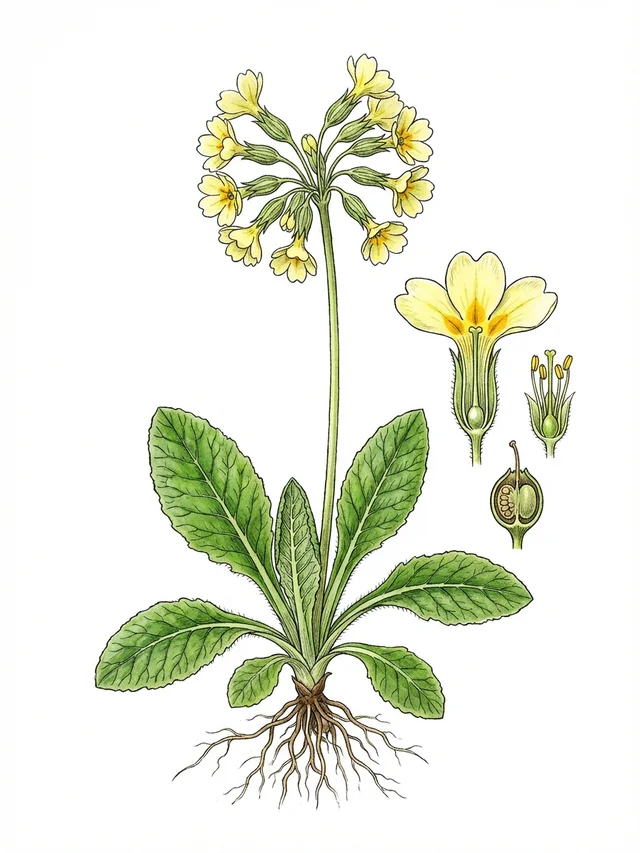
 Image to followAI-generated illustration
Viola canina
Viola canina
FamilyGenus: Violanative in Germany
🌿
9
Species
interact
🔗
9
Interactions
documented
🐛
1
Host relationships
Species
About this species
A small, native perennial wildflower of nutrient-poor grasslands and meadows, producing blooms over the summer months.
Ecological network
Click to highlight connections · Click again to open the species page
Loading network...
PollinationLarval hostFlower visit
Ecological significance
As a native component of extensive grassland communities, Viola canina supports some flower-visiting insects through its low-level nectar and pollen supply. The arbuscular mycorrhizal associations formed by its roots contribute to soil fungal networks, and its presence enriches the biodiversity of nutrient-poor meadow habitats.
Annual cycle
A herbaceous perennial; shoots emerge in spring, flowering begins in May and can continue until September. Seeds ripen in late summer and early autumn, after which the foliage dies back for the winter.
Standort & Merkmale
Light
Sonne
Moisture
Frisch (Mäßig feucht)
Soil
Schwachzehrer (Magerer Boden)
Flowering period
Mai – Sep
Soil reaction
Mäßig sauer bis neutral
Bioregion
Continental
Nectar value
2
Pollen value
2
Growth form
Krautige Pflanze
Woodiness
Nicht verholzt
Leaf type
Breitblättrig
Plant height
0.165 m
Morphological traits: TRY ID3 (CC BY 3.0) & TRY ID81 (CC BY)
Pflege & Anbau
This species requires full sun and a well-drained, nutrient-poor, moderately moist soil. It is best suited to wildflower meadows or unfertilised grassland, where it can persist without feeding. Avoid overwatering or fertilising, and refrain from fungicide use to protect its mycorrhizal fungi. Once established, it needs little ongoing care.
Scientific profile
Viola canina is a native herbaceous perennial of nutrient-poor grasslands and meadows in Great Britain. Typically reaching about 16 cm in height, it bears broad, non-woody leaves and produces flowers from May to September. The bloom offers modest amounts of nectar and pollen. The plant prefers full sun and moderately moist, neutral to weakly acidic, nutrient-poor soils, with a low tolerance to disturbance. Its seed mass averages 0.88 mg, and it forms arbuscular mycorrhizal associations.
Pollinators & visitors
6 Arten interagieren mit dieser Pflanze
Bombus pascuorumPlatycheirus clypeatusBombus lucorumBombus muscorumBombus lapidariusPieris napi
Host relationships
1 species use this plant as a host
Fabriciana adippe (Denis & Schiffermüller), 1775
Other flower visitors
2 other species visit the flowers
Boloria seleneSiphona geniculata
Sources & data origin
•Cook et al. (2025) UK Butterfly & Moth Traits (DOI: 10.5285/dbc7cc17-cbbd-49dd-bab4-8e8855768d66)
•pollinator_interactions
•FloraWeb / BfN
•EIVE 1.0 — Dengler et al. (2023), DOI: 10.3897/VCS.98324 (CC BY 4.0)
•EuPPollNet — Kuppler et al. (2025), DOI: 10.1111/geb.70000 (CC BY 4.0)
•Database of Pollinator Interactions (DoPI) — Pocock et al. (2022), DOI: 10.1002/ecy.3801 (CC BY)
•GBIF Backbone Taxonomy — GBIF Secretariat (2024), DOI: 10.15468/39omei (CC BY 4.0)
•TRY Categorical Traits (ID3) — Kattge et al. (2012), DOI: 10.17871/TRY.3 (CC BY 3.0)
•TRY Global Spectrum (ID81) — Díaz et al. (2016/2021), DOI: 10.17871/TRY.81 (CC BY)
•Govaerts R et al. (2025) — World Checklist of Vascular Plants (WCVP) v14. Royal Botanic Gardens, Kew. DOI: 10.34885/xs7h-ze42 (CC BY 4.0)
All data is licensed under CC BY 4.0, CC0, or compatible terms. Attribution according to license conditions. Full source overview →