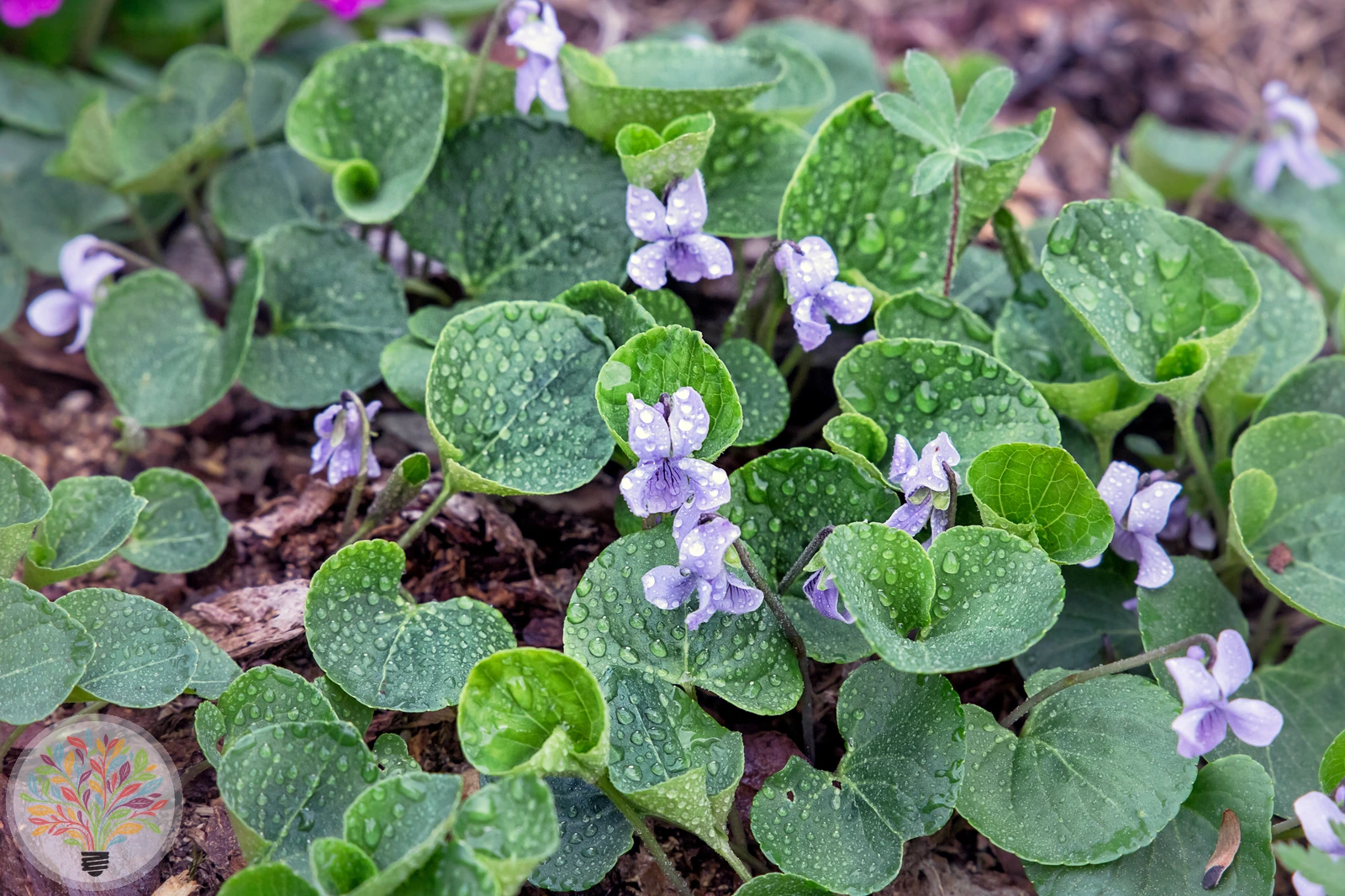
Viola palustris
Viola palustris
FamilyGenus: Violanative in Germany
🌿
4
Species
interact
🔗
4
Interactions
documented
🐛
2
Host relationships
Species
About this species
A low, creeping herbaceous perennial of wet, acidic ground, bearing pale lilac flowers in late spring and early summer. Native in Great Britain, it is a characteristic plant of mires, wet heaths and acid flushes.
Ecological network
Click to highlight connections · Click again to open the species page
Loading network...
Larval hostFlower visit
Ecological significance
As part of native mire, wet heath and acid flush vegetation, this violet contributes to the structure and functioning of these priority habitats. It produces nectar and pollen during late spring, though no specific pollinator associations are documented here.
Annual cycle
Shoots emerge from a thin, horizontal rhizome in early spring. Flowering occurs from May to June, and seed capsules ripen during summer. The foliage dies back to ground level in autumn, with the plant overwintering as underground organs.
Standort & Merkmale
Light
Halbschatten
Moisture
Feucht
Soil
Schwachzehrer (Magerer Boden)
Flowering period
Mai – Jun
Soil reaction
Sauer (Säurezeiger)
Bioregion
Continental
Growth form
Krautige Pflanze
Woodiness
Nicht verholzt
Leaf type
Breitblättrig
Plant height
0.096 m
Morphological traits: TRY ID3 (CC BY 3.0) & TRY ID81 (CC BY)
Pflege & Anbau
Grow in partial shade in persistently moist, acid soil that is low in nutrients. A peaty or sandy substrate with a reliably high water table suits it well. Avoid enrichment and disturbance. The plant spreads slowly by stolons and can form loose colonies over time.
Scientific profile
Viola palustris is a herbaceous perennial reaching about 10 cm in height. It does not develop woody tissue and forms a terrestrial, broad-leaved rosette from which slender stolons extend. The kidney-shaped leaves are mid-green and hairless, with a blade area averaging around 1060 mm². From May to June the plant produces typical violet flowers, pale lilac with darker veins, on slender stalks. After flowering, small capsules release seeds with a mean diaspore mass of approximately 0.73 mg. The species is a plant of cool, moist habitats with a preference for strongly acid, nutrient-poor soils. It tolerates only low levels of disturbance and grows best in partial shade. In Britain it is a native member of oligotrophic mire and wet heath communities, often appearing where water seeps through acid peat.
Sources & data origin
•Cook et al. (2025) UK Butterfly & Moth Traits (DOI: 10.5285/dbc7cc17-cbbd-49dd-bab4-8e8855768d66)
•pollinator_interactions
•FloraWeb / BfN
•EIVE 1.0 — Dengler et al. (2023), DOI: 10.3897/VCS.98324 (CC BY 4.0)
•GBIF Backbone Taxonomy — GBIF Secretariat (2024), DOI: 10.15468/39omei (CC BY 4.0)
•TRY Categorical Traits (ID3) — Kattge et al. (2012), DOI: 10.17871/TRY.3 (CC BY 3.0)
•TRY Global Spectrum (ID81) — Díaz et al. (2016/2021), DOI: 10.17871/TRY.81 (CC BY)
•Govaerts R et al. (2025) — World Checklist of Vascular Plants (WCVP) v14. Royal Botanic Gardens, Kew. DOI: 10.34885/xs7h-ze42 (CC BY 4.0)
•Foto: © (c)Nataliya Osipova, E-mail: slaviyanka72@mail.ru / Adobe Stock / AdobeStock_439171830
All data is licensed under CC BY 4.0, CC0, or compatible terms. Attribution according to license conditions. Full source overview →