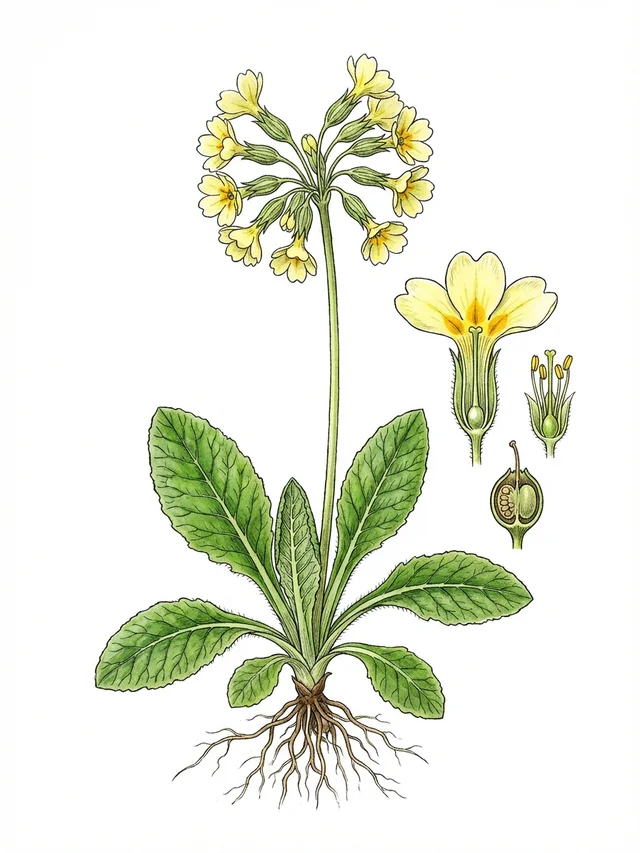
 Image to followAI-generated illustration
Viola tricolor
Viola tricolor subsp. curtisii
FamilyGenus: Violanon-native in Germany
🌿
35
Species
interact
🔗
45
Interactions
documented
🐛
2
Host relationships
Species
About this species
A small, native, broad-leaved herbaceous plant that reaches up to 25 cm. It produces flowers between April and July, favouring sunny, dry, nutrient-poor conditions.
Ecological network
Click to highlight connections · Click again to open the species page
Loading network...
PollinationLarval hostFlower visit
Ecological significance
As a native species of nutrient-poor, dry habitats, Viola tricolor contributes to the flora of these specialised environments. It is a natural component of certain grassland and open vegetation communities.
Annual cycle
Flowers are produced from April through July. The plant is herbaceous, dying back annually to its rootstock or seed.
Standort & Merkmale
Light
Sonne
Moisture
Trocken
Soil
Schwachzehrer (Magerer Boden)
Flowering period
Apr – Jul
Soil reaction
Mäßig sauer bis neutral
Growth form
Krautige Pflanze
Woodiness
Nicht verholzt
Leaf type
Breitblättrig
Plant height
0.25 m
Morphological traits: TRY ID3 (CC BY 3.0) & TRY ID81 (CC BY)
Corolla tube
15 mm
Pflege & Anbau
Provide a sunny position with free-draining, low-fertility soil. Water sparingly; avoid fertilisers. The plant is adapted to dry conditions and will not thrive in rich, moist ground.
Scientific profile
Viola tricolor is a native herbaceous plant in Great Britain. It grows to around 0.25 m in height, is non-woody and bears broad leaves. The species flowers from April to July. Ellenberg indicator values show a very high light requirement (L8), a preference for dry soils (F3), extremely low nutrient availability (N2), a moderately warm temperature regime (T5) and a neutral to slightly acid soil reaction (R6). Seeds are small, with a mean diaspore mass of 0.5 mg.
Pollinators & visitors
32 Arten interagieren mit dieser Pflanze
Gonepteryx rhamniOsmia bicolorBombus sylvestrisPyrgus malvaePieris napiLasioglossum fulvicorneAglais urticaeErynnis tagesOsmia aurulentaAnthocharis cardaminesBombus pratorumClossiana euphrosyneBombus hypnorumBombus muscorumBombus pascuorumBombus jonellusBoloria seleneBombus lucorumErebia aethiopsPieris rapaePieris brassicaeCallophrys rubiBombus terrestrisBombus lapidariusBombus vestalisLasioglossum laevigatumAndrena bicolorIssoria lathoniaFabriciana niobeApis melliferaBombus hortorumSpeyeria aglaja
Other flower visitors
1 other species visit the flowers
Coccinella septempunctata
Sources & data origin
•Interaktionsdaten via GloBI (CC-BY 4.0)
•Baden-Böhm F, App M, Thiele J (2022) — The FloRes Database: A floral resources trait database for pollinator habitat-assessment generated by a multistep workflow. Johann Heinrich von Thünen-Institut, Dryad, DOI: 10.5061/dryad.djh9w0w29 (CC0)
•EIVE 1.0 — Dengler et al. (2023), DOI: 10.3897/VCS.98324 (CC BY 4.0)
•GBIF Backbone Taxonomy — GBIF Secretariat (2024), DOI: 10.15468/39omei (CC BY 4.0)
•TRY Categorical Traits (ID3) — Kattge et al. (2012), DOI: 10.17871/TRY.3 (CC BY 3.0)
•TRY Global Spectrum (ID81) — Díaz et al. (2016/2021), DOI: 10.17871/TRY.81 (CC BY)
•Govaerts R et al. (2025) — World Checklist of Vascular Plants (WCVP) v14. Royal Botanic Gardens, Kew. DOI: 10.34885/xs7h-ze42 (CC BY 4.0)
All data is licensed under CC BY 4.0, CC0, or compatible terms. Attribution according to license conditions. Full source overview →