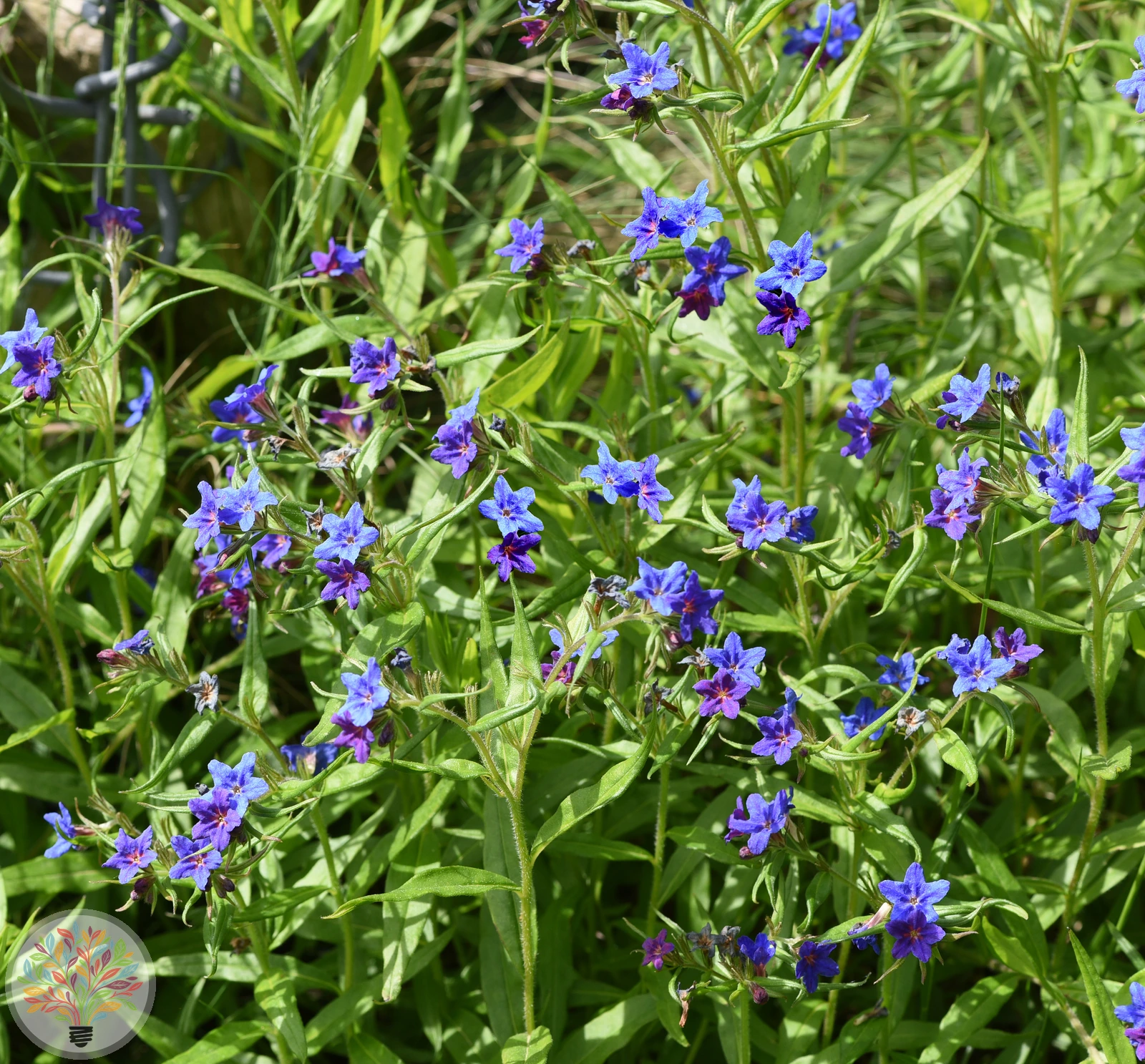
Aegonychon purpurocaeruleum
Aegonychon purpurocaeruleum
FamilyGenus: Aegonychonheimisch in Deutschland
🌿
3
Species
interact
🔗
4
Interactions
documented
About this species
A native perennial of semi-shaded spots, producing purplish-blue flowers from spring to early summer on lime-rich soils.
Ecological network
Click to highlight connections · Click again to open species page
Netzwerk wird geladen...
Pollination
Ecological significance
As a native perennial, it forms part of natural woodland‑edge and rocky‑slope communities without posing an invasive risk. Its blooms offer a low‑level nectar and pollen source early in the season, supporting small numbers of bees and other pollinators.
Annual cycle
New growth emerges in early spring from a woody rootstock, followed by flowering from April to June. Seeds ripen through summer and the plant gradually retreats underground in autumn, completing its annual cycle as a deciduous perennial.
Safety note
No toxicity information is available for this species.
Standort & Merkmale
Light
Halbschatten
Moisture
Trocken
Soil
Mittelzehrer (Normaler Boden)
Bloom time
Apr – Jun
Soil reaction
Basisch / Kalkhold
Bioregion
Continental
Nectar value
1
Pollen value
1
Pflege & Anbau
In cultivation, site in dappled shade or light woodland edge on a free‑draining, lime‑rich soil. Ordinary garden loam of neutral to alkaline pH is suitable, provided drainage is sharp. Water regularly during establishment but avoid waterlogging; once rooted the plant copes with dry periods. No supplementary feeding is required on average soils. Cut back spent stems after flowering if self‑seeding is unwanted, or leave seed‑heads as foraging for birds. Division or root cuttings can be used for propagation in early spring.
Scientific profile
Aegonychon purpurocaeruleum is a herbaceous perennial of the borage family, native in Great Britain. It forms clumps of upright, leafy stems and bears tubular, purplish‑blue flowers from April to June. The bloom colour shifts with age, opening a rich violet‑blue and fading slightly. Leaves are narrow, hairy and deep green. It favours semi‑shade and flourishes on well‑drained, alkaline to calcareous ground, often in open woodland, scrub margins or rocky slopes. The plant tolerates dry spells once settled and performs best where soil is not heavily enriched; excessive nutrients are not needed. Its flowers provide modest amounts of nectar and pollen for visiting insects.
Bestäuber & Besucher
3 Arten interagieren mit dieser Pflanze
Sources & data origin
•TraitCH — CC BY 4.0TraitCH 2.0 contributors; imported as source-preserving NaturKompass taxon evidence.
•Interaktionsdaten via GloBI (CC-BY 4.0)
•EIVE 1.0 — Dengler et al. (2023), DOI: 10.3897/VCS.98324 (CC BY 4.0)
•EuPPollNet — Kuppler et al. (2025), DOI: 10.1111/geb.70000 (CC BY 4.0)
•Database of Pollinator Interactions (DoPI) — Pocock et al. (2022), DOI: 10.1002/ecy.3801 (CC BY)
•GBIF Backbone Taxonomy — GBIF Secretariat (2024), DOI: 10.15468/39omei (CC BY 4.0)
•Govaerts R et al. (2025) — World Checklist of Vascular Plants (WCVP) v14. Royal Botanic Gardens, Kew. DOI: 10.34885/xs7h-ze42 (CC BY 4.0)
•Foto: © Manfred Ruckszio / Adobe Stock / AdobeStock_807903721
All data is licensed under CC BY 4.0, CC0, or compatible. Attribution according to license terms. Full source overview →