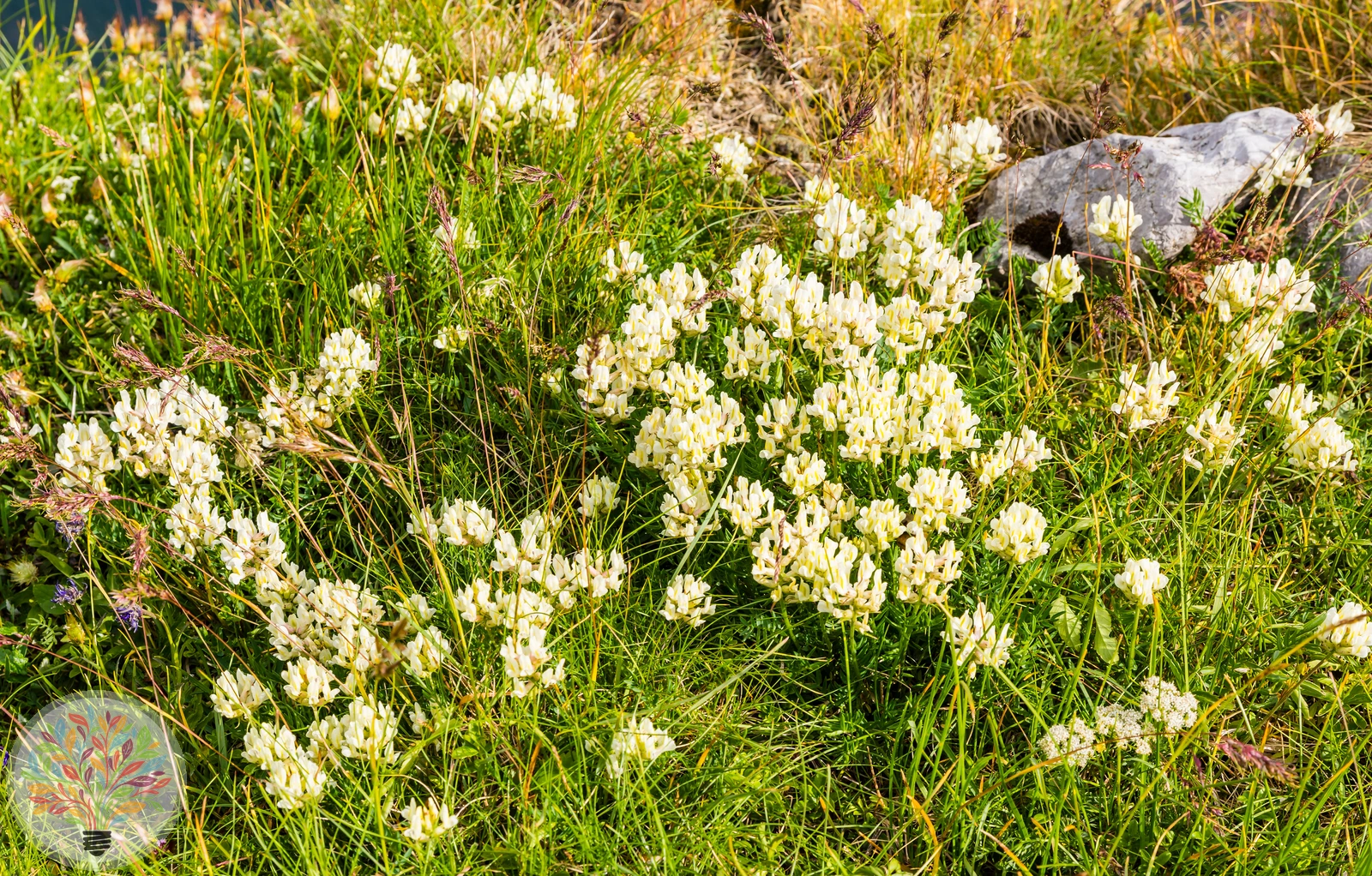
Oxytropis campestris
Oxytropis campestris
FamilyGenus: Spitzkieleheimisch in Deutschland
🌿
35
Species
interact
🔗
43
Interactions
documented
🐛
1
Host relationships
Species
About this species
A native, low-growing, non-woody plant of Great Britain, Oxytropis campestris reaches about 25 cm in height and bears broad leaves. It flowers in June and July, thriving in full sun on moderately moist, nutrient-poor soils in cold, upland sites.
Ecological network
Click to highlight connections · Click again to open species page
Netzwerk wird geladen...
PollinationLarval hostFlower visit
Ecological significance
As a native wild plant, Oxytropis campestris forms part of low-nutrient grassland and rocky slope communities.
Annual cycle
Oxytropis campestris is a perennial. Flowering occurs in June and July, followed by seed set. The small seeds (diaspore mass 1.17 mg) are shed close to the parent. The aerial growth dies back in winter, while the plant regrows from the base in spring.
Safety note
Not known to be toxic.
Standort & Merkmale
Light
Sonne
Moisture
Frisch (Mäßig feucht)
Soil
—
Bloom time
Jun – Jul
Bioregion
Continental
Growth form
Halbstrauch
Woodiness
Nicht verholzt
Leaf type
Breitblättrig
Plant height
0.245 m
Morphological traits: TRY ID3 (CC BY 3.0) & TRY ID81 (CC BY)
Pflege & Anbau
•
Full sun
•
Moderately moist, well-drained soil
•
Low-nutrient (poor) substrate
•
Best in cool, upland settings
•
Keep disturbance to a minimum
Scientific profile
Oxytropis campestris is a low, non-woody plant in the pea family (Fabaceae). Native in Great Britain, it grows to around 0.25 m tall and has broad, non-woody foliage. The plant is adapted to full sun and moderately moist, nutrient-poor soils, favouring cold, northern or alpine conditions. It shows only slight tolerance of disturbance. Flowering takes place in June and July. The tiny seeds weigh about 1.17 mg. Arbuscular mycorrhizal (AM) associations are present.
Bestäuber & Besucher
27 Arten interagieren mit dieser Pflanze
Cupido minimusPolyommatus erosPolyommatus icarusPyrgus centaureaeBombus balteatusHalictus confususMegachile lapponicaMegachile circumcinctaBombus jonellusPolyommatus fulgensPolyommatus humedasaeHesperia commaBombus appositusBombus flavifronsBombus mixtusBombus nevadensisBombus sylvicolaHoplitis albifronsLasioglossum albipenneLasioglossum nigrovirideOsmia albolateralisOsmia bucephalaOsmia integraOsmia iridisOsmia juxtaOsmia lignariaOsmia longula
Host relationships
1 species use this plant as a host
Rhizoglyphus echinopus
Other flower visitors
7 other species visit the flowers
Formica fuscaBrassicogethes aeneusMeligethes aeneusSpilogona solitarianaMeligethes viridescensEucera edwardsiiEucera frater
Sources & data origin
•TraitCH — CC BY 4.0TraitCH 2.0 contributors; imported as source-preserving NaturKompass taxon evidence.
•Interaktionsdaten via GloBI (CC-BY 4.0)
•Middleton-Welling_2020
•pollinator_interactions
•EIVE 1.0 — Dengler et al. (2023), DOI: 10.3897/VCS.98324 (CC BY 4.0)
•GBIF Backbone Taxonomy — GBIF Secretariat (2024), DOI: 10.15468/39omei (CC BY 4.0)
•TRY Categorical Traits (ID3) — Kattge et al. (2012), DOI: 10.17871/TRY.3 (CC BY 3.0)
•TRY Global Spectrum (ID81) — Díaz et al. (2016/2021), DOI: 10.17871/TRY.81 (CC BY)
•Govaerts R et al. (2025) — World Checklist of Vascular Plants (WCVP) v14. Royal Botanic Gardens, Kew. DOI: 10.34885/xs7h-ze42 (CC BY 4.0)
•Foto: © Pawel Gubernat / Adobe Stock
All data is licensed under CC BY 4.0, CC0, or compatible. Attribution according to license terms. Full source overview →