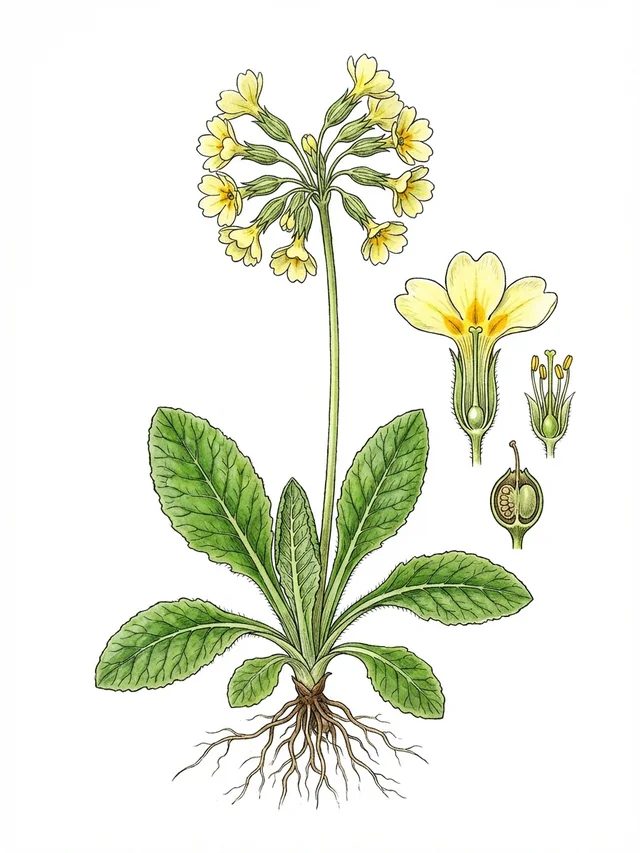
 Bild folgtKI-generierte Illustration
Arabis hirsuta
Arabis hirsuta
FamilyGenus: Arabisheimisch in Deutschland
🌿
8
Species
interact
🔗
8
Interactions
documented
🐛
1
Host relationships
Species
About this species
A native herbaceous plant of dry, calcareous ground, reaching about 37 cm tall. Its broad leaves form a low rosette, and small white flowers appear from April to May. It is a plant of sunny, low-nutrient habitats that experience little disturbance.
Ecological network
Click to highlight connections · Click again to open species page
Netzwerk wird geladen...
PollinationLarval host
Ecological significance
Flowering in April and May, Arabis hirsuta offers a nectar source for early-flying pollinators. Its minute seeds and broad leaves contribute to the structure of open, low-productivity plant communities.
Annual cycle
Foliage emerges in early spring. The flowering period runs from April to May, after which seeds ripen and are shed. As a herbaceous plant, above-ground growth dies back in late autumn.
Standort & Merkmale
Light
Sonne
Moisture
Trocken
Soil
Schwachzehrer (Magerer Boden)
Bloom time
Apr – Mai
Soil reaction
Basisch / Kalkhold
Bioregion
Continental
Growth form
Krautige Pflanze
Woodiness
Nicht verholzt
Leaf type
Breitblättrig
Plant height
0.372 m
Morphological traits: TRY ID3 (CC BY 3.0) & TRY ID81 (CC BY)
Pflege & Anbau
Provide a sunny, well-drained position on poor, calcareous soil. The plant is naturally adapted to dryness and will not require watering once established. Do not add fertiliser, as it thrives on low nutrient levels. It can be used in a rock garden or on a sunny, gravelly bank to appreciate its spring flowering.
Scientific profile
Arabis hirsuta is a native wildflower in Great Britain, belonging to the crucifer family. It is a non-woody terrestrial herb that typically grows to around 37 cm in height. The plant bears broad leaves, and the tiny seeds (diaspore mass approximately 0.09 mg) are wind- or wash-dispersed. Flowering takes place in April and May, when the plant prefers full sun, dry conditions and a markedly calcareous or basic soil reaction. It is found on nutrient-poor soils and in settings that undergo only low disturbance; its presence has been recorded on open slopes, for instance in the Malé Karpaty and Nízke Tatry regions of Slovakia, and on the margins of Turčianska kotlina.
Bestäuber & Besucher
7 Arten interagieren mit dieser Pflanze
Lasioglossum albipesAndrena nigroaeneaOsmia bicolorRophites algirusMelanostoma.mellinumSyritta pipiensPlatycheirus albimanus
Sources & data origin
•TraitCH — CC BY 4.0TraitCH 2.0 contributors; imported as source-preserving NaturKompass taxon evidence.
•Cook et al. (2025) UK Butterfly & Moth Traits (DOI: 10.5285/dbc7cc17-cbbd-49dd-bab4-8e8855768d66)
•pollinator_interactions
•FloraWeb / BfN
•EIVE 1.0 — Dengler et al. (2023), DOI: 10.3897/VCS.98324 (CC BY 4.0)
•GBIF Backbone Taxonomy — GBIF Secretariat (2024), DOI: 10.15468/39omei (CC BY 4.0)
•TRY Categorical Traits (ID3) — Kattge et al. (2012), DOI: 10.17871/TRY.3 (CC BY 3.0)
•TRY Global Spectrum (ID81) — Díaz et al. (2016/2021), DOI: 10.17871/TRY.81 (CC BY)
•Govaerts R et al. (2025) — World Checklist of Vascular Plants (WCVP) v14. Royal Botanic Gardens, Kew. DOI: 10.34885/xs7h-ze42 (CC BY 4.0)
All data is licensed under CC BY 4.0, CC0, or compatible. Attribution according to license terms. Full source overview →