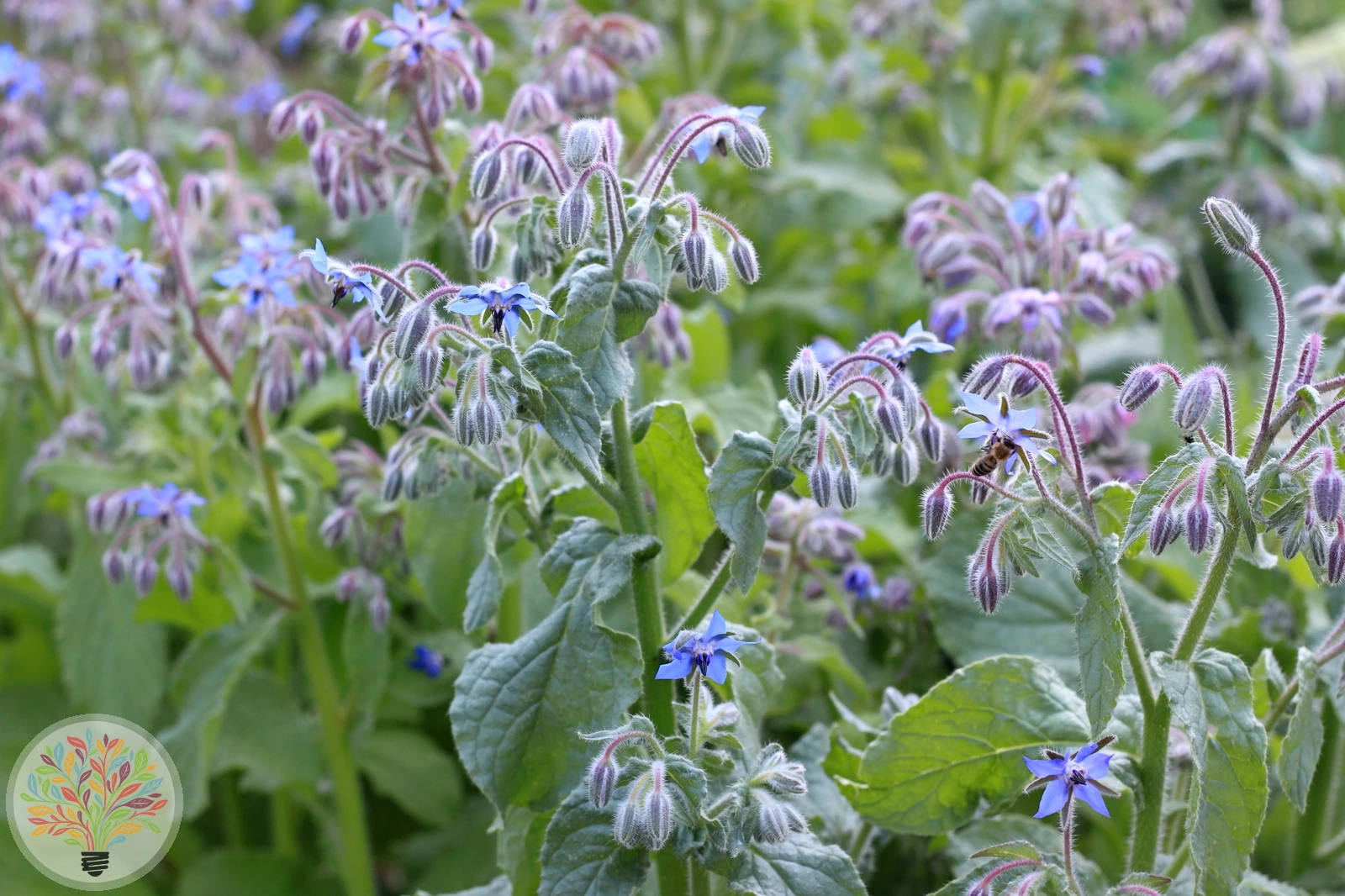
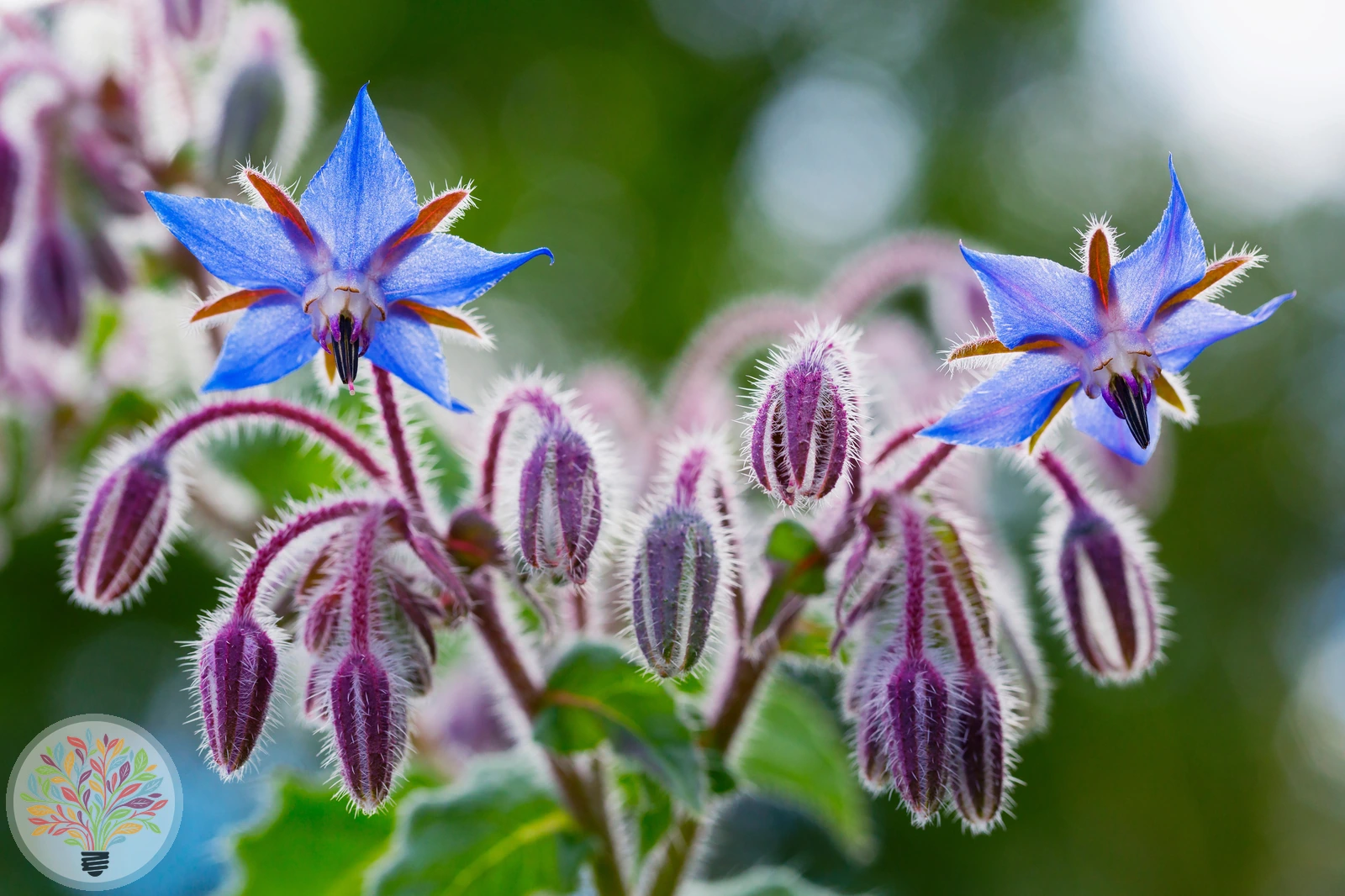
Borago officinalis
Borago officinalis
FamilyGenus: Borretschheimisch in Deutschland
🌿
84
Species
interact
🔗
159
Interactions
documented
🐛
4
Host relationships
Species
About this species
An introduced, established herbaceous plant flowering from March to August, providing rich nectar and pollen for insects.
Ecological network
Click to highlight connections · Click again to open species page
Netzwerk wird geladen...
PollinationLarval hostFlower visit
Ecological significance
The plant provides valuable nectar and pollen resources for pollinating insects during its long flowering season.
Annual cycle
Flowering occurs from March to August.
Safety note
No safety information is available.
Standort & Merkmale
Light
Sonne
Moisture
Frisch (Mäßig feucht)
Soil
—
Bloom time
Mär – Aug
Bioregion
Continental
Nectar value
5
Pollen value
5
Growth form
Krautige Pflanze
Woodiness
Nicht verholzt
Leaf type
Breitblättrig
Plant height
0.324 m
Morphological traits: TRY ID3 (CC BY 3.0) & TRY ID81 (CC BY)
Nectar
3.4987 µl/Blüte
Pflege & Anbau
Prefers full sun and a fresh, moderately moist, calcareous to alkaline soil. Tolerates low disturbance and benefits from medium fertility. Suitable for wildlife-friendly gardens.
Scientific profile
Borago officinalis is an introduced and established herbaceous plant in Great Britain. It is non-woody, with broad leaves, reaching about 0.32 metres in height. It thrives in sunny locations with fresh, moderately moist, calcareous to alkaline soils and a medium nutrient supply. It shows low tolerance for disturbance. Flowers appear from March to August and are noted for high nectar and pollen values, supporting a variety of insect visitors. It originates from parts of Europe and Africa.
Bestäuber & Besucher
66 Arten interagieren mit dieser Pflanze
Pieris rapaeBombus sylvestrisChelostoma florisomneBombus campestrisHalictus rubicundusBombus humilisLasioglossum calceatumAglais urticaeBombus pratorumBombus hypnorumBombus jonellusVespula vulgarisBombus pascuorumOsmia cornutaThymelicus sylvestrisBombus lapidariusMegachile centuncularisIssoria lathoniaPolyommatus icarusColletes daviesanusBombus lucorumVanessa atalantaXylocopa violaceaAnthophora quadrimaculataBombus soroeensisPolistes dominulaCelastrina argiolusApis melliferaAnthophora crinipesCarcharodus alceaeMegachile willughbiellaCheiracanthium punctoriumMangora acalyphaCoenonympha pamphilusAnthophora plumipesEucera nigrescensPhilaeus chrysopsCeratina cucurbitinaOedemera nobilisPapilio machaonBombus terrestrisAndrena flavipesXylocopa virginicaApis.melliferaEucera oraniensisEpistrophe eligansEpisyrphus balteatusAutographa gammaSphaerophoria scriptaMelanostoma mellinum
Host relationships
4 species use this plant as a host
Other flower visitors
14 other species visit the flowers
Synema globosumCoccinella septempunctataOedemera flavipesMisumena vatiaTropinota hirtaOxythyrea funestaPsilothrix aureolaAgapostemon virescensAmegilla chlorocyaneaAmegilla cingulataAugochlora puraHabropoda tristissimaMelissodes bimaculatusPseudaugochlora graminea
Sources & data origin
•TraitCH — CC BY 4.0TraitCH 2.0 contributors; imported as source-preserving NaturKompass taxon evidence.
•Interaktionsdaten via GloBI (CC-BY 4.0)
•Cook et al. (2025) UK Butterfly & Moth Traits (DOI: 10.5285/dbc7cc17-cbbd-49dd-bab4-8e8855768d66)
•pollinator_interactions
•Baden-Böhm F, App M, Thiele J (2022) — The FloRes Database: A floral resources trait database for pollinator habitat-assessment generated by a multistep workflow. Johann Heinrich von Thünen-Institut, Dryad, DOI: 10.5061/dryad.djh9w0w29 (CC0)
•EIVE 1.0 — Dengler et al. (2023), DOI: 10.3897/VCS.98324 (CC BY 4.0)
•EuPPollNet — Kuppler et al. (2025), DOI: 10.1111/geb.70000 (CC BY 4.0)
•Database of Pollinator Interactions (DoPI) — Pocock et al. (2022), DOI: 10.1002/ecy.3801 (CC BY)
•GBIF Backbone Taxonomy — GBIF Secretariat (2024), DOI: 10.15468/39omei (CC BY 4.0)
•TRY Categorical Traits (ID3) — Kattge et al. (2012), DOI: 10.17871/TRY.3 (CC BY 3.0)
•TRY Global Spectrum (ID81) — Díaz et al. (2016/2021), DOI: 10.17871/TRY.81 (CC BY)
•Checklist Alien Plants Belgium — Verloove F (2023), Botanic Garden Meise (CC BY 4.0)
•Govaerts R et al. (2025) — World Checklist of Vascular Plants (WCVP) v14. Royal Botanic Gardens, Kew. DOI: 10.34885/xs7h-ze42 (CC BY 4.0)
•Foto: © Adobe Stock / AdobeStock_749826994
All data is licensed under CC BY 4.0, CC0, or compatible. Attribution according to license terms. Full source overview →