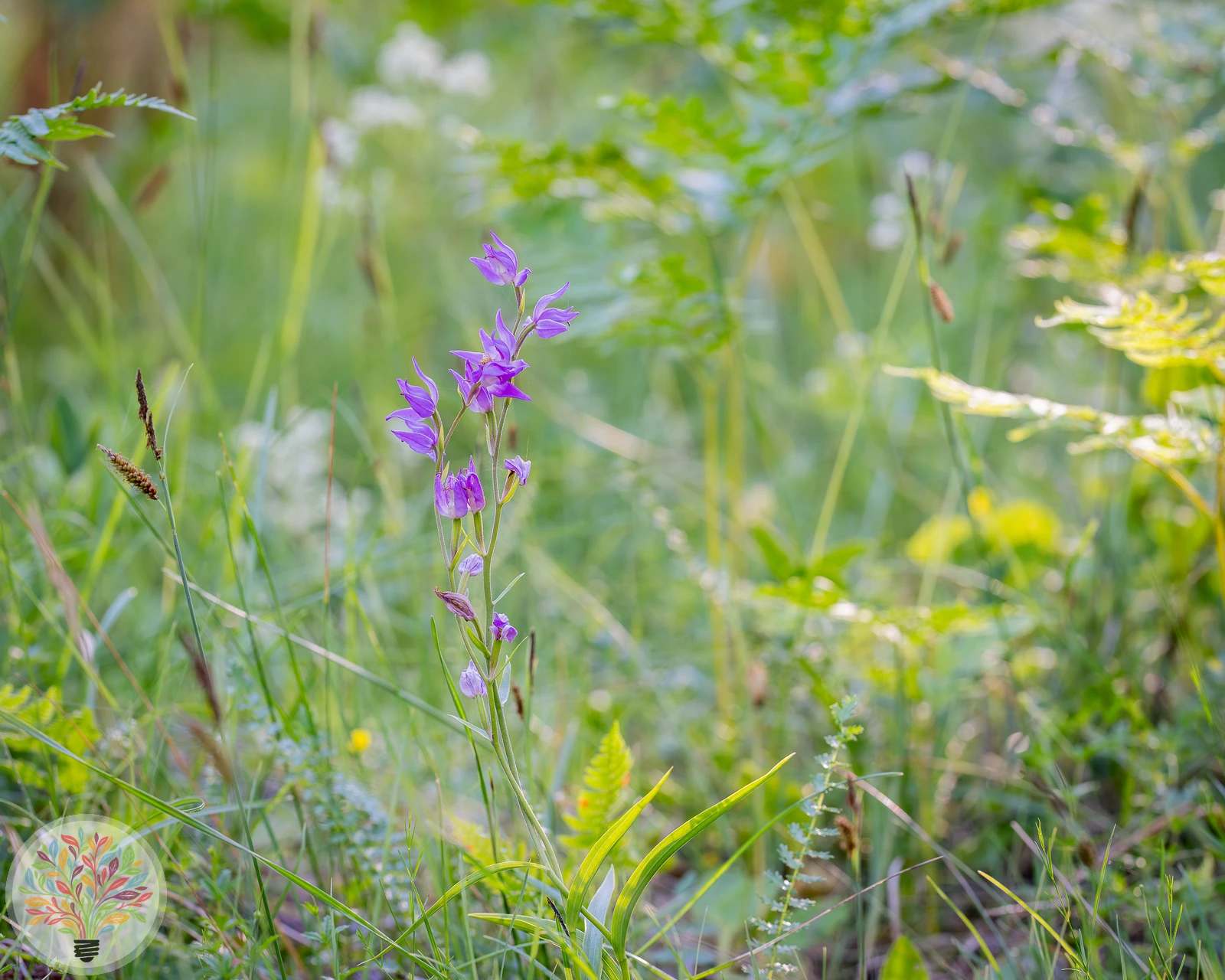
Cephalanthera rubra
Cephalanthera rubra
FamilyGenus: Cephalantheraheimisch in Deutschland
About this species
Cephalanthera rubra is a terrestrial orchid native in Great Britain, found in shaded woodlands on calcareous, moderately moist soils. It produces its flowers from June to July and is currently listed as Vulnerable.
Ecological significance
As a native orchid, it engages in mycorrhizal networks and supports the biodiversity of undisturbed, calcareous woodlands. Its presence points to a habitat with low disturbance and stable soil conditions.
Annual cycle
Foliage appears in spring, with the main flowering period spanning June and July. Seed development follows, and the small, dust-like seeds (diaspore mass about 0.05 mg) are dispersed later in the season.
Safety note
No specific hazards are documented for this species.
Standort & Merkmale
Light
Schatten
Moisture
Frisch (Mäßig feucht)
Soil
Mittelzehrer (Normaler Boden)
Bloom time
Jun – Jul
Soil reaction
Basisch / Kalkhold
Bioregion
Continental
Growth form
Krautige Pflanze
Woodiness
Nicht verholzt
Leaf type
Breitblättrig
Plant height
0.337 m
Morphological traits: TRY ID3 (CC BY 3.0) & TRY ID81 (CC BY)
Pflege & Anbau
Provide deep or partial shade and a moist but well-drained, moderately fertile, strongly alkaline soil. Cultivation is challenging because the plant depends on a specific orchid mycorrhizal fungus; it is best appreciated in its natural woodland setting.
Scientific profile
Cephalanthera rubra is a herbaceous perennial orchid with broad leaves and a non-woody structure. Native in Great Britain, it reaches a height of approximately 0.34 metres and is adapted to a terrestrial life habit. The species favours shaded conditions on fresh, moderately moist soils that are calcareous and of moderate nutrient status. Flowering takes place in June and July. It forms orchid mycorrhizal associations (type OM) essential for nutrient uptake. Based on current assessments, it is listed as Vulnerable (V).
Sources & data origin
•TraitCH — CC BY 4.0TraitCH 2.0 contributors; imported as source-preserving NaturKompass taxon evidence.
•FloraWeb / BfN
•EIVE 1.0 — Dengler et al. (2023), DOI: 10.3897/VCS.98324 (CC BY 4.0)
•GBIF Backbone Taxonomy — GBIF Secretariat (2024), DOI: 10.15468/39omei (CC BY 4.0)
•TRY Categorical Traits (ID3) — Kattge et al. (2012), DOI: 10.17871/TRY.3 (CC BY 3.0)
•TRY Global Spectrum (ID81) — Díaz et al. (2016/2021), DOI: 10.17871/TRY.81 (CC BY)
•Govaerts R et al. (2025) — World Checklist of Vascular Plants (WCVP) v14. Royal Botanic Gardens, Kew. DOI: 10.34885/xs7h-ze42 (CC BY 4.0)
•Foto: © © Kaja Hiis-Rinne / Adobe Stock / AdobeStock_862609513
All data is licensed under CC BY 4.0, CC0, or compatible. Attribution according to license terms. Full source overview →