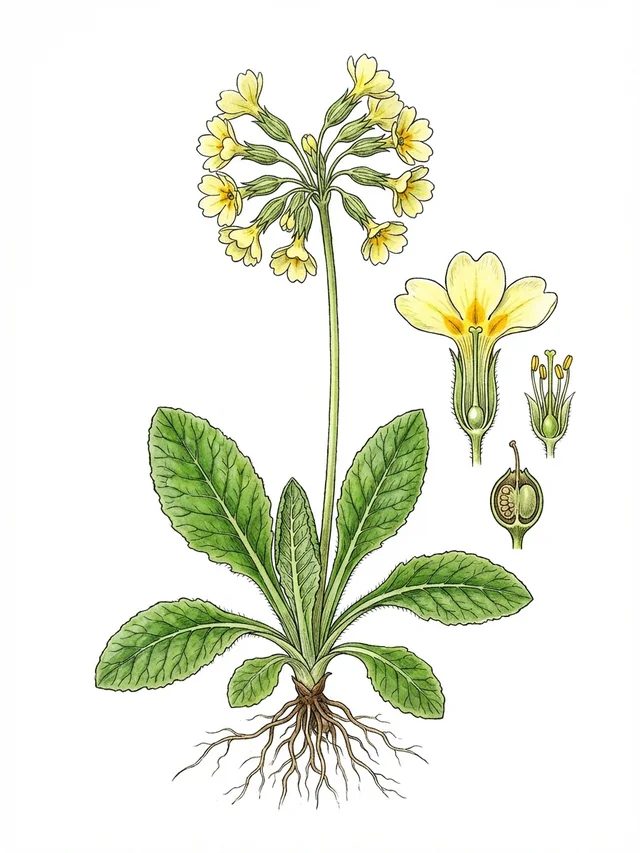
 Bild folgtKI-generierte Illustration
Crepis paludosa
Crepis paludosa
FamilyGenus: Crepisheimisch in Deutschland
🌿
31
Species
interact
🔗
51
Interactions
documented
About this species
A native broad-leaved herbaceous plant producing yellow composite flower heads from June to September, found in moist, semi-shaded places with neutral to slightly acid soil.
Ecological network
Click to highlight connections · Click again to open species page
Netzwerk wird geladen...
PollinationFlower visit
Ecological significance
As a native wild plant of damp, semi-shaded habitats, Crepis paludosa is part of the natural flora and contributes to the structure of local plant communities.
Annual cycle
Flowering takes place from June to September. As a non-woody herbaceous plant, its above-ground growth dies back in autumn and re-grows the following spring.
Safety note
No safety information is available.
Standort & Merkmale
Light
Halbschatten
Moisture
Frisch (Mäßig feucht)
Soil
Mittelzehrer (Normaler Boden)
Bloom time
Jun – Sep
Soil reaction
Basisch / Kalkhold
Bioregion
Continental
Growth form
Krautige Pflanze
Woodiness
Nicht verholzt
Leaf type
Breitblättrig
Plant height
0.555 m
Morphological traits: TRY ID3 (CC BY 3.0) & TRY ID81 (CC BY)
Pflege & Anbau
•
Site and soil: Place in semi-shade; use a moist, moderately fertile, normal garden soil that does not dry out.
•
Watering: Keep the soil evenly moist, particularly during the flowering period and warm spells.
•
Maintenance: No special pruning is required. Tidy old growth after flowering if desired.
Scientific profile
Crepis paludosa is native in Great Britain. It is a broad-leaved, non-woody herbaceous plant reaching approximately 0.55 metres in height, with leaves exhibiting a leaf area of about 2260 mm². Blooming occurs between June and September. Ellenberg-type indicator values characterise it as a species of moist sites (moisture value 8) on neutral to weakly acid soils (reaction value 6), with a light requirement indicating full sun (light value 7), though in cultivation it is considered to prefer semi-shade. It occurs in habitats with low disturbance severity (0.57) and moderately warm temperatures (temperature value 4). The minute seeds have a diaspore mass around 0.58 mg.
Bestäuber & Besucher
20 Arten interagieren mit dieser Pflanze
Bombus pratorumMelitaea athaliaMelitaea diaminaAphantopus hyperantusSyritta pipiensHalictus sexcintusSphaerophoria scriptaMerodon funestusHalictus rubicundusSyrphus ribesiiSyrphus vitripennisEpisyrphus balteatusCheilosia canicularisCheilosia bergenstammiPlatycheirus manicatusEristalis nemorumLejogaster metallinaEristalis tenaxPlatycheirus clypeatusApis mellifera
Other flower visitors
11 other species visit the flowers
Formica fuscaBrassicogethes aeneusCheilosia himantopaPhaonia angelicaeRhamphomyia longipesSiphona geniculataPollenia rudisThricops semicinereusPhaonia servaMeligethes viridescensPhaonia incana
Sources & data origin
•TraitCH — CC BY 4.0TraitCH 2.0 contributors; imported as source-preserving NaturKompass taxon evidence.
•Interaktionsdaten via GloBI (CC-BY 4.0)
•pollinator_interactions
•FloraWeb / BfN
•EIVE 1.0 — Dengler et al. (2023), DOI: 10.3897/VCS.98324 (CC BY 4.0)
•GBIF Backbone Taxonomy — GBIF Secretariat (2024), DOI: 10.15468/39omei (CC BY 4.0)
•TRY Categorical Traits (ID3) — Kattge et al. (2012), DOI: 10.17871/TRY.3 (CC BY 3.0)
•TRY Global Spectrum (ID81) — Díaz et al. (2016/2021), DOI: 10.17871/TRY.81 (CC BY)
•Govaerts R et al. (2025) — World Checklist of Vascular Plants (WCVP) v14. Royal Botanic Gardens, Kew. DOI: 10.34885/xs7h-ze42 (CC BY 4.0)
All data is licensed under CC BY 4.0, CC0, or compatible. Attribution according to license terms. Full source overview →