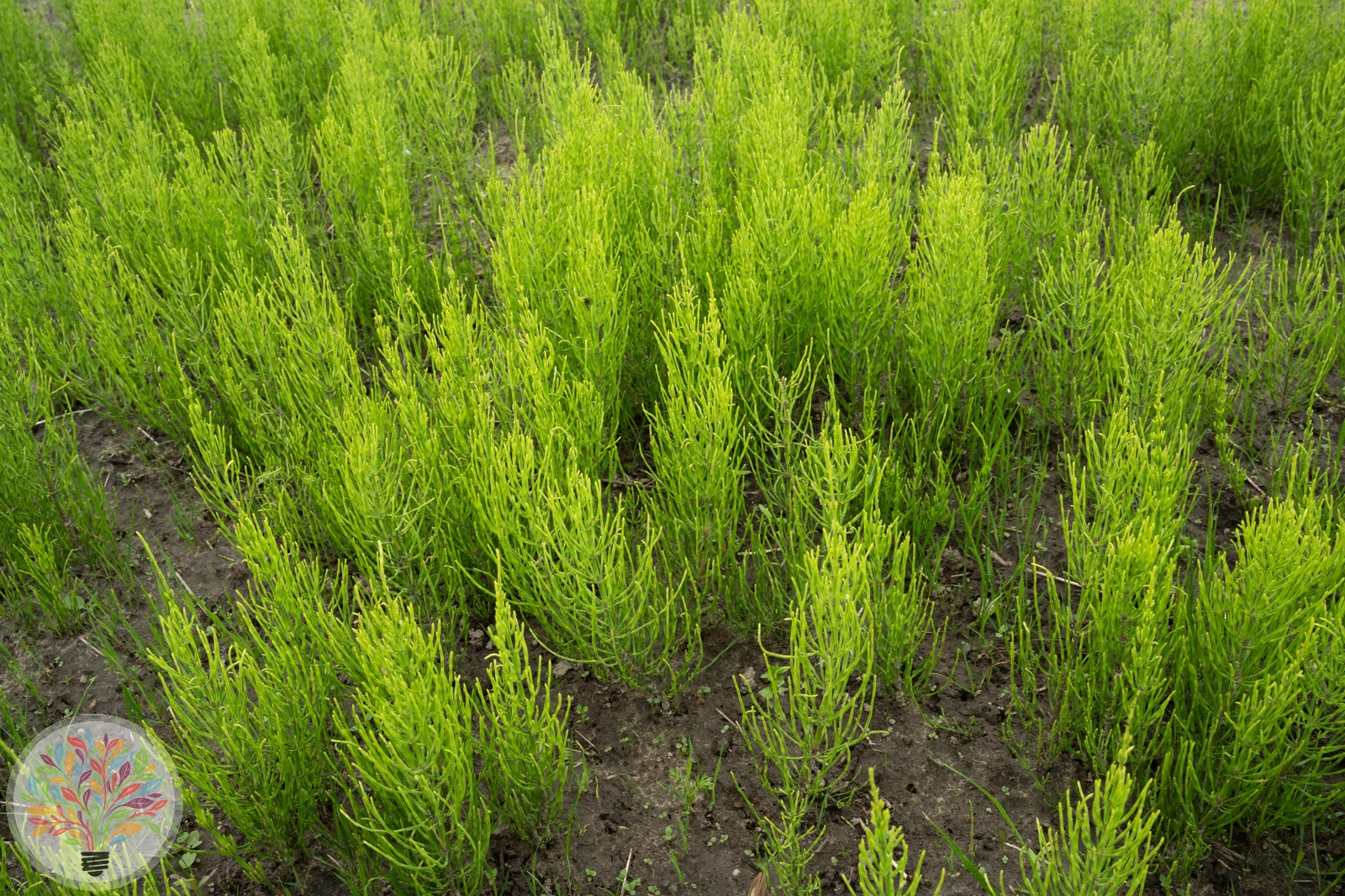
Equisetum arvense
Equisetum arvense
FamilyGenus: Equisetumheimisch in Deutschland
About this species
A native, non-woody fern ally common across Great Britain, producing photosynthetic stems up to about 35 cm tall. It favours moderately moist, neutral to slightly acidic soils in sunny positions and flowers (produces spores) in early spring, from March to April.
Ecological significance
As a native component of fresh, low-nutrient meadows and woodland edges, field horsetail offers year-round cover through its evergreen stems and contributes to the structural diversity of these habitats. It has a low tolerance for disturbance and maintains arbuscular mycorrhizal relationships, which can support soil health.
Annual cycle
Spore production takes place in early spring, from March to April, when the fertile, cone-bearing shoots emerge. The sterile, green stems persist throughout the year, maintaining an evergreen appearance and reaching approximately 0.35 m in height.
Standort & Merkmale
Light
Halbschatten
Moisture
Frisch (Mäßig feucht)
Soil
Mittelzehrer (Normaler Boden)
Bloom time
Mär – Apr
Soil reaction
Mäßig sauer bis neutral
Bioregion
Continental
Growth form
Farn
Woodiness
Nicht verholzt
Leaf type
Photosynthetischer Spross
Leaf phenology
Immergrün
Plant height
0.349 m
Morphological traits: TRY ID3 (CC BY 3.0) & TRY ID81 (CC BY)
Pflege & Anbau
Position in half-shade with a reliably moist but well-drained soil of moderate fertility. It naturally inhabits fresh meadows and woodland margins, so avoid arid or heavily disturbed sites. Once established, the plant requires minimal intervention.
Scientific profile
Equisetum arvense is a non-woody, terrestrial fern ally belonging to the Equisetaceae family. Its upright, photosynthetic stems typically reach around 0.35 m in height and bear minute leaves, with an average leaf area of approximately 113 mm². The plant is native in Great Britain, where it grows in fresh, moderately moist meadows of low fertility and along woodland edges. It tolerates only minor disturbance and shows a preference for sunny conditions. Soil requirements are neutral to slightly acidic, with a moderate nutrient supply. Spore-bearing shoots appear in early spring, from March to April, while the sterile stems persist year-round, giving the plant an evergreen character. It forms arbuscular mycorrhizal associations in the soil.
Sources & data origin
•TRY v6.0 / BiolFlor flowering phenology (Request 47350) — CC BY 4.0TRY request 47350 (Public, Data Released, TRY v6.0; 2026-02-15). Cite TRY: Kattge et al. (2020), doi:10.1111/gcb.14904; original source: Trefflich, A., Klotz, S. & Kühn, I. (2002). Blühphänologie. BIOLFLOR, Schriftenreihe für Vegetationskunde 38:127–131.
•FloraWeb / BfN
•EIVE 1.0 — Dengler et al. (2023), DOI: 10.3897/VCS.98324 (CC BY 4.0)
•GBIF Backbone Taxonomy — GBIF Secretariat (2024), DOI: 10.15468/39omei (CC BY 4.0)
•TRY Categorical Traits (ID3) — Kattge et al. (2012), DOI: 10.17871/TRY.3 (CC BY 3.0)
•TRY Global Spectrum (ID81) — Díaz et al. (2016/2021), DOI: 10.17871/TRY.81 (CC BY)
•Govaerts R et al. (2025) — World Checklist of Vascular Plants (WCVP) v14. Royal Botanic Gardens, Kew. DOI: 10.34885/xs7h-ze42 (CC BY 4.0)
•Foto: © Adobe Stock / AdobeStock_528124100
All data is licensed under CC BY 4.0, CC0, or compatible. Attribution according to license terms. Full source overview →