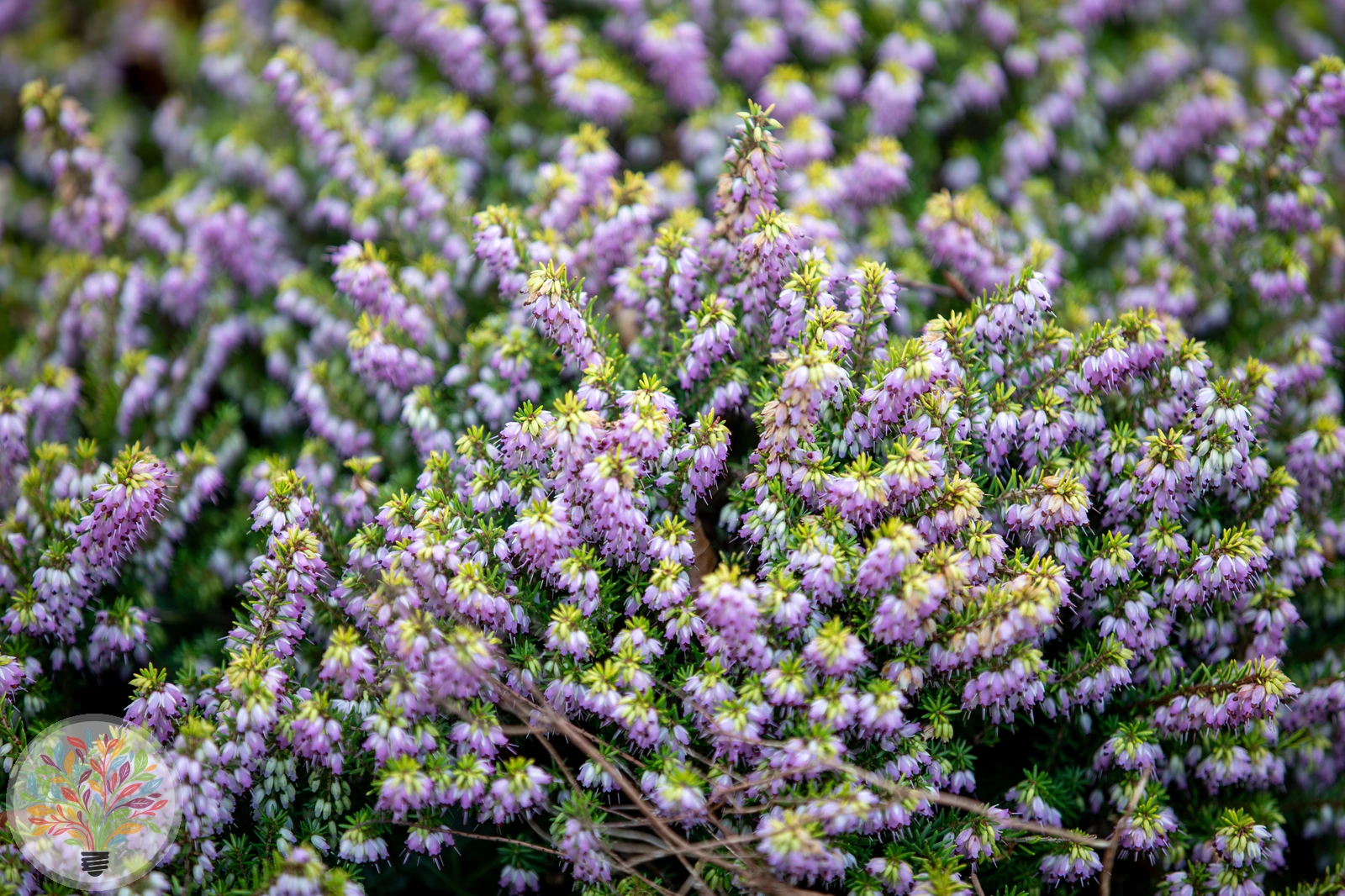
Erica carnea
Erica carnea
FamilyGenus: Ericaheimisch in Deutschland
🌿
20
Species
interact
🔗
602
Interactions
documented
About this species
An introduced, established evergreen perennial, Erica carnea brightens the late winter and early spring garden with a long-lasting display of nectar-rich flowers. Thriving in full sun and poor, well-drained soils, it is a valuable early-season resource for pollinators.
Ecological network
Click to highlight connections · Click again to open species page
Netzwerk wird geladen...
PollinationFlower visit
Ecological significance
The early blooms supply a vital nectar and pollen source for bees and other insects when few alternatives are available. The ecological consequences of its introduction in Britain have not been comprehensively evaluated.
Annual cycle
Evergreen foliage persists year-round. Flowering occurs from January to April.
Safety note
No specific toxicity or safety data are available for this species.
Standort & Merkmale
Light
Sonne
Moisture
Trocken
Soil
Schwachzehrer (Magerer Boden)
Bloom time
Jan – Apr
Soil reaction
Basisch / Kalkhold
Bioregion
Continental
Nectar value
5
Pollen value
5
Growth form
Krautige Pflanze
Woodiness
Nicht verholzt
Leaf type
Breitblättrig
Leaf phenology
Immergrün
Morphological traits: TRY ID3 (CC BY 3.0) & TRY ID81 (CC BY)
Corolla tube
4.5 mm
Pflege & Anbau
•
Light: full sun
•
Soil: poor, free-draining, neutral to slightly acid; avoid fertile or waterlogged ground
•
Moisture: tolerates dry conditions once established
Scientific profile
Erica carnea is an introduced, naturalised evergreen herbaceous perennial of the heather family (Ericaceae). Its low, spreading habit carries small, leathery leaves that remain green throughout the year. Blooming from January into April, the plant produces masses of bell-shaped blossoms that offer high levels of nectar and pollen to early-flying insects. It grows best in full sunshine and favours dry to moderately fresh, nutrient-poor ground with a neutral to slightly acid reaction. The species tolerates light disturbance and is often found in stable, open sites such as heathland margins, rocky slopes and dry banks. In Great Britain it is an established introduction that has spread beyond cultivation into suitable semi-natural habitats.
Bestäuber & Besucher
19 Arten interagieren mit dieser Pflanze
Bombus lapidariusBombus jonellusBombus sylvestrisApis melliferaBombus terrestrisPieris napiBombus pascuorumBombus monticolaCallophrys rubiBombus wurfleniiBombus lucorumBombus pratorumOsmia bicornisBombus ssCheilosia impressaBombus soroeensisBombus hypnorumBombus lucorum-KomplexBombus cryptarum
Other flower visitors
1 other species visit the flowers
Psithyrus
Sources & data origin
•TraitCH — CC BY 4.0TraitCH 2.0 contributors; imported as source-preserving NaturKompass taxon evidence.
•Interaktionsdaten via GloBI (CC-BY 4.0)
•pollinator_interactions
•Baden-Böhm F, App M, Thiele J (2022) — The FloRes Database: A floral resources trait database for pollinator habitat-assessment generated by a multistep workflow. Johann Heinrich von Thünen-Institut, Dryad, DOI: 10.5061/dryad.djh9w0w29 (CC0)
•FloraWeb / BfN
•EIVE 1.0 — Dengler et al. (2023), DOI: 10.3897/VCS.98324 (CC BY 4.0)
•EuPPollNet — Kuppler et al. (2025), DOI: 10.1111/geb.70000 (CC BY 4.0)
•Database of Pollinator Interactions (DoPI) — Pocock et al. (2022), DOI: 10.1002/ecy.3801 (CC BY)
•GBIF Backbone Taxonomy — GBIF Secretariat (2024), DOI: 10.15468/39omei (CC BY 4.0)
•TRY Categorical Traits (ID3) — Kattge et al. (2012), DOI: 10.17871/TRY.3 (CC BY 3.0)
•TRY Global Spectrum (ID81) — Díaz et al. (2016/2021), DOI: 10.17871/TRY.81 (CC BY)
•Checklist Alien Plants Belgium — Verloove F (2023), Botanic Garden Meise (CC BY 4.0)
•Govaerts R et al. (2025) — World Checklist of Vascular Plants (WCVP) v14. Royal Botanic Gardens, Kew. DOI: 10.34885/xs7h-ze42 (CC BY 4.0)
•Foto: © Adobe Stock / AdobeStock_1873084227
All data is licensed under CC BY 4.0, CC0, or compatible. Attribution according to license terms. Full source overview →