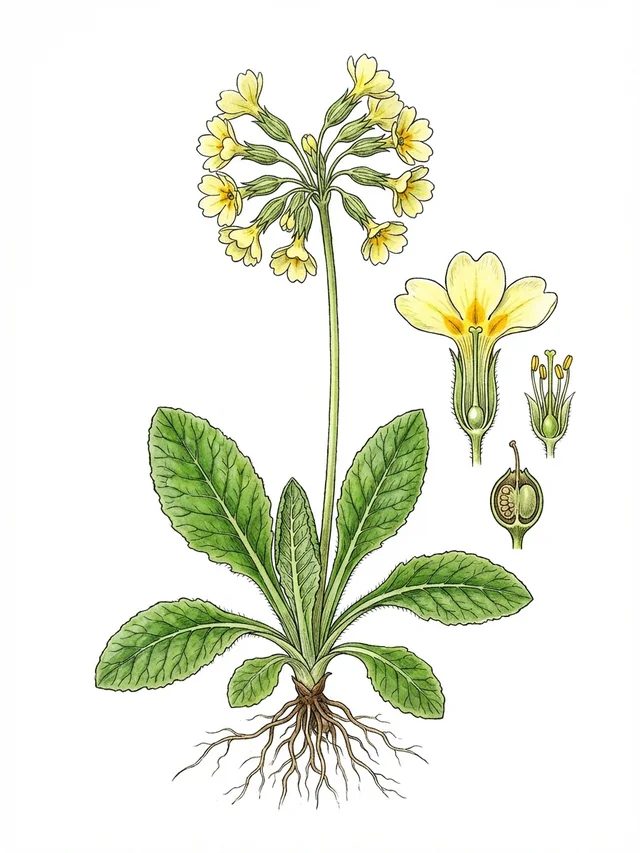
 Bild folgtKI-generierte Illustration
Fagopyrum esculentum
Fagopyrum esculentum
FamilyGenus: Fagopyrumnicht heimisch in Deutschland
🌿
30
Species
interact
🔗
33
Interactions
documented
🐛
1
Host relationships
Species
About this species
An introduced herbaceous plant, Fagopyrum esculentum is established in Great Britain. It bears broad leaves and flowers from July to October, offering pollen and nectar to insects.
Ecological network
Click to highlight connections · Click again to open species page
Netzwerk wird geladen...
PollinationLarval host
Ecological significance
In Great Britain, where Fagopyrum esculentum has become established, its flowers provide pollen and nectar for visiting insects during the summer and autumn flowering period.
Annual cycle
Flowering takes place from July to October.
Safety note
No specific safety information is recorded for this species.
Standort & Merkmale
Light
—
Moisture
—
Soil
—
Bloom time
Jul – Okt
Nectar value
3
Pollen value
3
Growth form
Krautige Pflanze
Woodiness
Nicht verholzt
Leaf type
Breitblättrig
Plant height
0.376 m
Morphological traits: TRY ID3 (CC BY 3.0) & TRY ID81 (CC BY)
Nectar
0.1249 µl/Blüte
Pollen
0.0948 mg/Blüte
Pflege & Anbau
This species is not widely cultivated as an ornamental in Great Britain, and no specific horticultural care notes are available.
Scientific profile
Fagopyrum esculentum is a member of the knotweed family (Polygonaceae). It is a non-woody, terrestrial, broad-leaved herbaceous plant that grows to about 0.38 metres in height. It originates from temperate Asia, Siberia, China, Mongolia and Eastern Asia. In Great Britain it is an introduced species that has become established. The flowering period runs from July to October, and the flowers produce pollen and nectar. The diaspores weigh approximately 26.9 milligrams.
Bestäuber & Besucher
29 Arten interagieren mit dieser Pflanze
Apis melliferaSphaerophoria scriptaHalictus rubicundusBombus lucorumLasioglossum malachurumBombus terrestrisEristalis tenaxMelanostoma mellinumVespula vulgarisBombus lapidariusApis ceranaBombus affinisBombus impatiensBombus ternariusBombus terricolaBombus vagansHalictus aerariusHylaeus floralisHylaeus nipponLasioglossum fuscipenneLasioglossum (austrevylaeus) maungaLasioglossum sibiriacumMegachile tsurugensisXylocopa appendiculataBombus pascuorumEpistrophe eligansEristalis pertinaxEpisyrphus balteatusLasioglossum calceatum
Host relationships
1 species use this plant as a host
Hyles livornica
Sources & data origin
•TraitCH — CC BY 4.0TraitCH 2.0 contributors; imported as source-preserving NaturKompass taxon evidence.
•Cook et al. (2025) UK Butterfly & Moth Traits (DOI: 10.5285/dbc7cc17-cbbd-49dd-bab4-8e8855768d66)
•pollinator_interactions
•Baden-Böhm F, App M, Thiele J (2022) — The FloRes Database: A floral resources trait database for pollinator habitat-assessment generated by a multistep workflow. Johann Heinrich von Thünen-Institut, Dryad, DOI: 10.5061/dryad.djh9w0w29 (CC0)
•EuPPollNet — Kuppler et al. (2025), DOI: 10.1111/geb.70000 (CC BY 4.0)
•Database of Pollinator Interactions (DoPI) — Pocock et al. (2022), DOI: 10.1002/ecy.3801 (CC BY)
•GBIF Backbone Taxonomy — GBIF Secretariat (2024), DOI: 10.15468/39omei (CC BY 4.0)
•TRY Categorical Traits (ID3) — Kattge et al. (2012), DOI: 10.17871/TRY.3 (CC BY 3.0)
•TRY Global Spectrum (ID81) — Díaz et al. (2016/2021), DOI: 10.17871/TRY.81 (CC BY)
•Checklist Alien Plants Belgium — Verloove F (2023), Botanic Garden Meise (CC BY 4.0)
•Govaerts R et al. (2025) — World Checklist of Vascular Plants (WCVP) v14. Royal Botanic Gardens, Kew. DOI: 10.34885/xs7h-ze42 (CC BY 4.0)
All data is licensed under CC BY 4.0, CC0, or compatible. Attribution according to license terms. Full source overview →