Bellis perennis
Bellis perennis
FamilyGenus: Gänseblümchenheimisch in Deutschland
🌿
292
Species
interact
🔗
1270
Interactions
documented
About this species
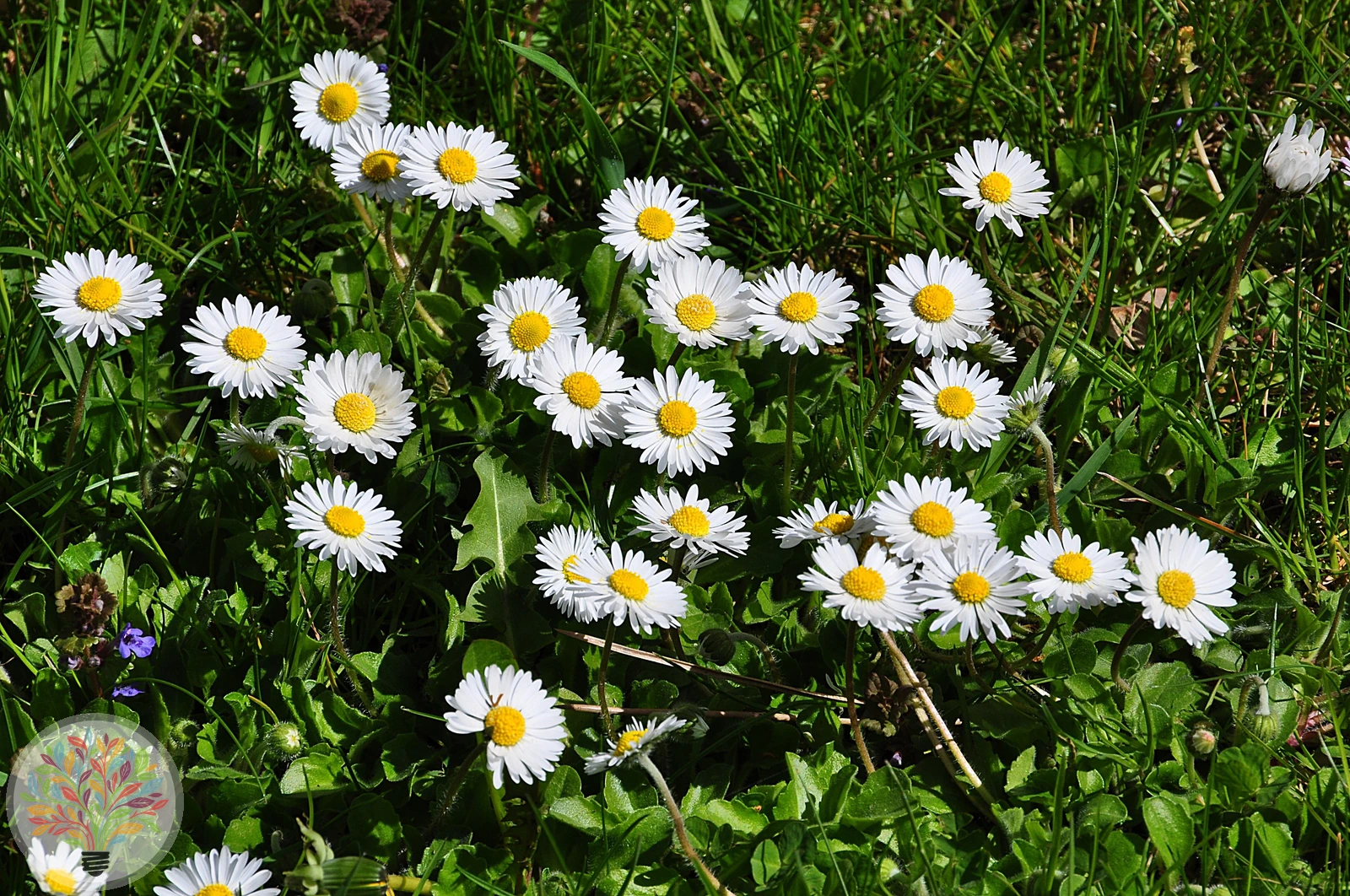
A low-growing, broad-leaved herbaceous plant native in Great Britain. Its daisy-like flowers appear from January to November, providing a long season of nectar and pollen for insects. It thrives in sunny, undisturbed sites with neutral to weakly acid soil and is harmless to children.
Ecological network
Click to highlight connections · Click again to open species page
Netzwerk wird geladen...
PollinationFlower visit
Ecological significance
As a native wildflower, Bellis perennis provides a season-long resource for pollinators. Its high pollen and nectar scores support a wide range of insects, from early spring through to late autumn. The plant’s low disturbance tolerance means it is most valuable in stable, unploughed ground.
Annual cycle
Flowers can appear as early as January and continue until November, with a peak usually in late spring and early summer. The foliage remains green for much of the year, resting only during the hardest parts of winter.
Safety note
The plant is considered safe for children, with no known toxicity or physical hazards.
Standort & Merkmale
Light
Sonne
Moisture
—
Soil
—
Bloom time
Jan – Nov
Bioregion
Continental
Nectar value
5
Pollen value
5
Growth form
Krautige Pflanze
Woodiness
Nicht verholzt
Leaf type
Breitblättrig
Plant height
0.053 m
Morphological traits: TRY ID3 (CC BY 3.0) & TRY ID81 (CC BY)
Pollen
0.1668 mg/Blüte
Pflege & Anbau
Choose an open, sunny spot with neutral to slightly acid soil. Avoid saline soils. Once established, this plant needs very little intervention and is best left undisturbed. Its naturally low growth and long flowering period make it a useful addition to lawn or meadow schemes.
Scientific profile
Bellis perennis is a herbaceous, non-woody perennial that forms a rosette of broad leaves. Individual plants typically reach about 5 cm in height. The leaf area averages 358.55 mm². Flowers are produced from January through to November, offering pollen and nectar of high value to visiting insects (scoring 5 out of 5 for both rewards). The species has a strong preference for full sun, indicated by an Ellenberg-type light value of 8. It grows on soils of neutral to weakly acid reaction and shows no tolerance of salinity. Disturbance tolerance is low, reflecting an affinity for stable, less disturbed habitats. Root associations are of the arbuscular mycorrhizal (AM) type. The tiny wind-dispersed seeds (diaspores) weigh around 0.12 mg.
Bestäuber & Besucher
179 Arten interagieren mit dieser Pflanze
Pieris napiBombus pascuorumPolygonia c-albumPyronia tithonusPyrgus malvaeLasioglossum xanthopusLasiommata megeraNomada flavoguttataOsmia bicolorNomada fabricianaHamearis lucinaSphecodes crassusCallophrys rubiPieris brassicaeLasioglossum zonulumLasioglossum pauxillumNomada fucataPararge aegeriaLasioglossum villosulumLasioglossum fratellumAndrena haemorrhoaAndrena nigroaeneaAndrena chrysoscelesAndrena subopacaAndrena bicolorAndrena barbilabrisAndrena nitidaPolyommatus icarusManiola jurtinaAnthocharis cardaminesAndrena helvolaMelitaea athaliaAphantopus hyperantusPieris rapaeAndrena cinerariaNomada flavaAndrena labialisAglais urticaeCelastrina argiolusSphecodes monilicornisLasioglossum cupromicansLasioglossum leucopusHylaeus hyalinatusAndrena clarkellaAndrena labiataHalictus tumulorumAndrena flavipesCoenonympha pamphilusBombus lapidariusBombus hypnorum
Other flower visitors
113 other species visit the flowers
Myrmica rubraChloephaga pictaCoccinella septempunctataLasius nigerTytthaspis sedecimpunctataHarpalus griseusAmara ovataCantharis fuscaTrechus quadristriatusHarpalus distinguendusOphonus azureusAmara lunicollisAgriotes obscurusHemicrepidius nigerHemicrepidius hirtusHarpalus latusAmara familiarisAmara convexiorPoecilus cupreusStenurella bifasciataAnthrenus verbasciHarmonia axyridisOedemera femorataPseudovadonia lividaPyrausta aurataColumba liviaMisumena vatiaTropinota hirtaPyrausta despicataThomisus onustusCidnopus pilosusByrrhus pilulaAmara communisCassida rubiginosaOphonus ardosiacusAmara plebejaFringilla coelebsTurdus merulaHarpalus rufipesHarpalus affinisTachinidae sp. 3Anthomyiidae sp. 3Empis praeviaEmpis nuntiaMuscidae sp. 5Calliphoridae sp. 1Empis femorataSarcophagidae sp. 1Platystoma seminationisEmpis caudatula
Sources & data origin
•Interaktionsdaten via GloBI (CC-BY 4.0)
•Middleton-Welling_2020
•pollinator_interactions
•Baden-Böhm F, App M, Thiele J (2022) — The FloRes Database: A floral resources trait database for pollinator habitat-assessment generated by a multistep workflow. Johann Heinrich von Thünen-Institut, Dryad, DOI: 10.5061/dryad.djh9w0w29 (CC0)
•FloraWeb / BfN
•EIVE 1.0 — Dengler et al. (2023), DOI: 10.3897/VCS.98324 (CC BY 4.0)
•EuPPollNet — Kuppler et al. (2025), DOI: 10.1111/geb.70000 (CC BY 4.0)
•Database of Pollinator Interactions (DoPI) — Pocock et al. (2022), DOI: 10.1002/ecy.3801 (CC BY)
•GBIF Backbone Taxonomy — GBIF Secretariat (2024), DOI: 10.15468/39omei (CC BY 4.0)
•TRY Categorical Traits (ID3) — Kattge et al. (2012), DOI: 10.17871/TRY.3 (CC BY 3.0)
•TRY Global Spectrum (ID81) — Díaz et al. (2016/2021), DOI: 10.17871/TRY.81 (CC BY)
•Govaerts R et al. (2025) — World Checklist of Vascular Plants (WCVP) v14. Royal Botanic Gardens, Kew. DOI: 10.34885/xs7h-ze42 (CC BY 4.0)
•Foto: © Adobe Stock / AdobeStock_500213296
All data is licensed under CC BY 4.0, CC0, or compatible. Attribution according to license terms. Full source overview →