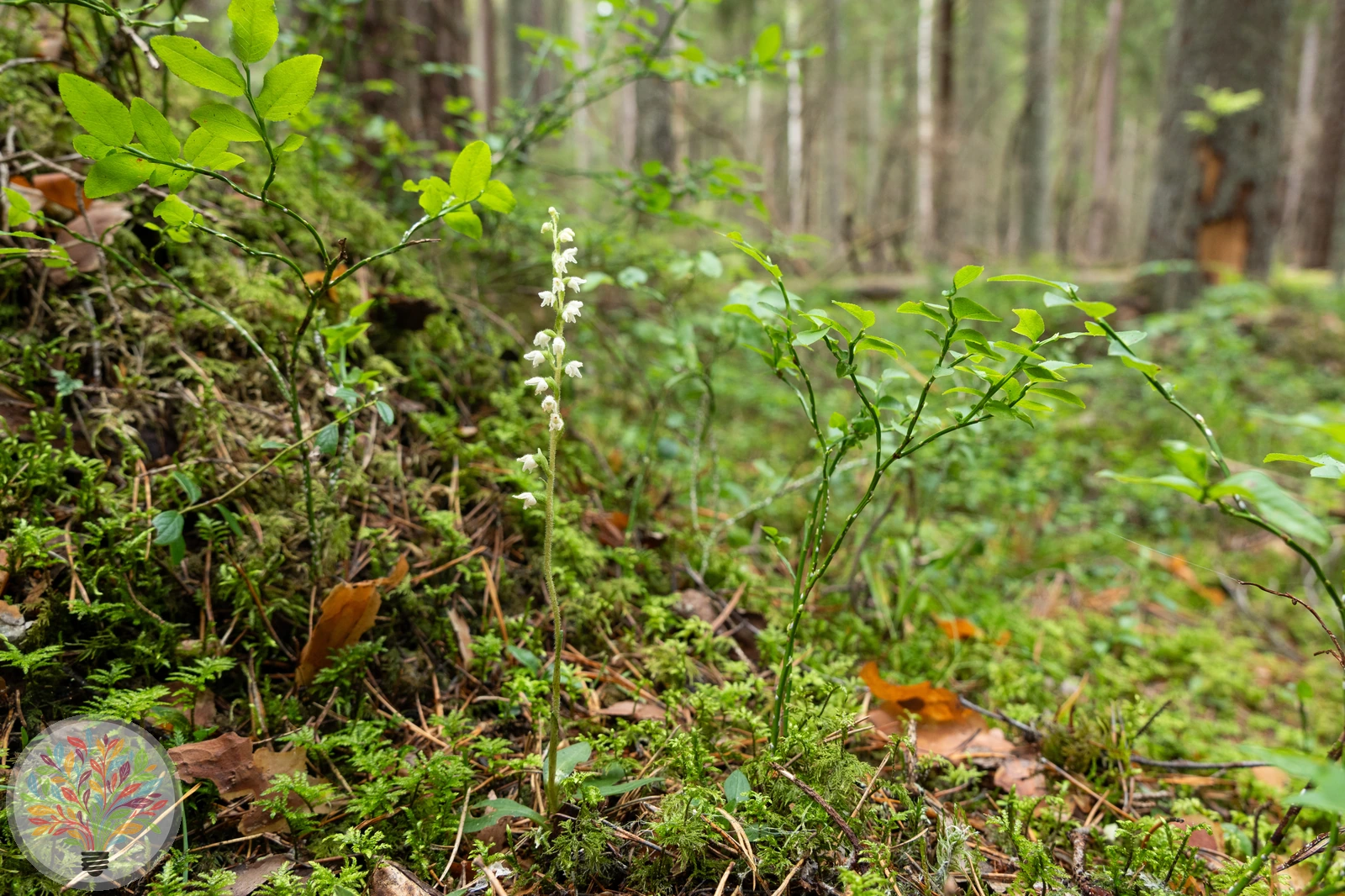
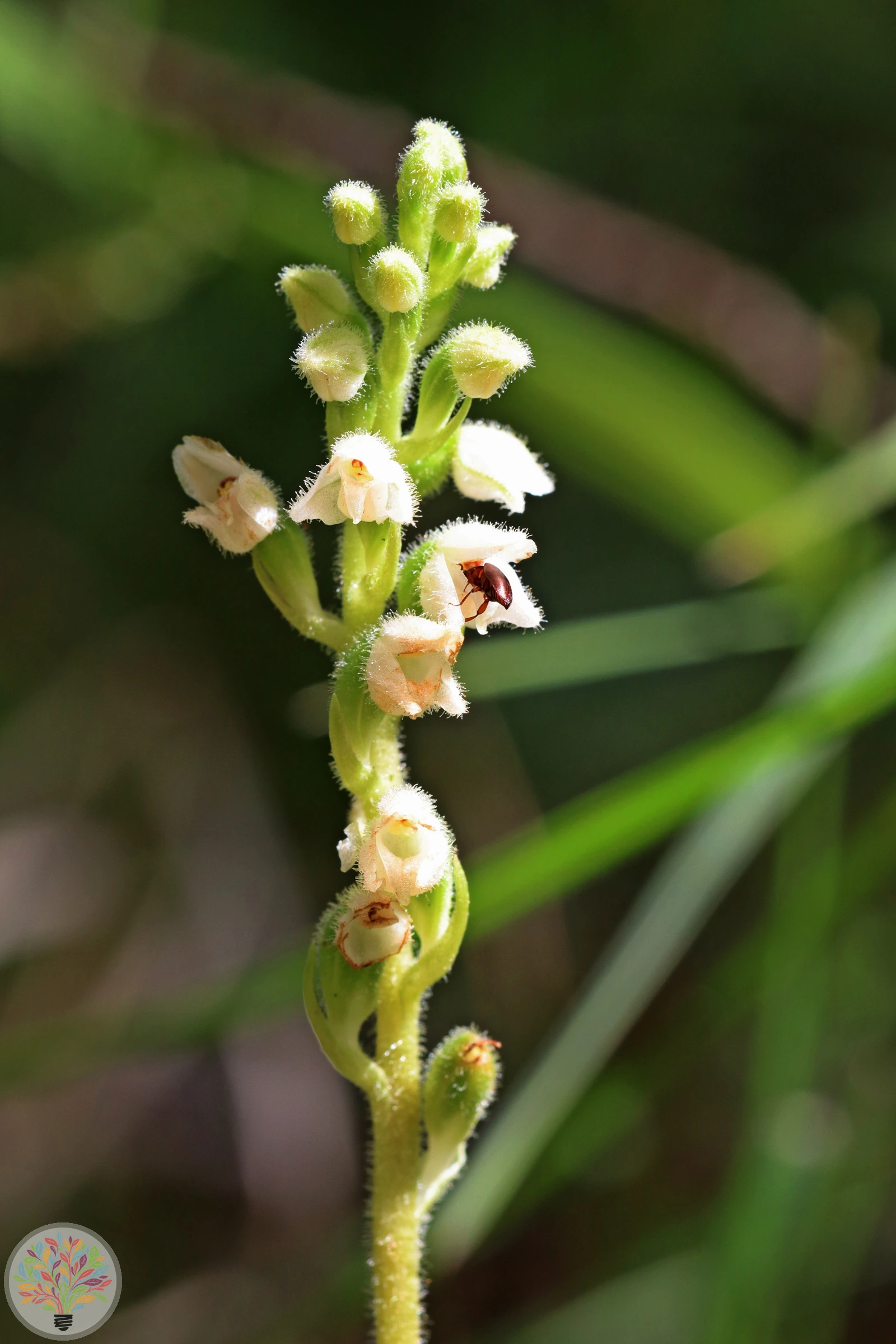
Goodyera repens
Goodyera repens
FamilyGenus: Netzblattheimisch in Deutschland
About this species
A native terrestrial orchid of shaded, coniferous woodland on acid to neutral, nutrient-poor soils. It is a deciduous perennial, producing a basal rosette of broad leaves and a slender spike of small, whitish flowers from July to August. It relies on a mycorrhizal association with arbuscular mycorrhizal fungi. In Great Britain it is a native wild plant.
Ecological significance
Goodyera repens is a native component of the ground flora in acidic coniferous woodlands. Its presence contributes to the structural diversity of the forest floor and provides microhabitats for soil-dwelling organisms. As an orchid, it forms part of the intricate fungal networks within these ecosystems.
Annual cycle
In spring, the plant produces a fresh rosette of broad leaves. Flowering takes place in July and August. By autumn, the above-ground parts die back, and the plant enters winter dormancy as an underground rhizome sustained by mycorrhizal fungi.
Standort & Merkmale
Light
Schatten
Moisture
Frisch (Mäßig feucht)
Soil
Schwachzehrer (Magerer Boden)
Bloom time
Jul – Aug
Soil reaction
Mäßig sauer bis neutral
Bioregion
Continental
Growth form
Krautige Pflanze
Woodiness
Nicht verholzt
Leaf type
Breitblättrig
Leaf phenology
Laubabwerfend
Plant height
0.155 m
Morphological traits: TRY ID3 (CC BY 3.0) & TRY ID81 (CC BY)
Pflege & Anbau
**Light:** Deep shade.
**Soil:** Moist, nutrient-poor, acidic to neutral soil with good drainage.
**Water:** Keep soil consistently moist but not waterlogged.
**Special notes:** This orchid relies on a mycorrhizal association with arbuscular mycorrhizal fungi; it is difficult to cultivate without the appropriate soil microbiota. Deciduous; the leaves die back in autumn.
Scientific profile
Goodyera repens is a low-growing, deciduous perennial orchid reaching about 16 cm in height. The plant forms a basal rosette of broad leaves with an average area of 75 mm². During July and August, it sends up a flowering stem bearing a spike of small blossoms. The species is terrestrial and non-woody. It is characteristic of deep shade in coniferous woodland, particularly within acid spruce forests, where it occurs on moist but well-drained, nutrient-poor soils. It has an obligate mycorrhizal relationship with arbuscular mycorrhizal fungi. Leaf senescence occurs in autumn, and the plant survives winter underground.
Sources & data origin
•TraitCH — CC BY 4.0TraitCH 2.0 contributors; imported as source-preserving NaturKompass taxon evidence.
•FloraWeb / BfN
•EIVE 1.0 — Dengler et al. (2023), DOI: 10.3897/VCS.98324 (CC BY 4.0)
•GBIF Backbone Taxonomy — GBIF Secretariat (2024), DOI: 10.15468/39omei (CC BY 4.0)
•TRY Categorical Traits (ID3) — Kattge et al. (2012), DOI: 10.17871/TRY.3 (CC BY 3.0)
•TRY Global Spectrum (ID81) — Díaz et al. (2016/2021), DOI: 10.17871/TRY.81 (CC BY)
•Checklist Alien Plants Belgium — Verloove F (2023), Botanic Garden Meise (CC BY 4.0)
•Govaerts R et al. (2025) — World Checklist of Vascular Plants (WCVP) v14. Royal Botanic Gardens, Kew. DOI: 10.34885/xs7h-ze42 (CC BY 4.0)
•Foto: © Adobe Stock / AdobeStock_713603827
All data is licensed under CC BY 4.0, CC0, or compatible. Attribution according to license terms. Full source overview →