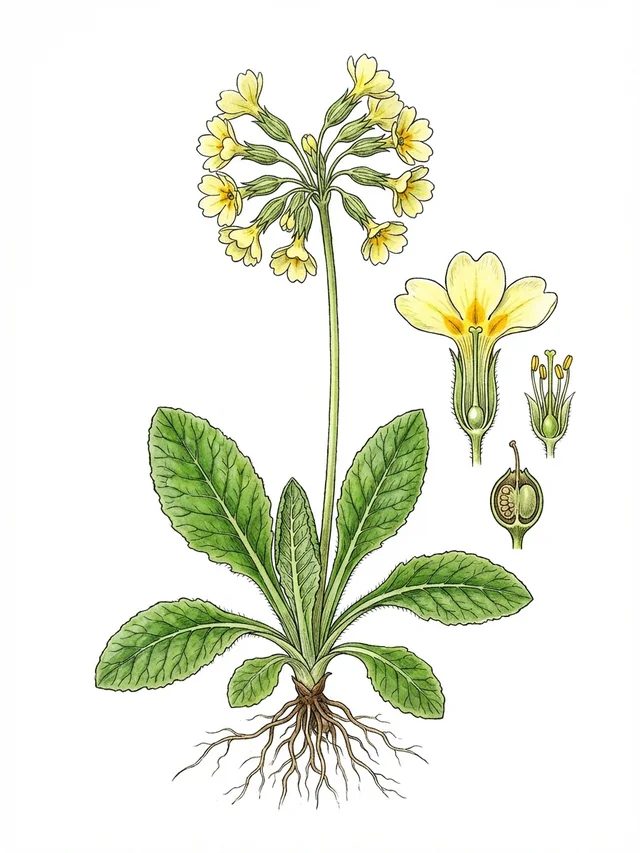
 Bild folgtKI-generierte Illustration
Hypericum calycinum
Hypericum calycinum
FamilyGenus: Johanniskräuterheimisch in Deutschland
🌿
19
Species
interact
🔗
20
Interactions
documented
About this species
A low, evergreen shrub with broad leaves and large yellow flowers that appear from July to September. It grows in partial shade on moist, neutral to slightly acid soils and is an introduced, established plant in Great Britain.
Ecological network
Click to highlight connections · Click again to open species page
Netzwerk wird geladen...
Pollination
Ecological significance
There is no evidence of ecological impact in the available source data.
Annual cycle
Flowering occurs from July to September. The shrub is evergreen, keeping its broad leaves through the winter.
Standort & Merkmale
Light
Halbschatten
Moisture
Feucht
Soil
—
Bloom time
Jul – Sep
Bioregion
Continental
Growth form
Strauch
Woodiness
Verholzt
Leaf type
Breitblättrig
Leaf phenology
Immergrün
Plant height
0.31 m
Morphological traits: TRY ID3 (CC BY 3.0) & TRY ID81 (CC BY)
Pflege & Anbau
Plant in partial shade in a moist, well-drained soil that is neutral to slightly acid. It has a moderate nutrient requirement and benefits from an even moisture supply. Once established, this low, spreading shrub remains evergreen.
Scientific profile
Hypericum calycinum is a low, woody, evergreen shrub (growth form ‘Strauch’) with broad leaves (leaf type ‘Breitblättrig’). It typically reaches about 0.3 m in height. The leaves persist year-round (leaf phenology ‘Immergrün’) and have an average area of 1641 mm². Flowers are borne from July to September. The plant forms arbuscular mycorrhizal (AM) associations. Its environmental requirements, as indicated by Ellenberg-type values, are partial shade (light value 5), moist conditions (moisture value 7), a neutral to weakly acid soil reaction (value 5), moderate nutrient supply (value 5) and a preference for warm sites (temperature value 8). Seeds are small, with a mean diaspore mass of about 0.45 mg. The reported distribution includes south-western and south-eastern Europe and temperate Asia. In Great Britain, it is recorded as an introduced species that has become established (Plant Atlas 2020).
Bestäuber & Besucher
19 Arten interagieren mit dieser Pflanze
Thymelicus sylvestrisManiola jurtinaCelastrina argiolusPararge aegeriaBombus vestalisBombus sylvestrisBombus lucorumBombus lapidariusBombus hypnorumBombus pascuorumPyronia tithonusPieris napiPieris rapaeBombus terrestrisApis melliferaEupeodes corollaeEpisyrphus balteatusBombus californicusBombus griseocollis
Sources & data origin
•TraitCH — CC BY 4.0TraitCH 2.0 contributors; imported as source-preserving NaturKompass taxon evidence.
•Interaktionsdaten via GloBI (CC-BY 4.0)
•pollinator_interactions
•EIVE 1.0 — Dengler et al. (2023), DOI: 10.3897/VCS.98324 (CC BY 4.0)
•GBIF Backbone Taxonomy — GBIF Secretariat (2024), DOI: 10.15468/39omei (CC BY 4.0)
•TRY Categorical Traits (ID3) — Kattge et al. (2012), DOI: 10.17871/TRY.3 (CC BY 3.0)
•TRY Global Spectrum (ID81) — Díaz et al. (2016/2021), DOI: 10.17871/TRY.81 (CC BY)
•Checklist Alien Plants Belgium — Verloove F (2023), Botanic Garden Meise (CC BY 4.0)
•Govaerts R et al. (2025) — World Checklist of Vascular Plants (WCVP) v14. Royal Botanic Gardens, Kew. DOI: 10.34885/xs7h-ze42 (CC BY 4.0)
All data is licensed under CC BY 4.0, CC0, or compatible. Attribution according to license terms. Full source overview →