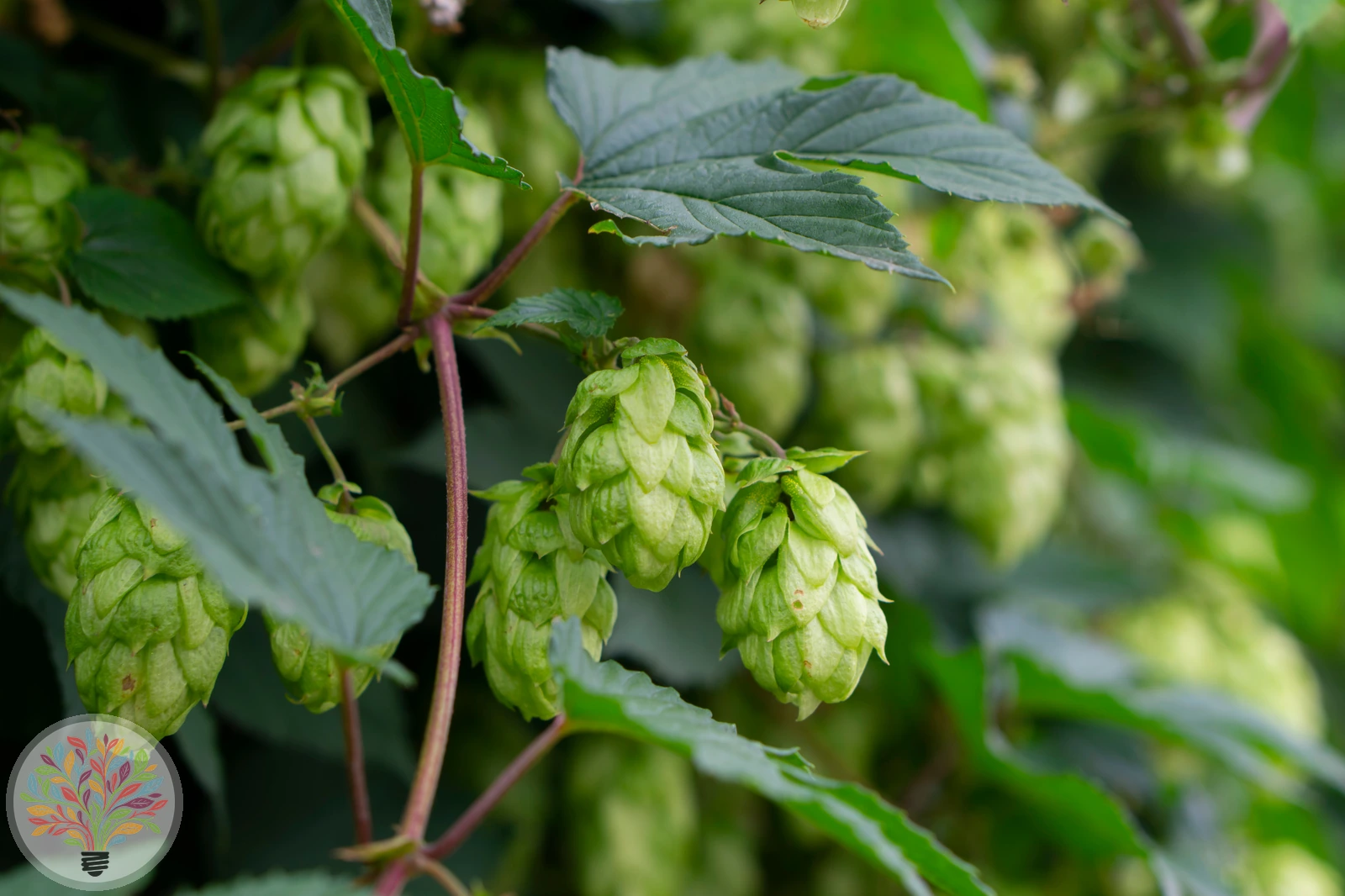
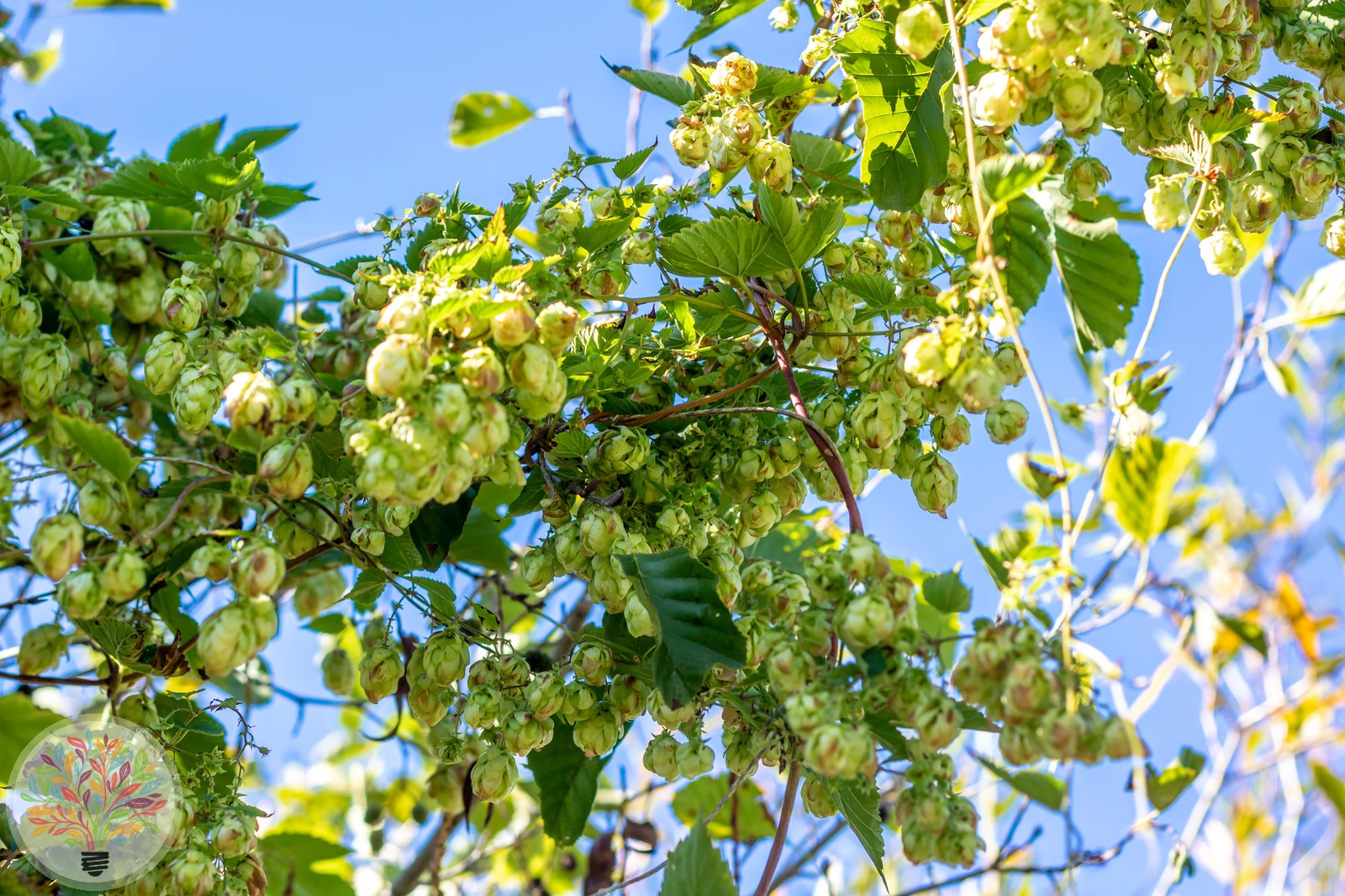
Humulus lupulus
Humulus lupulus
FamilyGenus: Humulusheimisch in Deutschland
🌿
42
Species
interact
🔗
56
Interactions
documented
🐛
28
Host relationships
Species
About this species
Common hop is a native perennial climber that twines clockwise and produces aromatic cone-like flowers in summer. It thrives in partial shade on fertile, moist soils and can reach heights over three metres.
Ecological network
Click to highlight connections · Click again to open species page
Netzwerk wird geladen...
PollinationLarval hostFlower visit
Ecological significance
In the wild, it occupies nutrient-rich, moist habitats such as wet meadows and woodland borders.
Annual cycle
New shoots emerge in spring from perennial underground stems. Flowers are produced from July to August.
Safety note
Specific information on potential toxicity or handling risks is not included in the available dataset.
Standort & Merkmale
Light
Halbschatten
Moisture
Frisch (Mäßig feucht)
Soil
Starkzehrer (Nährstoffreicher/Fetter Boden)
Bloom time
Jul – Aug
Soil reaction
Mäßig sauer bis neutral
Bioregion
Continental
Growth form
Kletterpflanze
Woodiness
Nicht verholzt
Leaf type
Breitblättrig
Plant height
3.104 m
Morphological traits: TRY ID3 (CC BY 3.0) & TRY ID81 (CC BY)
Pflege & Anbau
**Light:** Partial shade.
**Soil:** Fertile, moisture-retentive soil.
**Support:** Provide a trellis, fence or other structure for the twining stems to climb.
Scientific profile
Humulus lupulus is a herbaceous climbing plant in the hemp family (Cannabaceae). It is native in Great Britain, where it occurs in hedgerows, woodland edges and nutrient-rich damp grasslands. The stems are non-woody, and the broad leaves give it a lush appearance. Plants are dioecious, with male and female flowers on separate individuals. The female inflorescences develop into the familiar papery hop cones in late summer. The species prefers partial shade and consistently moist, nutrient-rich, often calcareous soils. It can grow to approximately 3.1 metres in height, using its twining stems to scramble over supporting vegetation.
Bestäuber & Besucher
9 Arten interagieren mit dieser Pflanze
Polygonia c-albumNymphalis antiopaCelastrina argiolusEuplexia luciparaNemophora degeerellaHalictus subauratusLasioglossum lucidulumEpisyrphus balteatusHeringia heringi
Host relationships
28 species use this plant as a host
Vanessa atalantaAglais ioEupithecia assimilataBiston betulariaHypena rostralisCalliteara pudibundaSpilosoma luteaTyria jacobaeaeAnorthoa mundaMelanchra persicariaeabrostola triplasiaLacanobia oleraceaHepialus humuliXylena vetustaAxylia putrisAutographa gammaSphinx ligustriCaradrina morpheusHydraecia micaceaXylena exsoletaOstrinia nubilalisPhlogophora meticulosaOrthosia gothicaOrthosia incertaAcronicta rumicisTriodia sylvinaOrgyia antiquaAglais urticae
Other flower visitors
5 other species visit the flowers
Sylvia atricapillaLeptinotarsa decemlineataPhyllobius arboratorAdalia bipunctataHippodamia variegata
Sources & data origin
•TRY v6.0 / BiolFlor flowering phenology (Request 47350) — CC BY 4.0TRY request 47350 (Public, Data Released, TRY v6.0; 2026-02-15). Cite TRY: Kattge et al. (2020), doi:10.1111/gcb.14904; original source: Trefflich, A., Klotz, S. & Kühn, I. (2002). Blühphänologie. BIOLFLOR, Schriftenreihe für Vegetationskunde 38:127–131.
•Cook et al. (2025) UK Butterfly & Moth Traits (DOI: 10.5285/dbc7cc17-cbbd-49dd-bab4-8e8855768d66)
•Interaktionsdaten via GloBI (CC-BY 4.0)
•pollinator_interactions
•FloraWeb / BfN
•EIVE 1.0 — Dengler et al. (2023), DOI: 10.3897/VCS.98324 (CC BY 4.0)
•GBIF Backbone Taxonomy — GBIF Secretariat (2024), DOI: 10.15468/39omei (CC BY 4.0)
•TRY Categorical Traits (ID3) — Kattge et al. (2012), DOI: 10.17871/TRY.3 (CC BY 3.0)
•TRY Global Spectrum (ID81) — Díaz et al. (2016/2021), DOI: 10.17871/TRY.81 (CC BY)
•Govaerts R et al. (2025) — World Checklist of Vascular Plants (WCVP) v14. Royal Botanic Gardens, Kew. DOI: 10.34885/xs7h-ze42 (CC BY 4.0)
•Foto: © Adobe Stock / AdobeStock_461735246
All data is licensed under CC BY 4.0, CC0, or compatible. Attribution according to license terms. Full source overview →