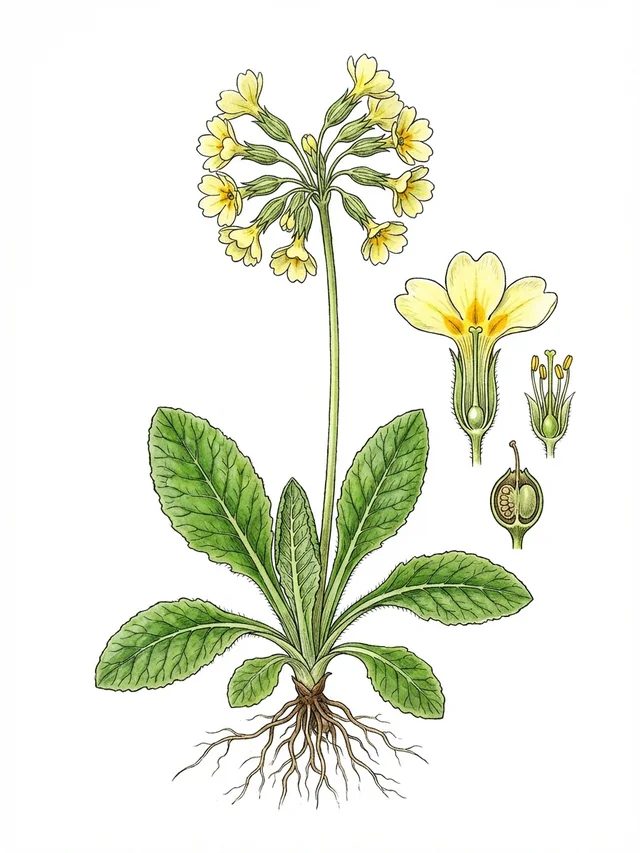
 Bild folgtKI-generierte Illustration
Hypericum pulchrum
Hypericum pulchrum
FamilyGenus: Johanniskräuterheimisch in Deutschland
🌿
21
Species
interact
🔗
32
Interactions
documented
About this species
Hypericum pulchrum is a slender herbaceous perennial native to Great Britain. It typically grows in partly shaded, acidic, nutrient-poor soils and produces yellow flowers from July to September. The plant reaches around 40 cm in height and forms arbuscular mycorrhizal associations.
Ecological network
Click to highlight connections · Click again to open species page
Netzwerk wird geladen...
PollinationFlower visit
Ecological significance
As a native wild plant, Hypericum pulchrum forms part of the natural herbaceous layer in suitable habitats. It associates with arbuscular mycorrhizal fungi, contributing to soil health.
Annual cycle
This herbaceous perennial emerges in spring, blooms from July to September, and dies back in autumn.
Standort & Merkmale
Light
Halbschatten
Moisture
Frisch (Mäßig feucht)
Soil
Schwachzehrer (Magerer Boden)
Bloom time
Jul – Sep
Soil reaction
Sauer (Säurezeiger)
Bioregion
Continental
Growth form
Krautige Pflanze
Woodiness
Nicht verholzt
Leaf type
Breitblättrig
Plant height
0.387 m
Morphological traits: TRY ID3 (CC BY 3.0) & TRY ID81 (CC BY)
Pflege & Anbau
Prefers a partially shaded position with fresh, moderately moist, acidic and nutrient-poor soil. Avoid rich or fertilised ground. Established plants tolerate low disturbance. Flowering occurs from July to September. Minimal maintenance is required.
Scientific profile
Hypericum pulchrum is native in Great Britain. It is a non-woody, broad-leaved herbaceous plant, typically reaching about 0.4 metres in height. The species flowers from July to September. It associates with arbuscular mycorrhizal fungi. Ellenberg-type indicator values indicate a preference for partly shaded sites, fresh moisture, a strongly acid soil reaction and nutrient-poor conditions. The plant tolerates low disturbance and moderately warm temperatures. Diaspores are very light, averaging 0.08 mg.
Bestäuber & Besucher
17 Arten interagieren mit dieser Pflanze
Other flower visitors
4 other species visit the flowers
Sources & data origin
•TRY v6.0 / BiolFlor flowering phenology (Request 47350) — CC BY 4.0TRY request 47350 (Public, Data Released, TRY v6.0; 2026-02-15). Cite TRY: Kattge et al. (2020), doi:10.1111/gcb.14904; original source: Trefflich, A., Klotz, S. & Kühn, I. (2002). Blühphänologie. BIOLFLOR, Schriftenreihe für Vegetationskunde 38:127–131.
•Interaktionsdaten via GloBI (CC-BY 4.0)
•pollinator_interactions
•Baden-Böhm F, App M, Thiele J (2022) — The FloRes Database: A floral resources trait database for pollinator habitat-assessment generated by a multistep workflow. Johann Heinrich von Thünen-Institut, Dryad, DOI: 10.5061/dryad.djh9w0w29 (CC0)
•FloraWeb / BfN
•EIVE 1.0 — Dengler et al. (2023), DOI: 10.3897/VCS.98324 (CC BY 4.0)
•GBIF Backbone Taxonomy — GBIF Secretariat (2024), DOI: 10.15468/39omei (CC BY 4.0)
•TRY Categorical Traits (ID3) — Kattge et al. (2012), DOI: 10.17871/TRY.3 (CC BY 3.0)
•TRY Global Spectrum (ID81) — Díaz et al. (2016/2021), DOI: 10.17871/TRY.81 (CC BY)
•Govaerts R et al. (2025) — World Checklist of Vascular Plants (WCVP) v14. Royal Botanic Gardens, Kew. DOI: 10.34885/xs7h-ze42 (CC BY 4.0)
All data is licensed under CC BY 4.0, CC0, or compatible. Attribution according to license terms. Full source overview →