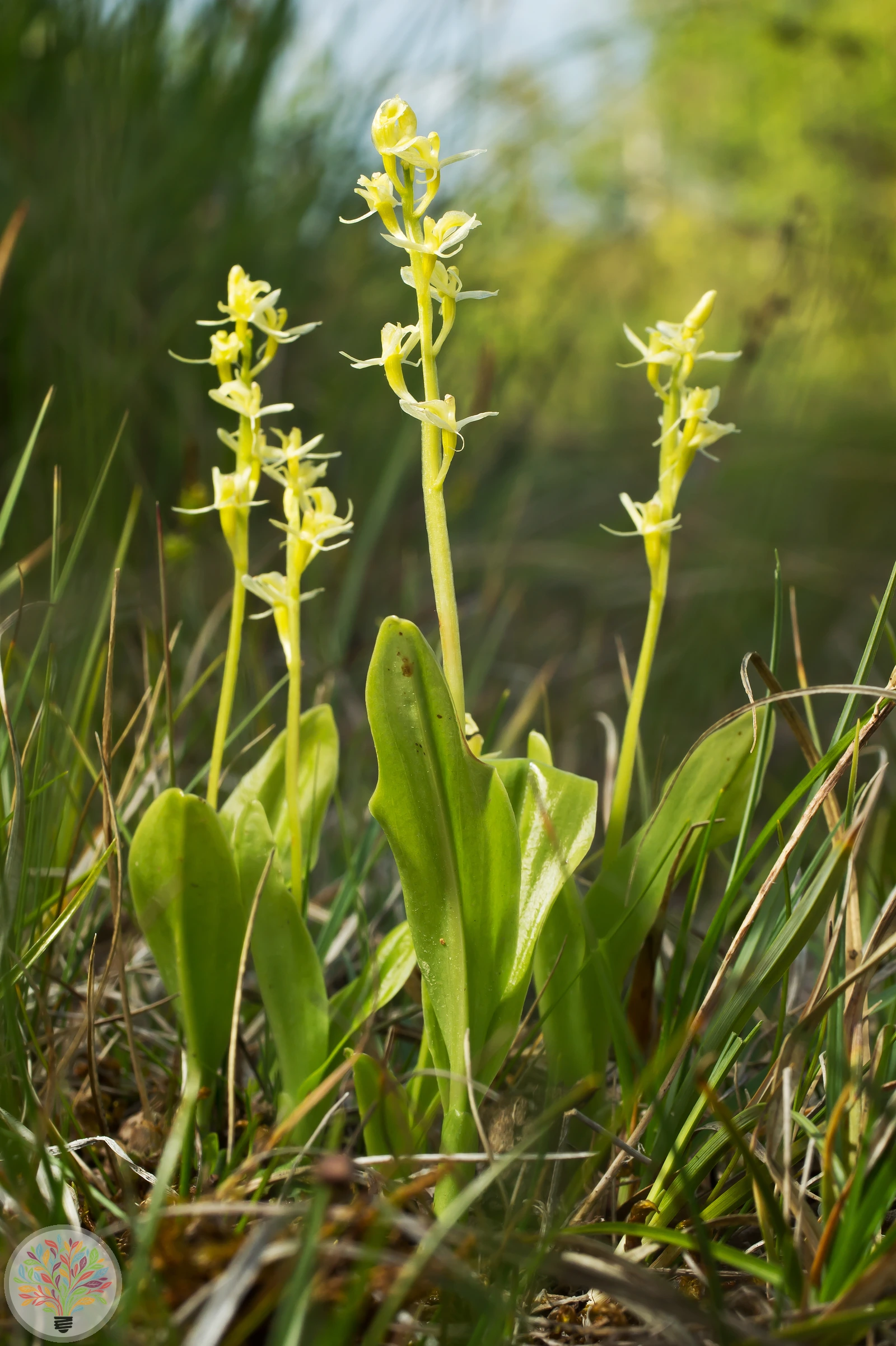
Liparis loeselii
Liparis loeselii
FamilyGenus: Liparisheimisch in Deutschland
About this species
A small native orchid of damp, calcareous, nutrient-poor soils in full sun, flowering in June and July.
Ecological significance
As a native orchid of nutrient-poor calcareous wetlands, this species forms part of a distinctive vegetation type. It relies on a mycorrhizal partnership and contributes to the ecological complexity of its habitat.
Annual cycle
This perennial orchid emerges above ground in spring, producing broad green leaves. Flowering occurs in June and July, with pollination leading to the formation of dust-like seeds by late summer. The foliage senesces in autumn and the plant overwinters as underground storage organs together with its fungal partner.
Standort & Merkmale
Light
Sonne
Moisture
Feucht
Soil
Schwachzehrer (Magerer Boden)
Bloom time
Jun – Jul
Soil reaction
Basisch / Kalkhold
Bioregion
Continental
Growth form
Krautige Pflanze
Woodiness
Nicht verholzt
Leaf type
Breitblättrig
Plant height
0.089 m
Morphological traits: TRY ID3 (CC BY 3.0) & TRY ID81 (CC BY)
Pflege & Anbau
Liparis loeselii demands exacting conditions: a position in full sun, a constantly moist but not stagnant, calcareous substrate that is extremely low in nutrients, and the presence of its specific orchid mycorrhizal partner. It is not suited to ordinary garden cultivation and should never be collected from the wild.
Scientific profile
Liparis loeselii is a small, native orchid of damp, calcareous, nutrient-poor habitats, growing in full sun and reaching about 9 cm in height. The broad leaves, which average around 8 cm² in area, are carried on a herbaceous, non-woody stem. Flowering takes place in June and July. The plant depends entirely on an orchid mycorrhizal association (OM type) for nutrient uptake and establishment, and produces minute, dust-like seeds that weigh just 0.004 mg. It occurs in open, low-disturbance situations on moist, alkaline soils.
Sources & data origin
•TraitCH — CC BY 4.0TraitCH 2.0 contributors; imported as source-preserving NaturKompass taxon evidence.
•FloraWeb / BfN
•EIVE 1.0 — Dengler et al. (2023), DOI: 10.3897/VCS.98324 (CC BY 4.0)
•GBIF Backbone Taxonomy — GBIF Secretariat (2024), DOI: 10.15468/39omei (CC BY 4.0)
•TRY Categorical Traits (ID3) — Kattge et al. (2012), DOI: 10.17871/TRY.3 (CC BY 3.0)
•TRY Global Spectrum (ID81) — Díaz et al. (2016/2021), DOI: 10.17871/TRY.81 (CC BY)
•Govaerts R et al. (2025) — World Checklist of Vascular Plants (WCVP) v14. Royal Botanic Gardens, Kew. DOI: 10.34885/xs7h-ze42 (CC BY 4.0)
•Foto: © ©2015 Tiina Võsumägi, all rights reserved / Adobe Stock / AdobeStock_98798591
All data is licensed under CC BY 4.0, CC0, or compatible. Attribution according to license terms. Full source overview →