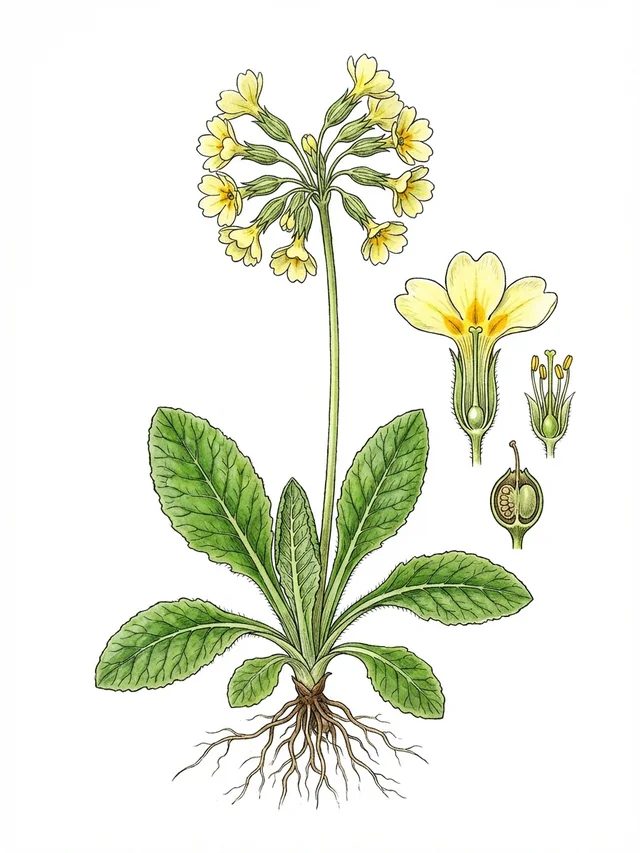
 Bild folgtKI-generierte Illustration
Melampyrum pratense
Melampyrum pratense
FamilyGenus: Wachtelweizenheimisch in Deutschland
🌿
24
Species
interact
🔗
58
Interactions
documented
🐛
2
Host relationships
Species
About this species
A native, hemiparasitic herb of acidic, nutrient-poor soils, bearing pairs of narrow tubular flowers from June to September. It typically reaches around 22 cm in height and favours lightly shaded sites.
Ecological network
Click to highlight connections · Click again to open species page
Netzwerk wird geladen...
PollinationLarval hostFlower visit
Ecological significance
As a native hemiparasite, it forms root connections with surrounding vegetation.
Annual cycle
Flowering occurs from June to September.
Safety note
No known hazards.
Standort & Merkmale
Light
Halbschatten
Moisture
Frisch (Mäßig feucht)
Soil
Schwachzehrer (Magerer Boden)
Bloom time
Jun – Sep
Soil reaction
Sauer (Säurezeiger)
Bioregion
Continental
Growth form
Krautige Pflanze
Woodiness
Nicht verholzt
Leaf type
Breitblättrig
Plant height
0.223 m
Morphological traits: TRY ID3 (CC BY 3.0) & TRY ID81 (CC BY)
Pflege & Anbau
Grow in partial shade in acidic, low-nutrient soils that remain moderately moist. The species is adapted to unimproved ground and does not benefit from added nutrients. Minimal disturbance and the presence of established mycorrhizal networks may aid establishment.
Scientific profile
Melampyrum pratense is a native, non-woody, broad-leaved herbaceous plant in the Orobanchaceae family. It is hemiparasitic, attaching to the roots of neighbouring plants to supplement its nutrition. Plants commonly attain heights of about 22 cm and bear leaves with a blade area of approximately 240 mm². The species is adapted to acidic, nutrient-poor soils that are moderately moist and experiences low disturbance. It forms arbuscular mycorrhizal associations. Flowering spans from June to September. The small seeds have a mass of about 5.6 mg.
Bestäuber & Besucher
20 Arten interagieren mit dieser Pflanze
Melitaea diaminaMelitaea celadussaMelitaea britomartisBombus pascuorumBombus hortorumBombus terrestrisBombus pratorumBombus lucorumBombus muscorumBombus sylvarumEupeodes corollaeBombus ruderariusAnthophora furcataPlatycheirus scutatusSyrphus sexmaculatusBombus cryptarumOchlodes sylvanusAgriades optileteBombus soroeensisBombus terrestris/lucorum type
Other flower visitors
2 other species visit the flowers
Myrmica ruginodisThricops
Sources & data origin
•TRY v6.0 / BiolFlor flowering phenology (Request 47350) — CC BY 4.0TRY request 47350 (Public, Data Released, TRY v6.0; 2026-02-15). Cite TRY: Kattge et al. (2020), doi:10.1111/gcb.14904; original source: Trefflich, A., Klotz, S. & Kühn, I. (2002). Blühphänologie. BIOLFLOR, Schriftenreihe für Vegetationskunde 38:127–131.
•Cook et al. (2025) UK Butterfly & Moth Traits (DOI: 10.5285/dbc7cc17-cbbd-49dd-bab4-8e8855768d66)
•Middleton-Welling_2020
•pollinator_interactions
•FloraWeb / BfN
•EIVE 1.0 — Dengler et al. (2023), DOI: 10.3897/VCS.98324 (CC BY 4.0)
•GBIF Backbone Taxonomy — GBIF Secretariat (2024), DOI: 10.15468/39omei (CC BY 4.0)
•TRY Categorical Traits (ID3) — Kattge et al. (2012), DOI: 10.17871/TRY.3 (CC BY 3.0)
•TRY Global Spectrum (ID81) — Díaz et al. (2016/2021), DOI: 10.17871/TRY.81 (CC BY)
•Govaerts R et al. (2025) — World Checklist of Vascular Plants (WCVP) v14. Royal Botanic Gardens, Kew. DOI: 10.34885/xs7h-ze42 (CC BY 4.0)
All data is licensed under CC BY 4.0, CC0, or compatible. Attribution according to license terms. Full source overview →