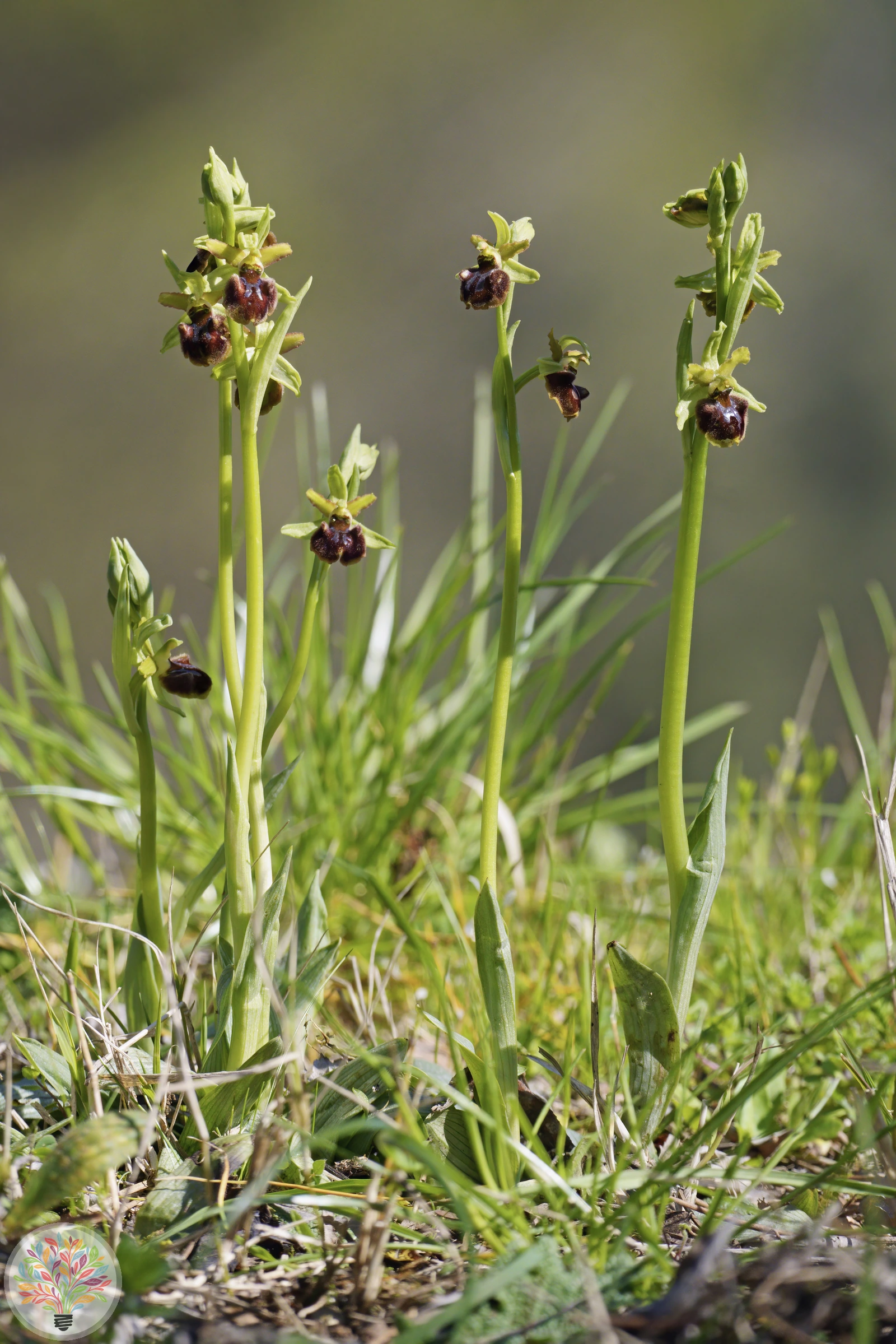
Ophrys sphegodes
Ophrys sphegodes
FamilyGenus: Ophrysheimisch in Deutschland
🌿
1
Species
interact
🔗
1
Interactions
documented
About this species
Ophrys sphegodes is a small terrestrial orchid native in Great Britain. It bears intricate flowers in April on a stem about 18 cm tall, thriving in sunny, calcareous, low-nutrient grasslands.
Ecological network
Click to highlight connections · Click again to open species page
Netzwerk wird geladen...
Pollination
Ecological significance
As a native species of species‑rich calcareous grassland, Ophrys sphegodes contributes to the botanical diversity of these habitats.
Annual cycle
This perennial orchid produces its flowers in April.
Safety note
Safety information for this species is not documented.
Standort & Merkmale
Light
Sonne
Moisture
Frisch (Mäßig feucht)
Soil
Schwachzehrer (Magerer Boden)
Bloom time
Apr – Apr
Soil reaction
Basisch / Kalkhold
Bioregion
Continental
Growth form
Krautige Pflanze
Woodiness
Nicht verholzt
Leaf type
Breitblättrig
Plant height
0.178 m
Morphological traits: TRY ID3 (CC BY 3.0) & TRY ID81 (CC BY)
Pflege & Anbau
Ophrys sphegodes is exceptionally difficult to cultivate and is best left undisturbed in its wild habitat. If attempting to grow it, provide a sunny, freely draining, nutrient-poor calcareous substrate and keep the soil moderately moist during the growing season. The plant relies on a specific soil fungus (orchid mycorrhiza) and is unlikely to persist without it. Never collect plants or seed from the wild.
Scientific profile
Ophrys sphegodes is a native wild orchid of Great Britain. It is a herbaceous, non-woody terrestrial plant with broad leaves. The flowering stem typically reaches around 18 cm in height. It grows in full sun on fresh, moderately moist, nutrient-poor soils, showing a strong preference for calcareous or basic substrates. The plant forms an orchid mycorrhizal association (OM type) necessary for its nutrient uptake. Flowering is restricted to April. Ellenberg-type indicator values confirm its high light demand (8), base‑rich soil reaction (8), low nutrient status (3), and tolerance of only low levels of disturbance.
Bestäuber & Besucher
1 Arten interagieren mit dieser Pflanze
Osmia rufohirta
Sources & data origin
•TraitCH — CC BY 4.0TraitCH 2.0 contributors; imported as source-preserving NaturKompass taxon evidence.
•pollinator_interactions
•FloraWeb / BfN
•EIVE 1.0 — Dengler et al. (2023), DOI: 10.3897/VCS.98324 (CC BY 4.0)
•GBIF Backbone Taxonomy — GBIF Secretariat (2024), DOI: 10.15468/39omei (CC BY 4.0)
•TRY Categorical Traits (ID3) — Kattge et al. (2012), DOI: 10.17871/TRY.3 (CC BY 3.0)
•TRY Global Spectrum (ID81) — Díaz et al. (2016/2021), DOI: 10.17871/TRY.81 (CC BY)
•Govaerts R et al. (2025) — World Checklist of Vascular Plants (WCVP) v14. Royal Botanic Gardens, Kew. DOI: 10.34885/xs7h-ze42 (CC BY 4.0)
•Foto: © Adobe Stock / AdobeStock_764621737
All data is licensed under CC BY 4.0, CC0, or compatible. Attribution according to license terms. Full source overview →