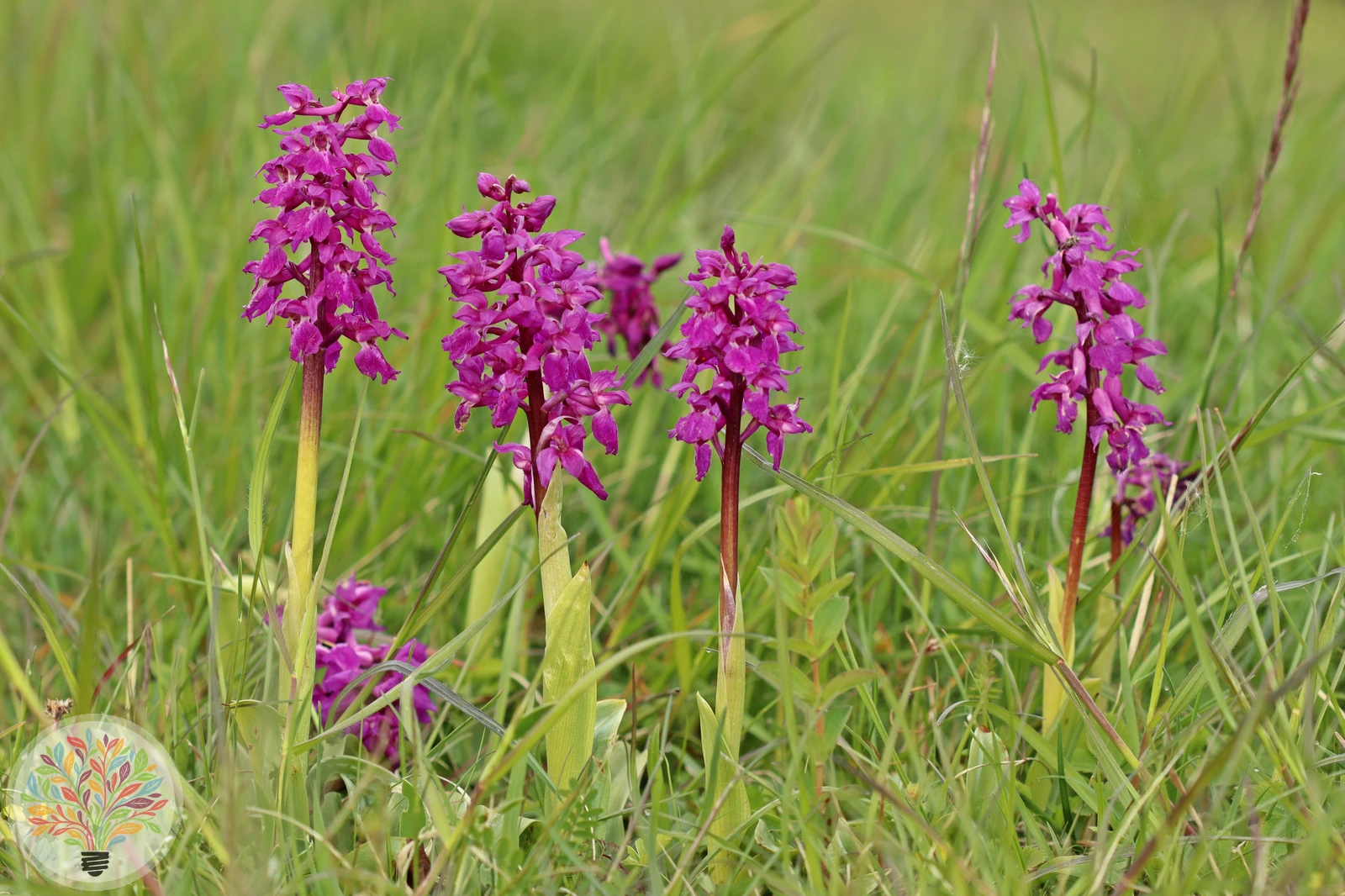
Orchis mascula
Orchis mascula
FamilyGenus: Orchisheimisch in Deutschland
🌿
21
Species
interact
🔗
22
Interactions
documented
About this species
A native terrestrial orchid of Great Britain, bearing spikes of purple flowers in June. It favours semi-shaded, moist, nutrient-poor grassland and open woodland, and depends on specific mycorrhizal fungi.
Ecological network
Click to highlight connections · Click again to open species page
Netzwerk wird geladen...
PollinationFlower visit
Ecological significance
Orchis mascula supplies nectar and pollen for insect visitors in June, supporting wild pollinators in semi-natural grassland and wood-edge habitats. As a native component of unimproved plant communities, it contributes to the characteristic structure and diversity of these low-nutrient ecosystems.
Annual cycle
Leaves emerge in spring, followed by a flowering spike in June. After pollination, slender seed capsules release minute, wind-dispersed seeds. By late summer the above-ground parts begin to die back, and the plant survives the winter as a dormant underground tuber.
Standort & Merkmale
Light
Halbschatten
Moisture
Frisch (Mäßig feucht)
Soil
Schwachzehrer (Magerer Boden)
Bloom time
Jun – Jun
Soil reaction
Basisch / Kalkhold
Bioregion
Continental
Nectar value
2
Pollen value
2
Growth form
Krautige Pflanze
Woodiness
Nicht verholzt
Leaf type
Breitblättrig
Plant height
0.253 m
Morphological traits: TRY ID3 (CC BY 3.0) & TRY ID81 (CC BY)
Pflege & Anbau
In a garden, position plants in semi-shade, such as a lightly shaded meadow edge or a woodland glade. The soil must be moisture-retentive but freely drained, and very low in nutrients – do not add fertiliser or compost. Success depends entirely on the presence of the correct orchid mycorrhizal fungi; plants will not persist without them. If introducing plants, ensure they are pot-grown with their associated soil fungi, and avoid root disturbance once settled. Limit mowing or cutting until after seed has been shed in late summer.
Scientific profile
Orchis mascula is a herbaceous, broad-leaved, non-woody plant belonging to the orchid family (Orchidaceae). In Great Britain it is a native wild species. The plant typically reaches a height of about 25 centimetres, with an average leaf area of around 1960 mm². Ellenberg-type indicator values place it in semi-shade (light value 6), on soils that are fresh to moderately moist and distinctly nutrient-poor (nutrient value 3). Its tolerance of disturbance is low (severity 0.57), so it is a poor competitor and persists in stable, unimproved swards. Like all orchids in the genus Orchis, it requires an orchid mycorrhizal association (type OM) for seedling establishment and continuing nutrition. Flowering occurs in June; nectar and pollen are both rated 2, suggesting a modest reward for visiting insects.
Bestäuber & Besucher
18 Arten interagieren mit dieser Pflanze
Andrena nigroaeneaArgogorytes mystaceusBombus hortorumBombus lapidariusBombus lucorumBombus muscorumBombus pratorumBombus ruderatusBombus sylvarumBombus terrestrisNomada marshamellaOsmia bicolorBombus vestalisEristalis tenaxBombus pascuorumBombus ruderariusBombus rupestrisAndrena dorsata
Other flower visitors
3 other species visit the flowers
Ecrizotes longicornisScathophaga stercorariaEmpis tessellata
Sources & data origin
•TraitCH — CC BY 4.0TraitCH 2.0 contributors; imported as source-preserving NaturKompass taxon evidence.
•pollinator_interactions
•FloraWeb / BfN
•EIVE 1.0 — Dengler et al. (2023), DOI: 10.3897/VCS.98324 (CC BY 4.0)
•EuPPollNet — Kuppler et al. (2025), DOI: 10.1111/geb.70000 (CC BY 4.0)
•Database of Pollinator Interactions (DoPI) — Pocock et al. (2022), DOI: 10.1002/ecy.3801 (CC BY)
•GBIF Backbone Taxonomy — GBIF Secretariat (2024), DOI: 10.15468/39omei (CC BY 4.0)
•TRY Categorical Traits (ID3) — Kattge et al. (2012), DOI: 10.17871/TRY.3 (CC BY 3.0)
•TRY Global Spectrum (ID81) — Díaz et al. (2016/2021), DOI: 10.17871/TRY.81 (CC BY)
•Govaerts R et al. (2025) — World Checklist of Vascular Plants (WCVP) v14. Royal Botanic Gardens, Kew. DOI: 10.34885/xs7h-ze42 (CC BY 4.0)
•Foto: © Adobe Stock / AdobeStock_800568914
All data is licensed under CC BY 4.0, CC0, or compatible. Attribution according to license terms. Full source overview →