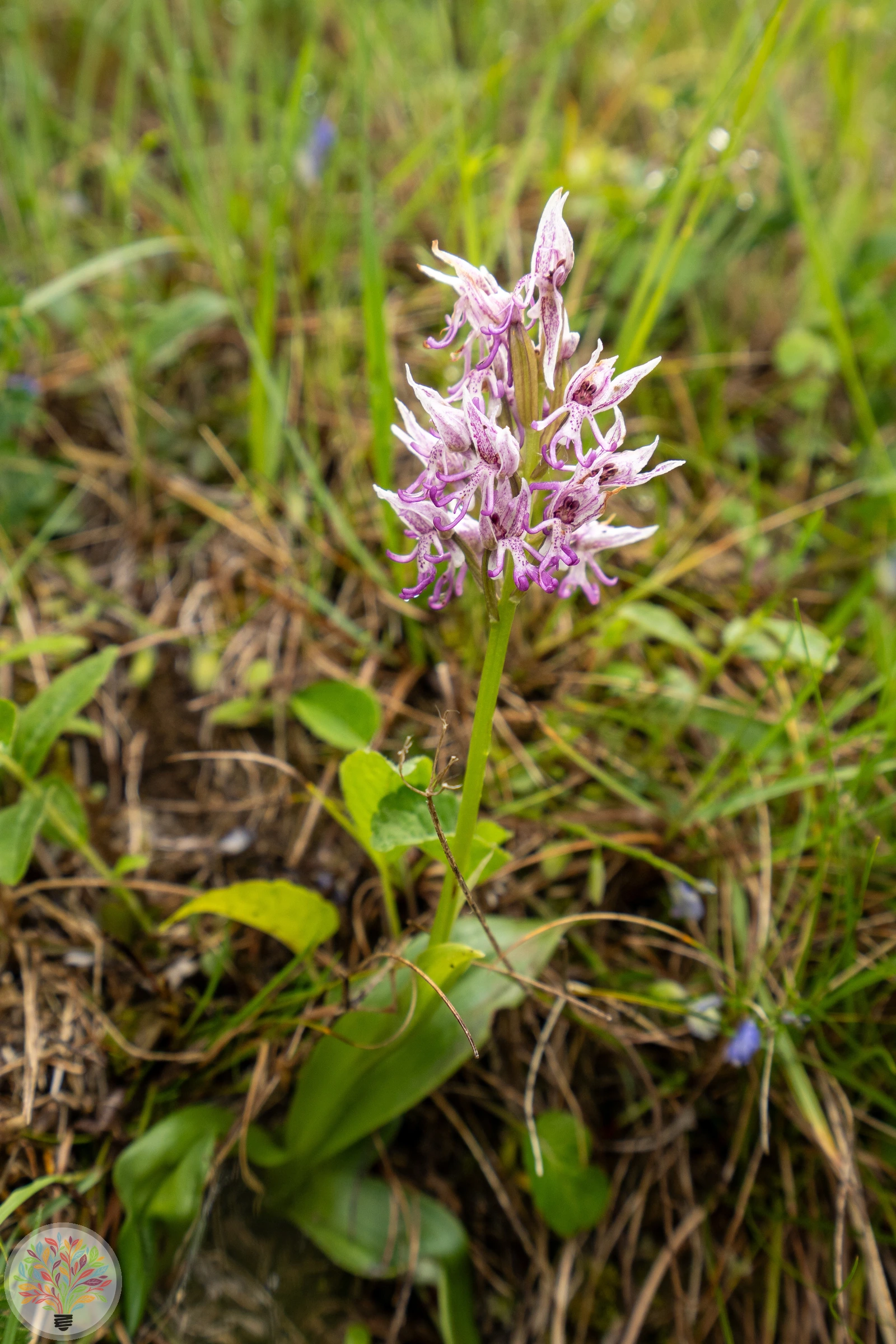
Orchis simia
Orchis simia
FamilyGenus: Orchisheimisch in Deutschland
🌿
3
Species
interact
🔗
3
Interactions
documented
About this species
A native terrestrial orchid found in calcareous grasslands, growing to about 30 cm tall, with broad leaves and flowering in April and May. It favours full sun and dry, nutrient-poor, calcareous soils.
Ecological network
Click to highlight connections · Click again to open species page
Netzwerk wird geladen...
PollinationFlower visit
Ecological significance
No specific information is available regarding ecological interactions or impacts.
Annual cycle
Flowering occurs in April and May.
Standort & Merkmale
Light
Sonne
Moisture
Trocken
Soil
Schwachzehrer (Magerer Boden)
Bloom time
Apr – Mai
Soil reaction
Basisch / Kalkhold
Bioregion
Continental
Growth form
Krautige Pflanze
Woodiness
Nicht verholzt
Leaf type
Breitblättrig
Plant height
0.306 m
Morphological traits: TRY ID3 (CC BY 3.0) & TRY ID81 (CC BY)
Scientific profile
Orchis simia is a herbaceous perennial orchid native in Great Britain. It typically reaches a height of approximately 30 cm and produces broad leaves. The flowering period runs from April to May, when the distinctive flower spikes appear. The species is characteristic of open, sunny sites on calcareous, nutrient-poor soils. It is associated with dry conditions, although ecological indicator values place it in fresh, moderately moist moisture classes, suggesting a preference for well-drained yet seasonally moist calcareous ground. The plant is terrestrial and entirely non-woody.
Sources & data origin
•Interaktionsdaten via GloBI (CC-BY 4.0)
•pollinator_interactions
•FloraWeb / BfN
•EIVE 1.0 — Dengler et al. (2023), DOI: 10.3897/VCS.98324 (CC BY 4.0)
•GBIF Backbone Taxonomy — GBIF Secretariat (2024), DOI: 10.15468/39omei (CC BY 4.0)
•TRY Categorical Traits (ID3) — Kattge et al. (2012), DOI: 10.17871/TRY.3 (CC BY 3.0)
•TRY Global Spectrum (ID81) — Díaz et al. (2016/2021), DOI: 10.17871/TRY.81 (CC BY)
•Govaerts R et al. (2025) — World Checklist of Vascular Plants (WCVP) v14. Royal Botanic Gardens, Kew. DOI: 10.34885/xs7h-ze42 (CC BY 4.0)
•Foto: © Adobe Stock / AdobeStock_827366493
All data is licensed under CC BY 4.0, CC0, or compatible. Attribution according to license terms. Full source overview →