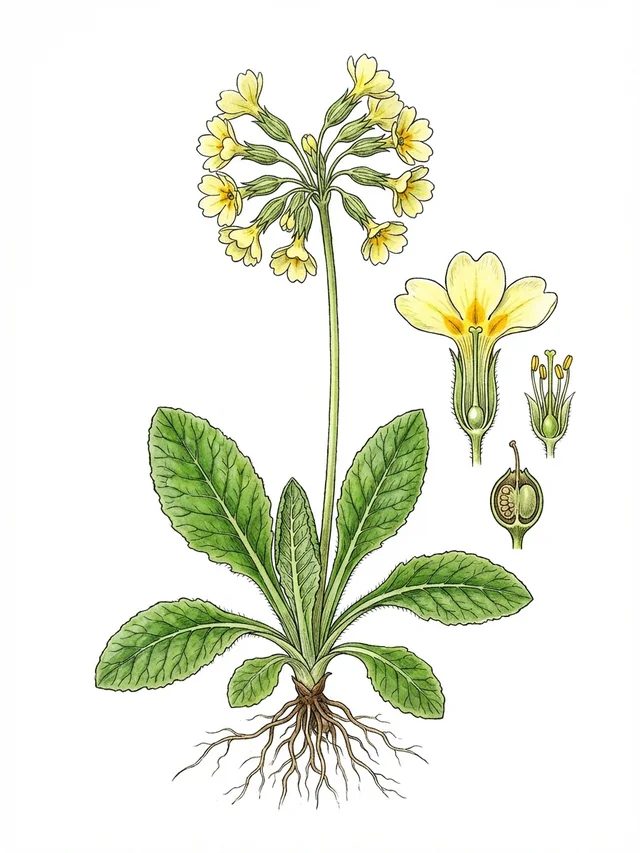
 Bild folgtKI-generierte Illustration
Plantago coronopus
Plantago coronopus
FamilyGenus: Plantagoheimisch in Deutschland
🌿
5
Species
interact
🔗
8
Interactions
documented
🐛
1
Host relationships
Species
About this species
A native herb of sunny, fresh soils, Plantago coronopus reaches about 7 cm tall and bears flowers from June to September. It tolerates slightly saline conditions.
Ecological network
Click to highlight connections · Click again to open species page
Netzwerk wird geladen...
PollinationLarval hostFlower visit
Ecological significance
The available evidence does not detail specific ecological interactions; as a native species it forms part of the natural flora of its habitats.
Annual cycle
Foliage develops in spring. Flowering takes place from June to September, with seed setting through late summer and autumn.
Safety note
No toxic or irritant properties are indicated in the source data.
Standort & Merkmale
Light
Sonne
Moisture
Frisch (Mäßig feucht)
Soil
Mittelzehrer (Normaler Boden)
Bloom time
Jun – Sep
Soil reaction
Basisch / Kalkhold
Bioregion
Continental
Growth form
Krautige Pflanze
Woodiness
Nicht verholzt
Leaf type
Breitblättrig
Plant height
0.073 m
Morphological traits: TRY ID3 (CC BY 3.0) & TRY ID81 (CC BY)
Pflege & Anbau
•
Light: Full sun.
•
Soil: Ordinary, well-drained garden soil that remains moderately moist.
•
Watering: Water during prolonged dry periods to keep the soil fresh.
•
Feeding: Thrives without supplementary fertiliser on normal soils.
•
Salinity: Can be planted in coastal gardens because of its slight salt tolerance.
Scientific profile
Plantago coronopus is a small, terrestrial herb in the plantain family (Plantaginaceae) reaching around 7 cm in height. The foliage is broad-leaved and the stems are non-woody. Flowering occurs from June to September. The species is native in Great Britain and grows in full sun on normally fertile, fresh to moderately moist soils that are neutral to weakly acidic. It shows a slight tolerance of salinity and occurs in habitats subject to low levels of disturbance. The diaspores are tiny, with an average mass of about 0.16 mg.
Bestäuber & Besucher
2 Arten interagieren mit dieser Pflanze
Andrena(Chlorandrena) sp_1Andrena
Sources & data origin
•TRY v6.0 / BiolFlor flowering phenology (Request 47350) — CC BY 4.0TRY request 47350 (Public, Data Released, TRY v6.0; 2026-02-15). Cite TRY: Kattge et al. (2020), doi:10.1111/gcb.14904; original source: Trefflich, A., Klotz, S. & Kühn, I. (2002). Blühphänologie. BIOLFLOR, Schriftenreihe für Vegetationskunde 38:127–131.
•Cook et al. (2025) UK Butterfly & Moth Traits (DOI: 10.5285/dbc7cc17-cbbd-49dd-bab4-8e8855768d66)
•Interaktionsdaten via GloBI (CC-BY 4.0)
•pollinator_interactions
•FloraWeb / BfN
•EIVE 1.0 — Dengler et al. (2023), DOI: 10.3897/VCS.98324 (CC BY 4.0)
•GBIF Backbone Taxonomy — GBIF Secretariat (2024), DOI: 10.15468/39omei (CC BY 4.0)
•TRY Categorical Traits (ID3) — Kattge et al. (2012), DOI: 10.17871/TRY.3 (CC BY 3.0)
•TRY Global Spectrum (ID81) — Díaz et al. (2016/2021), DOI: 10.17871/TRY.81 (CC BY)
•Govaerts R et al. (2025) — World Checklist of Vascular Plants (WCVP) v14. Royal Botanic Gardens, Kew. DOI: 10.34885/xs7h-ze42 (CC BY 4.0)
All data is licensed under CC BY 4.0, CC0, or compatible. Attribution according to license terms. Full source overview →