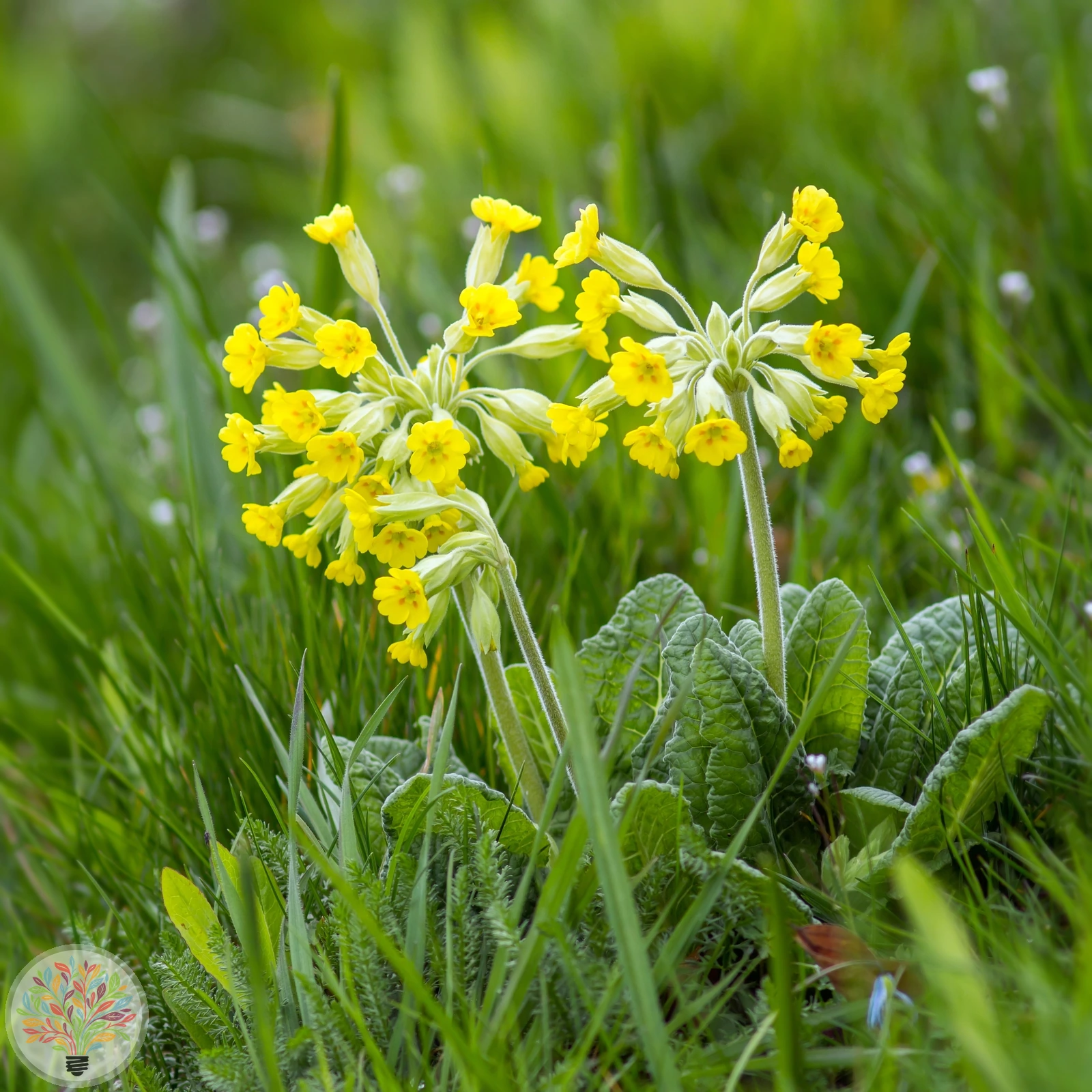
Primula veris
Primula veris
FamilyGenus: Primulaheimisch in Deutschland
🌿
71
Species
interact
🔗
196
Interactions
documented
🐛
7
Host relationships
Species
About this species
Primula veris is native in Great Britain. This herbaceous perennial bears nodding, deep yellow flowers from March to September and thrives in sunny, moderately moist, calcareous soils of low fertility. It is a valuable nectar and pollen source for insects.
Ecological network
Click to highlight connections · Click again to open species page
Netzwerk wird geladen...
PollinationLarval hostFlower visit
Ecological significance
Primula veris provides an important early-season pollen and nectar supply for a range of insects, including bees and butterflies. As a component of unimproved grassland it supports meadow biodiversity and has no known negative impacts.
Annual cycle
Flowers from March to September. The basal leaf rosette persists through the growing season; the plant dies back to ground level in winter.
Safety note
The plant is considered safe for children.
Standort & Merkmale
Light
Sonne
Moisture
Frisch (Mäßig feucht)
Soil
Schwachzehrer (Magerer Boden)
Bloom time
Mär – Sep
Soil reaction
Basisch / Kalkhold
Bioregion
Continental
Nectar value
4
Pollen value
4
Growth form
Krautige Pflanze
Woodiness
Nicht verholzt
Leaf type
Breitblättrig
Plant height
0.151 m
Morphological traits: TRY ID3 (CC BY 3.0) & TRY ID81 (CC BY)
Pflege & Anbau
•
Light: Full sun.
•
Soil: Well-drained, moderately moist, neutral to alkaline (lime-loving), low fertility; avoid rich soils.
•
Water: Maintain even moisture during the growing season, without waterlogging.
•
Maintenance: Low; do not apply fertiliser, as the plant thrives in lean conditions.
•
Hardiness: Fully hardy in Great Britain.
Scientific profile
Belonging to the primrose family (Primulaceae), Primula veris is a broad-leaved, non-woody herbaceous plant typically reaching 15–18 cm in height. A basal rosette of leaves supports clusters of fragrant yellow flowers with orange markings at the petal base. Flowering extends from early spring into early autumn. The species occurs in full sun on fresh, moderately moist, base-rich substrates with low nutrient availability, corresponding to low-disturbance situations. Its small seeds (diaspore mass approx. 0.9 mg) are dispersed by wind or water. Ellenberg-type indicator values from Central European datasets confirm a strong preference for high light, moist but well-drained conditions, and a calcareous reaction.
Bestäuber & Besucher
40 Arten interagieren mit dieser Pflanze
Hamearis lucinaAndrena haemorrhoaBombus lucorumPolyommatus icarusPieris rapaeBombus terrestrisBombus pratorumBombus muscorumLasioglossum fulvicorneAndrena bicolorBombus lapidariusPieris napiBombus hortorumHalictus tumulorumBombus vestalisBombus pascuorumLasioglossum albipesAndrena falsificaAndrena fulvataLasioglossum morioLasioglossum pauxillumBombus sylvestrisApis melliferaBombus jonellusAnthophora plumipesBombus argillaceusTrichodes alveariusGonepteryx rhamniLiparus germanusPyrgus malvaeRhingia campestrisMelanostoma mellinumAndrena nigroaeneaOsmia bicolorChrysotoxum cautumSeladonia tumulorumBombus wurfleniiBombusPlatycheirus albimanusBombus spec
Host relationships
7 species use this plant as a host
Xanthorhoe montanata (Denis & Schiffermüller), 1775Eugnorisma depunctaNoctua orbonaCamptogramma bilineataPolia nebulosaNoctua pronubaNoctua fimbriata
Other flower visitors
24 other species visit the flowers
Harpalus rufipesBrassicogethes aeneusAmara communisHarpalus griseusAmara ovataCantharis fuscaHarpalus distinguendusTrechus quadristriatusAgriotes obscurusAmara lunicollisAmara plebejaHemicrepidius nigerDiachromus germanusHemicrepidius hirtusAnthicus antherinusAmara convexiorMeligethes nigrescensHalictidaeBombylius discolorMeligethes aeneusMeligethes difficilisMeligethes obscurusMeligethes solidusHalictidae spec1
Sources & data origin
•Cook et al. (2025) UK Butterfly & Moth Traits (DOI: 10.5285/dbc7cc17-cbbd-49dd-bab4-8e8855768d66)
•Interaktionsdaten via GloBI (CC-BY 4.0)
•pollinator_interactions
•FloraWeb / BfN
•EIVE 1.0 — Dengler et al. (2023), DOI: 10.3897/VCS.98324 (CC BY 4.0)
•EuPPollNet — Kuppler et al. (2025), DOI: 10.1111/geb.70000 (CC BY 4.0)
•Database of Pollinator Interactions (DoPI) — Pocock et al. (2022), DOI: 10.1002/ecy.3801 (CC BY)
•GBIF Backbone Taxonomy — GBIF Secretariat (2024), DOI: 10.15468/39omei (CC BY 4.0)
•TRY Categorical Traits (ID3) — Kattge et al. (2012), DOI: 10.17871/TRY.3 (CC BY 3.0)
•TRY Global Spectrum (ID81) — Díaz et al. (2016/2021), DOI: 10.17871/TRY.81 (CC BY)
•Govaerts R et al. (2025) — World Checklist of Vascular Plants (WCVP) v14. Royal Botanic Gardens, Kew. DOI: 10.34885/xs7h-ze42 (CC BY 4.0)
•Foto: © Adobe Stock / AdobeStock_108223275
All data is licensed under CC BY 4.0, CC0, or compatible. Attribution according to license terms. Full source overview →