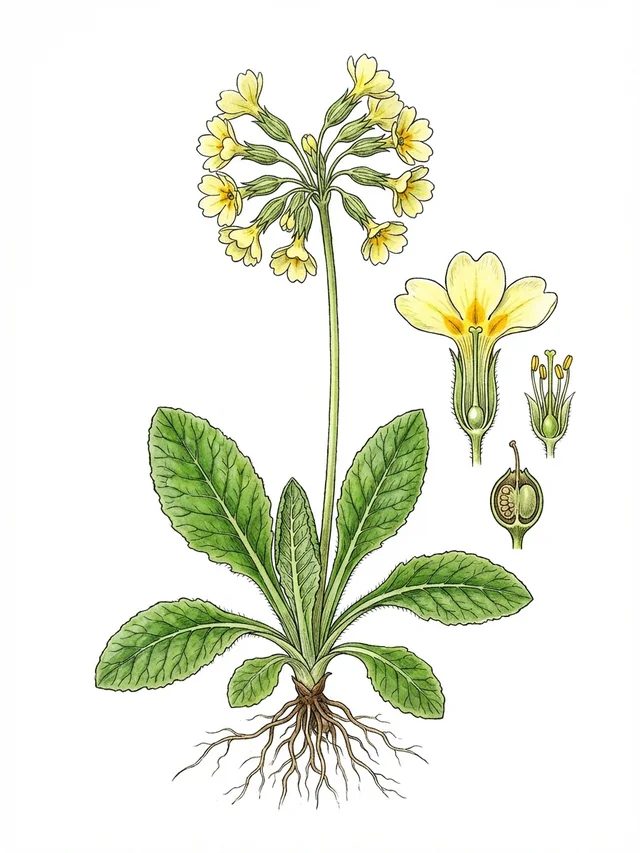
 Bild folgtKI-generierte Illustration
Pulicaria vulgaris
Pulicaria vulgaris
FamilyGenus: Pulicariaheimisch in Deutschland
🌿
2
Species
interact
🔗
3
Interactions
documented
About this species
Pulicaria vulgaris is a native British herbaceous plant belonging to the Asteraceae family. It thrives in full sun and moist, nutrient-rich soils with a neutral to slightly acidic pH. The plant produces broad leaves and grows to about 26 cm tall, flowering between June and September. There are no known toxicity concerns, and it is classified as native in Great Britain.
Ecological network
Click to highlight connections · Click again to open species page
Netzwerk wird geladen...
Pollination
Ecological significance
As a native member of Great Britain's flora, Pulicaria vulgaris contributes to local biodiversity and provides nectar and pollen for insects during its summer flowering period. No negative ecological impacts are recorded in the available evidence.
Annual cycle
Flowering occurs from June to September.
Safety note
No toxicity or safety hazards are documented for this species.
Standort & Merkmale
Light
Sonne
Moisture
Feucht
Soil
—
Bloom time
Jun – Sep
Bioregion
Continental
Growth form
Krautige Pflanze
Woodiness
Nicht verholzt
Leaf type
Breitblättrig
Plant height
0.257 m
Morphological traits: TRY ID3 (CC BY 3.0) & TRY ID81 (CC BY)
Pflege & Anbau
Grow in full sun and consistently moist, nutrient-rich soil. A neutral to slightly acid pH is ideal. The plant is suited to sites with minimal disturbance and can be used in wildflower areas or damp borders; avoid waterlogged soils. Cutting back after flowering may help maintain its vigour, though no specific pruning is required.
Scientific profile
Pulicaria vulgaris is a broad-leaved, non-woody herb that reaches an average height of around 26 cm. It grows best in full sun and moist conditions, typically on fertile, neutral to slightly acidic soils where disturbance is low. The species is native in Great Britain and flowers from June to September. Its seeds are light, with a diaspore mass of approximately 0.1 mg, and the average leaf area is 262 mm². The plant shows slight tolerance of saline conditions.
Sources & data origin
•pollinator_interactions
•FloraWeb / BfN
•EIVE 1.0 — Dengler et al. (2023), DOI: 10.3897/VCS.98324 (CC BY 4.0)
•GBIF Backbone Taxonomy — GBIF Secretariat (2024), DOI: 10.15468/39omei (CC BY 4.0)
•TRY Categorical Traits (ID3) — Kattge et al. (2012), DOI: 10.17871/TRY.3 (CC BY 3.0)
•TRY Global Spectrum (ID81) — Díaz et al. (2016/2021), DOI: 10.17871/TRY.81 (CC BY)
•Govaerts R et al. (2025) — World Checklist of Vascular Plants (WCVP) v14. Royal Botanic Gardens, Kew. DOI: 10.34885/xs7h-ze42 (CC BY 4.0)
All data is licensed under CC BY 4.0, CC0, or compatible. Attribution according to license terms. Full source overview →