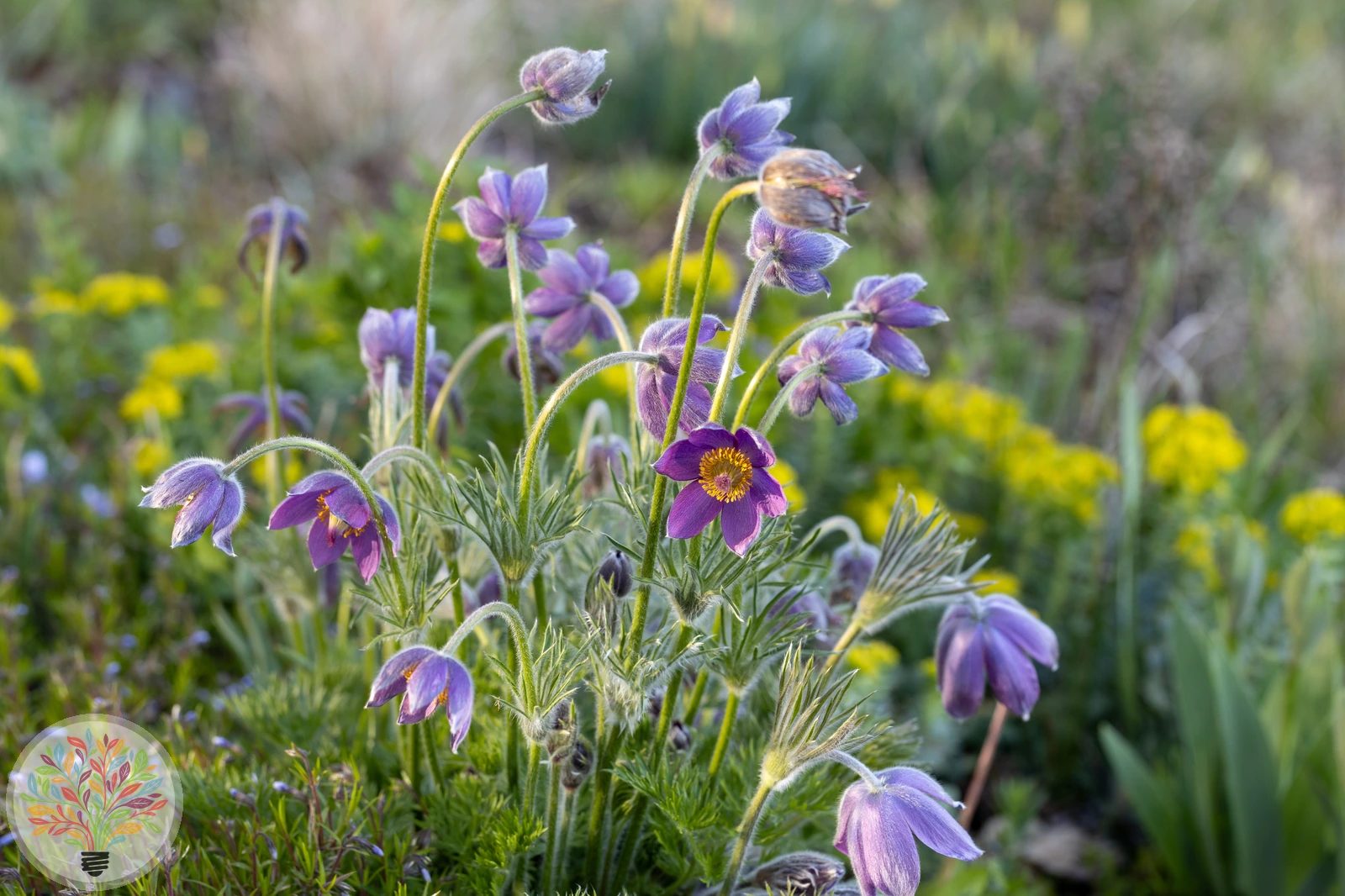
Pulsatilla vulgaris
Pulsatilla vulgaris
FamilyGenus: Pulsatillaheimisch in Deutschland
🌿
14
Species
interact
🔗
16
Interactions
documented
About this species
Pulsatilla vulgaris is a perennial herb native in Great Britain, favouring full sun, dry conditions and nutrient-poor alkaline soils. It flowers in May and occurs predominantly in calcareous grasslands and sparse meadows. Its Red List status is 3.
Ecological network
Click to highlight connections · Click again to open species page
Netzwerk wird geladen...
PollinationFlower visit
Ecological significance
The flowers provide pollen and nectar for early spring pollinators. The plant’s arbuscular mycorrhizal associations may contribute to soil health in its nutrient-poor habitat. It is a characteristic element of species-rich calcareous grasslands.
Annual cycle
Flowers in May.
Standort & Merkmale
Light
Sonne
Moisture
Trocken
Soil
Schwachzehrer (Magerer Boden)
Bloom time
Mai – Mai
Soil reaction
Basisch / Kalkhold
Bioregion
Continental
Nectar value
2
Pollen value
2
Growth form
Krautige Pflanze
Woodiness
Nicht verholzt
Leaf type
Breitblättrig
Morphological traits: TRY ID3 (CC BY 3.0) & TRY ID81 (CC BY)
Pflege & Anbau
Prefers a sunny position in very well-drained, low-nutrient, alkaline soil. Avoid rich soils and overwatering. Once established, it requires minimal intervention and does not need feeding.
Scientific profile
A herbaceous, non-woody plant with broad leaves. Its ecological profile indicates a strong preference for full light (Ellenberg L value 8.1), dry soil (F value 3) and a calcareous, basic reaction (R value 8). Nutrient requirements are low (N value 2), and it is adapted to low-disturbance habitats (disturbance severity 0.47). The species forms arbuscular mycorrhizal (AM) associations. Nectar and pollen scores are both 2. In Great Britain it is categorised as Red List 3, and its primary habitat is calcareous dry grassland, with secondary occurrence in extensive, low-intensity meadows.
Bestäuber & Besucher
12 Arten interagieren mit dieser Pflanze
Bombus pratorumOsmia bicolorNomada flavoguttataNomada zonataAnthophora plumipesBombus gr. terrestrisBombus pascuorumHalictus tumulorumPlatycheirus albimanusPlatycheirus manicatusPlatycheirus tarsalisRhingia campestris
Other flower visitors
2 other species visit the flowers
Forficula auriculariaMyrmica scabrinodis
Sources & data origin
•pollinator_interactions
•FloraWeb / BfN
•EIVE 1.0 — Dengler et al. (2023), DOI: 10.3897/VCS.98324 (CC BY 4.0)
•EuPPollNet — Kuppler et al. (2025), DOI: 10.1111/geb.70000 (CC BY 4.0)
•Database of Pollinator Interactions (DoPI) — Pocock et al. (2022), DOI: 10.1002/ecy.3801 (CC BY)
•GBIF Backbone Taxonomy — GBIF Secretariat (2024), DOI: 10.15468/39omei (CC BY 4.0)
•TRY Categorical Traits (ID3) — Kattge et al. (2012), DOI: 10.17871/TRY.3 (CC BY 3.0)
•TRY Global Spectrum (ID81) — Díaz et al. (2016/2021), DOI: 10.17871/TRY.81 (CC BY)
•Govaerts R et al. (2025) — World Checklist of Vascular Plants (WCVP) v14. Royal Botanic Gardens, Kew. DOI: 10.34885/xs7h-ze42 (CC BY 4.0)
•Foto: © Adobe Stock / AdobeStock_760140637
All data is licensed under CC BY 4.0, CC0, or compatible. Attribution according to license terms. Full source overview →