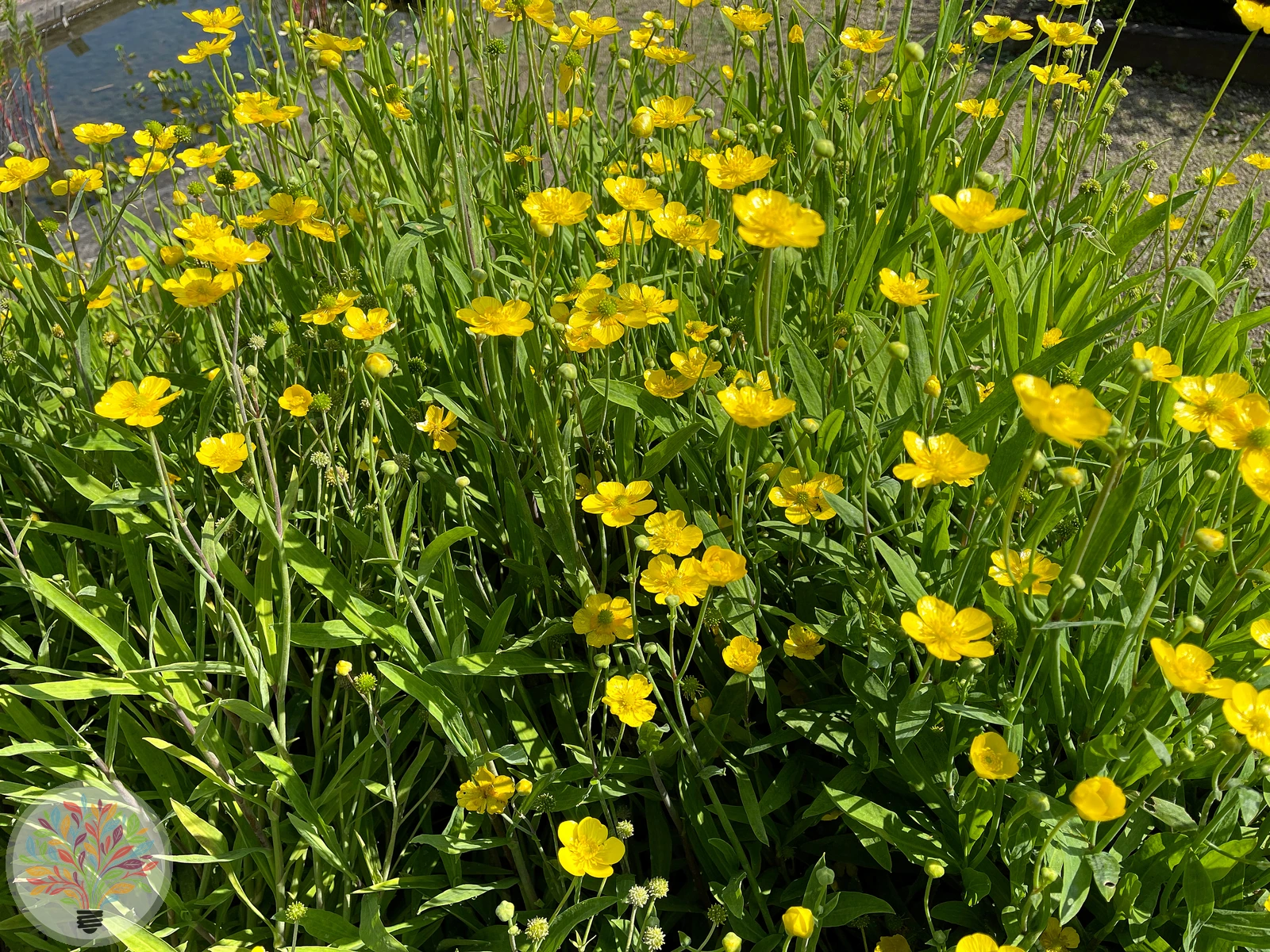
Ranunculus lingua
Ranunculus lingua
FamilyGenus: Ranunculusheimisch in Deutschland
🌿
51
Species
interact
🔗
51
Interactions
documented
🐛
1
Host relationships
Species
About this species
A native aquatic buttercup found in wet, sunny habitats, flowering in summer.
Ecological network
Click to highlight connections · Click again to open species page
Netzwerk wird geladen...
PollinationLarval hostFlower visit
Annual cycle
Flowering occurs from June to August.
Standort & Merkmale
Light
Sonne
Moisture
Feucht
Soil
Mittelzehrer (Normaler Boden)
Bloom time
Jun – Aug
Soil reaction
Mäßig sauer bis neutral
Bioregion
Continental
Growth form
Krautige Pflanze
Woodiness
Nicht verholzt
Leaf type
Breitblättrig
Plant height
0.892 m
Morphological traits: TRY ID3 (CC BY 3.0) & TRY ID81 (CC BY)
Pflege & Anbau
Prefers full sun and consistently moist to wet soil. It does best in nutrient-rich ground but can manage in ordinary damp garden soil. A neutral to slightly acidic soil suits it. Ideal for pond edges and bog gardens.
Scientific profile
Ranunculus lingua is a herbaceous, non-woody perennial belonging to the buttercup family (Ranunculaceae). It is native to Great Britain. The plant has broad leaves and an aquatic habit, reaching a height of about 0.9 metres. It grows in full sun on wet, often swampy ground, preferring nutrient-rich, neutral to slightly acidic soils. Flowering occurs from June to August. The species is associated with habitats that experience low levels of disturbance.
Bestäuber & Besucher
48 Arten interagieren mit dieser Pflanze
Pyrgus malvaePolyommatus icarusPieris napiThymelicus sylvestrisBoloria seleneOsmia spinulosaErynnis tagesHalictus tumulorumNomada fucataHalictus rubicundusManiola jurtinaCelastrina argiolusAglais urticaeCallophrys rubiLasioglossum pauxillumNomada striataCoenonympha pamphilusLasiommata megeraLasioglossum zonulumLasioglossum xanthopusLeptidea sinapisLycaena phlaeasHamearis lucinaLasioglossum fulvicorneLasioglossum malachurumOsmia bicolorEuphydryas auriniaAndrena labiataAndrena nitidaAndrena labialisAndrena haemorrhoaBombus pratorumMelitaea athaliaNomada goodenianaChelostoma florisomneHylaeus brevicornisOsmia bicornisAndrena nigroaeneaBombus lapidariusFixsenia pruniClossiana euphrosyneGonepteryx rhamniLasioglossum albipesBombus sylvestrisLasioglossum calceatumLasioglossum morioAndrena bicolorAraschnia levana
Sources & data origin
•TRY v6.0 / BiolFlor flowering phenology (Request 47350) — CC BY 4.0TRY request 47350 (Public, Data Released, TRY v6.0; 2026-02-15). Cite TRY: Kattge et al. (2020), doi:10.1111/gcb.14904; original source: Trefflich, A., Klotz, S. & Kühn, I. (2002). Blühphänologie. BIOLFLOR, Schriftenreihe für Vegetationskunde 38:127–131.
•Interaktionsdaten via GloBI (CC-BY 4.0)
•Baden-Böhm F, App M, Thiele J (2022) — The FloRes Database: A floral resources trait database for pollinator habitat-assessment generated by a multistep workflow. Johann Heinrich von Thünen-Institut, Dryad, DOI: 10.5061/dryad.djh9w0w29 (CC0)
•FloraWeb / BfN
•EIVE 1.0 — Dengler et al. (2023), DOI: 10.3897/VCS.98324 (CC BY 4.0)
•GBIF Backbone Taxonomy — GBIF Secretariat (2024), DOI: 10.15468/39omei (CC BY 4.0)
•TRY Categorical Traits (ID3) — Kattge et al. (2012), DOI: 10.17871/TRY.3 (CC BY 3.0)
•TRY Global Spectrum (ID81) — Díaz et al. (2016/2021), DOI: 10.17871/TRY.81 (CC BY)
•Govaerts R et al. (2025) — World Checklist of Vascular Plants (WCVP) v14. Royal Botanic Gardens, Kew. DOI: 10.34885/xs7h-ze42 (CC BY 4.0)
•Foto: © Manfred Ruckszio / Adobe Stock / AdobeStock_488587189
All data is licensed under CC BY 4.0, CC0, or compatible. Attribution according to license terms. Full source overview →