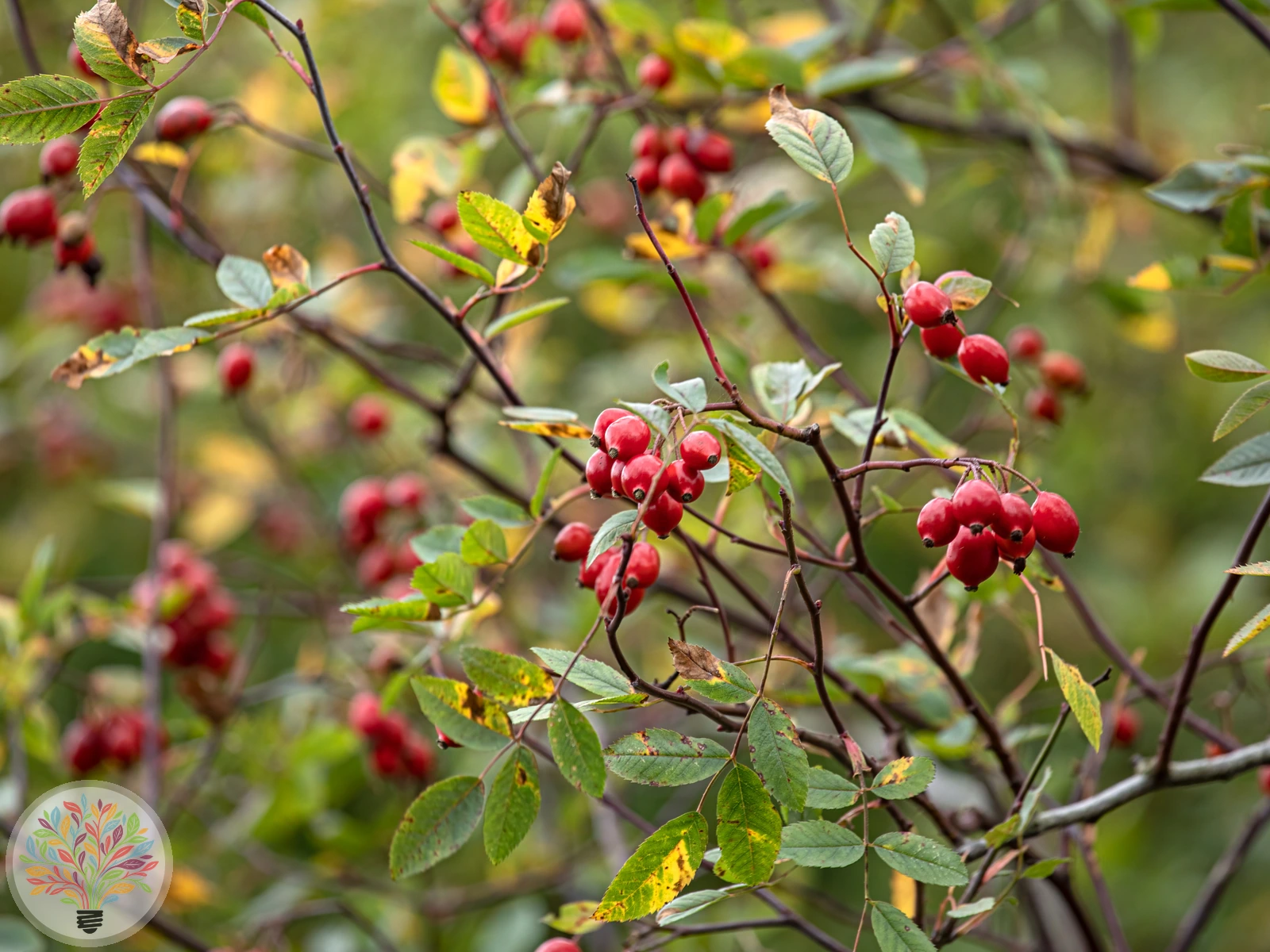
Rosa glauca
Rosa glauca
FamilyGenus: Rosaheimisch in Deutschland
🌿
2
Species
interact
🔗
2
Interactions
documented
🐛
1
Host relationships
Species
About this species
Rosa glauca is an introduced deciduous shrub established in Great Britain, valued for its bluish-green foliage and delicate clusters of small pink flowers with pale centres that appear in June and July. Reaching around two metres in height, it thrives in full sun on moderately moist, normal to calcareous soils and is considered child-safe.
Ecological network
Click to highlight connections · Click again to open species page
Netzwerk wird geladen...
PollinationLarval host
Ecological significance
Rosa glauca is an introduced and established shrub in Great Britain, grown in gardens without evidence of invasive spread. Its interactions with local wildlife are not documented.
Annual cycle
A deciduous shrub, Rosa glauca leafs out in spring and produces its pale-centred pink flowers in June and July. The foliage is shed in autumn, and the plant remains leafless through the winter dormancy.
Safety note
The plant is considered child-safe, with no known toxicity or physical hazards reported.
Standort & Merkmale
Light
Sonne
Moisture
Frisch (Mäßig feucht)
Soil
Mittelzehrer (Normaler Boden)
Bloom time
Jun – Jul
Soil reaction
Mäßig sauer bis neutral
Bioregion
Continental
Growth form
Strauch
Woodiness
Verholzt
Leaf type
Breitblättrig
Leaf phenology
Laubabwerfend
Plant height
2.026 m
Morphological traits: TRY ID3 (CC BY 3.0) & TRY ID81 (CC BY)
Pflege & Anbau
Plant in full sun on a moderately moist, well-drained soil. Rosa glauca does well in normal garden soil and tolerates calcareous conditions. Its nutrient needs are modest, suiting a lean soil. No special winter protection is required once established.
Scientific profile
A woody, broad-leaved shrub of terrestrial habit, Rosa glauca reaches about 2.03 metres tall under optimal conditions. Its deciduous leaves are relatively large, with a mean area of 436 mm², lending a soft, grey-green texture. Flowering occurs in June and July. The diaspore mass averages 13.335 milligrams. Indicator values place it as a sun-demanding, moderately warm-site species with a preference for alkaline to basic soil reaction and low nutrient levels, tolerating only slight disturbance. Moisture requirements are fresh and it grows on normal soils. In Great Britain it is an introduced species that has become established.
Sources & data origin
•TraitCH — CC BY 4.0TraitCH 2.0 contributors; imported as source-preserving NaturKompass taxon evidence.
•TRY v6.0 / BiolFlor flowering phenology (Request 47350) — CC BY 4.0TRY request 47350 (Public, Data Released, TRY v6.0; 2026-02-15). Cite TRY: Kattge et al. (2020), doi:10.1111/gcb.14904; original source: Trefflich, A., Klotz, S. & Kühn, I. (2002). Blühphänologie. BIOLFLOR, Schriftenreihe für Vegetationskunde 38:127–131.
•Interaktionsdaten via GloBI (CC-BY 4.0)
•FloraWeb / BfN
•EIVE 1.0 — Dengler et al. (2023), DOI: 10.3897/VCS.98324 (CC BY 4.0)
•GBIF Backbone Taxonomy — GBIF Secretariat (2024), DOI: 10.15468/39omei (CC BY 4.0)
•TRY Categorical Traits (ID3) — Kattge et al. (2012), DOI: 10.17871/TRY.3 (CC BY 3.0)
•TRY Global Spectrum (ID81) — Díaz et al. (2016/2021), DOI: 10.17871/TRY.81 (CC BY)
•Checklist Alien Plants Belgium — Verloove F (2023), Botanic Garden Meise (CC BY 4.0)
•Govaerts R et al. (2025) — World Checklist of Vascular Plants (WCVP) v14. Royal Botanic Gardens, Kew. DOI: 10.34885/xs7h-ze42 (CC BY 4.0)
•Foto: © Adobe Stock / AdobeStock_457801345
All data is licensed under CC BY 4.0, CC0, or compatible. Attribution according to license terms. Full source overview →