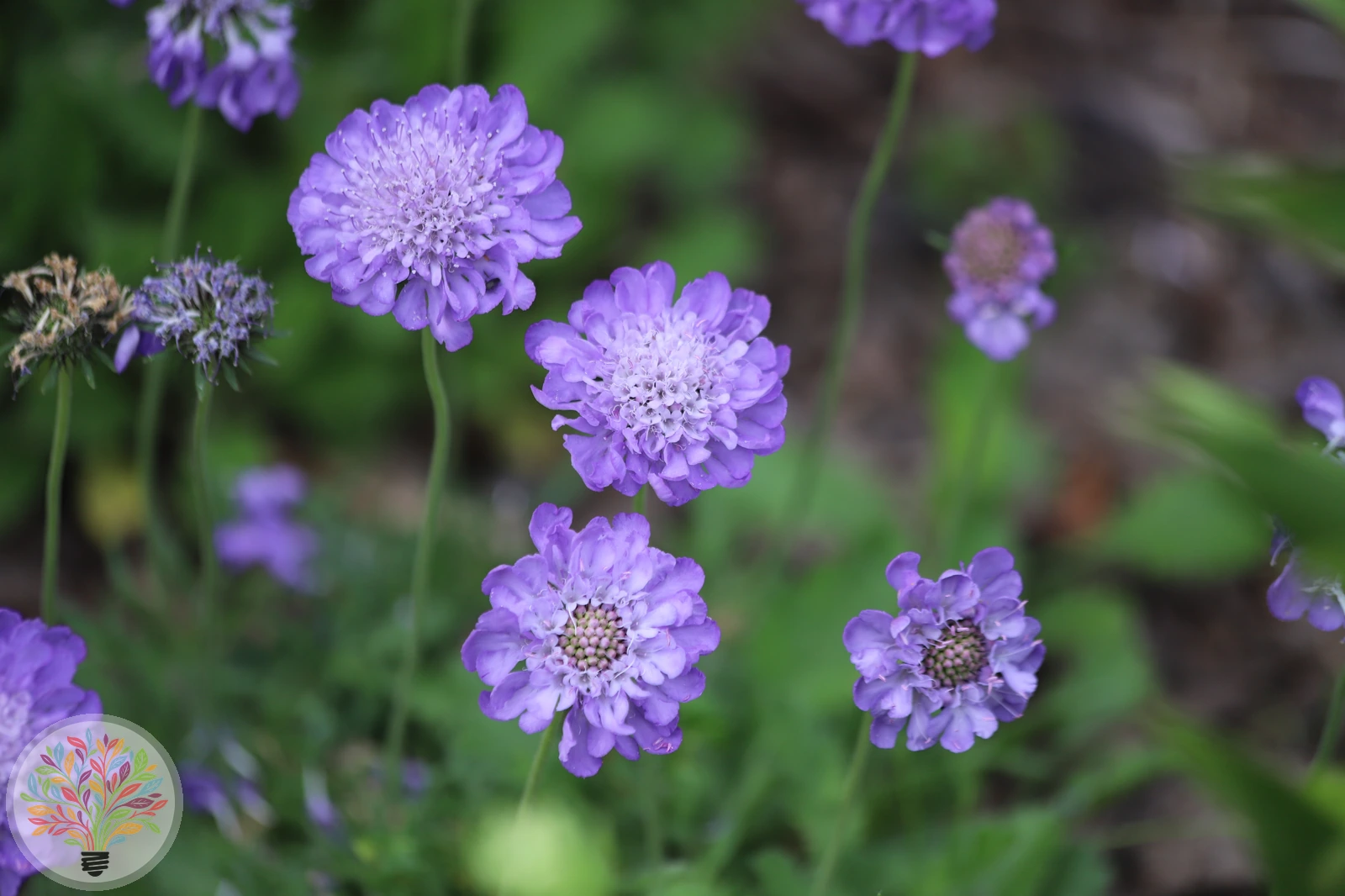
Scabiosa columbaria
Scabiosa columbaria
FamilyGenus: Scabiosaheimisch in Deutschland
🌿
108
Species
interact
🔗
1442
Interactions
documented
🐛
2
Host relationships
Species
About this species
A sun-loving native wildflower that thrives in dry, lean, alkaline soils and rewards with a long season of nectar-rich blooms from midsummer well into autumn.
Ecological network
Click to highlight connections · Click again to open species page
Netzwerk wird geladen...
PollinationLarval hostFlower visit
Ecological significance
The flowers offer a high combined nectar and pollen reward, rated 5 out of 5 for both, making this plant a valuable resource for a wide range of insect visitors. Its arbuscular mycorrhizal partnerships help it inhabit nutrient-poor soils and can benefit the wider soil community.
Annual cycle
Bloom period extends from July through to November, providing a sustained source of forage late in the year.
Standort & Merkmale
Light
Sonne
Moisture
Trocken
Soil
Schwachzehrer (Magerer Boden)
Bloom time
Jul – Nov
Soil reaction
Basisch / Kalkhold
Bioregion
Continental
Nectar value
5
Pollen value
5
Growth form
Krautige Pflanze
Woodiness
Nicht verholzt
Leaf type
Breitblättrig
Plant height
0.397 m
Morphological traits: TRY ID3 (CC BY 3.0) & TRY ID81 (CC BY)
Pflege & Anbau
•
Light: Full sun
•
Moisture: Dry, well-drained soil; drought-tolerant once established
•
Soil: Lean, low-nutrient, alkaline to neutral
•
Mycorrhiza: Associates with arbuscular mycorrhizal fungi; avoid high-phosphate fertilisers
•
Maintenance: No feeding required; suitable for gravel gardens, wildflower meadows and sunny banks
Scientific profile
Scabiosa columbaria is a herbaceous, non-woody, broad-leaved plant of open, sunny habitats. Typically reaching about 0.4 metres in height, it performs best on dry, calcareous substrates with very low nutrient availability and only minor disturbance. The plant produces diaspores with an average mass of 1.7 mg. It is native in Great Britain.
Bestäuber & Besucher
95 Arten interagieren mit dieser Pflanze
Bombus lapidariusZygaena loniceraeVanessa carduiBombus terrestrisEristalis tenaxCeratina cucurbitinaSyritta pipiensEpisyrphus balteatusPlatycheirus albimanusSyrphus ribesiiHelophilus trivittatusBombus pascuorumHalictus gr. simplexPipiza austriacaLasioglossum nitidulumLasioglossum malachurumDasysyrphus albostriatusLasioglossum morioEupeodes lunigerLasioglossum fulvicorneSeladonia tumulorumOsmia spinulosaBombus lucorumBombus bohemicusBombus soroeensisLasioglossum calceatumBombus pratorumLasioglossum villosulumBombus terrestris/lucorumBombus hortorumBombus rupestrisBombus sylvestrisLasioglossum albipesSphaerophoria scriptaApis.melliferaHalictus.scabiosaeBombus.lapidariusAndrena hattorfianaAphantopus hyperantusBombus lapidarusEristalis lineataEristalis arbustorumEpistrophe grossulariaeLasioglossum zonulumLycaena virgaureaeMelanargia galatheaPolyommatus icarusMerodon equestrisSyrphus vitripennisVolucella pellucens
Other flower visitors
11 other species visit the flowers
Adscita/Jodanita spBombylidaeMelitaea athalia/britomartisPyrgus alveus/armoricanusTryphoninaeCriorhina floccosaCylindromyia brevicornisNowickia feroxLavathera lavatheraeLucilia illustrisMeligethes solidus
Sources & data origin
•TRY v6.0 / BiolFlor flowering phenology (Request 47350) — CC BY 4.0TRY request 47350 (Public, Data Released, TRY v6.0; 2026-02-15). Cite TRY: Kattge et al. (2020), doi:10.1111/gcb.14904; original source: Trefflich, A., Klotz, S. & Kühn, I. (2002). Blühphänologie. BIOLFLOR, Schriftenreihe für Vegetationskunde 38:127–131.
•Cook et al. (2025) UK Butterfly & Moth Traits (DOI: 10.5285/dbc7cc17-cbbd-49dd-bab4-8e8855768d66)
•pollinator_interactions
•FloraWeb / BfN
•EIVE 1.0 — Dengler et al. (2023), DOI: 10.3897/VCS.98324 (CC BY 4.0)
•EuPPollNet — Kuppler et al. (2025), DOI: 10.1111/geb.70000 (CC BY 4.0)
•Database of Pollinator Interactions (DoPI) — Pocock et al. (2022), DOI: 10.1002/ecy.3801 (CC BY)
•GBIF Backbone Taxonomy — GBIF Secretariat (2024), DOI: 10.15468/39omei (CC BY 4.0)
•TRY Categorical Traits (ID3) — Kattge et al. (2012), DOI: 10.17871/TRY.3 (CC BY 3.0)
•TRY Global Spectrum (ID81) — Díaz et al. (2016/2021), DOI: 10.17871/TRY.81 (CC BY)
•Govaerts R et al. (2025) — World Checklist of Vascular Plants (WCVP) v14. Royal Botanic Gardens, Kew. DOI: 10.34885/xs7h-ze42 (CC BY 4.0)
•Foto: © Adobe Stock / AdobeStock_856358640
All data is licensed under CC BY 4.0, CC0, or compatible. Attribution according to license terms. Full source overview →