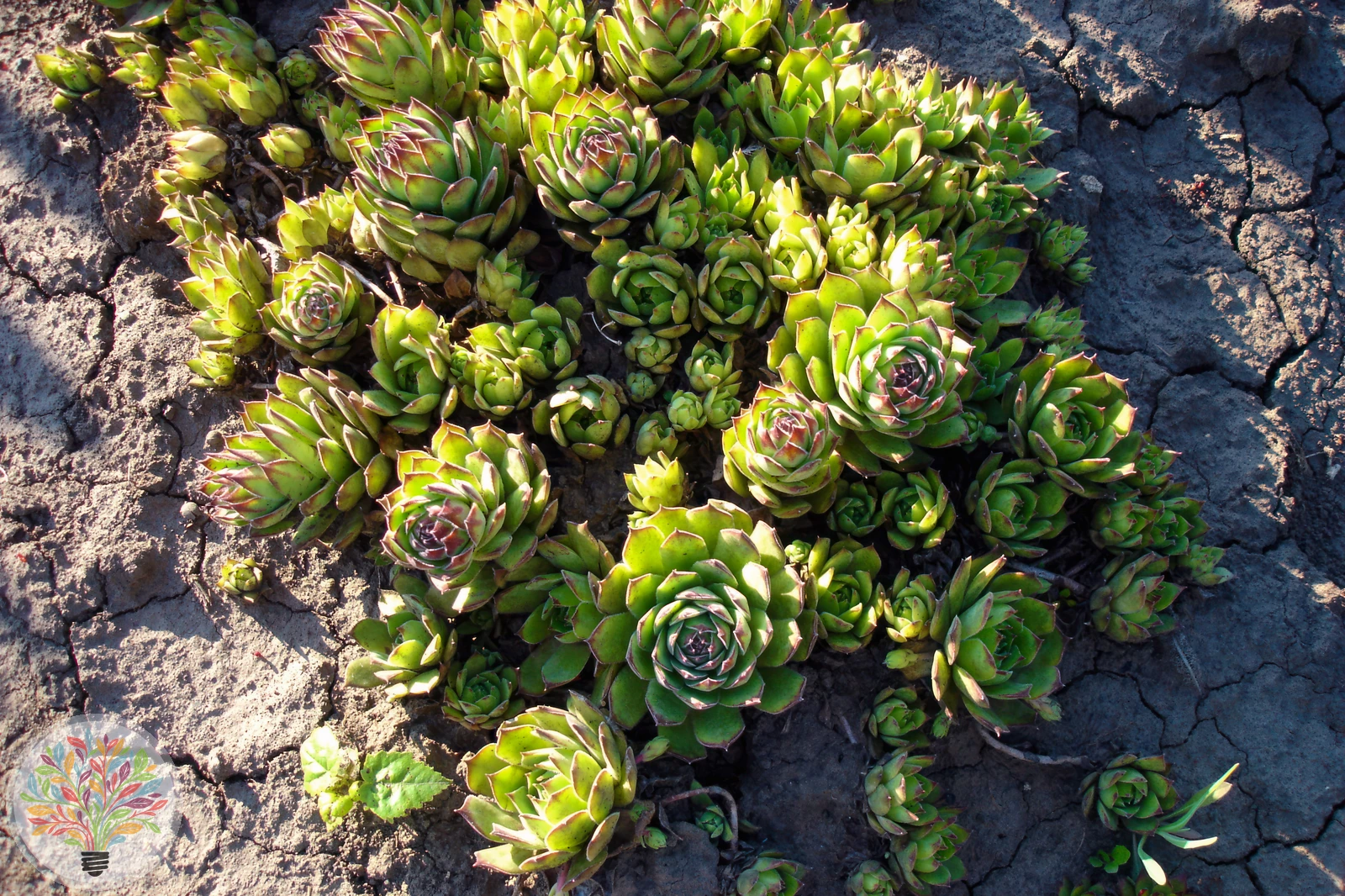
Sempervivum arachnoideum
Sempervivum arachnoideum
FamilyGenus: Sempervivumheimisch in Deutschland
About this species
An introduced, established succulent perennial in Great Britain, forming evergreen rosettes of broad, fleshy leaves. It blooms from July to September and favours full sun on dry, acidic, nutrient-poor soils.
Ecological significance
Sempervivum arachnoideum is an introduced plant that has established in the wild in Great Britain. It occurs in dry, acidic, nutrient-poor grassland habitats, but no further information on its ecological impact is available.
Annual cycle
Evergreen rosettes persist throughout the year. Erect flowering stems appear from July to September, carrying small blooms, after which the flowering rosette dies away; new offsets continue the clump.
Standort & Merkmale
Light
Sonne
Moisture
Trocken
Soil
Schwachzehrer (Magerer Boden)
Bloom time
Jul – Sep
Soil reaction
Sauer (Säurezeiger)
Bioregion
Continental
Growth form
Sukkulente
Woodiness
Nicht verholzt
Leaf type
Breitblättrig
Leaf phenology
Immergrün
Plant height
0.08 m
Morphological traits: TRY ID3 (CC BY 3.0) & TRY ID81 (CC BY)
Pflege & Anbau
Grow in full sun in very well-drained, gritty or sandy soil with low fertility. It tolerates dry conditions and requires minimal watering once established, particularly during winter. Suitable for rock gardens, troughs or crevices where drainage is sharp. Hardy in temperate regions, but avoid waterlogged ground.
Scientific profile
Sempervivum arachnoideum is a low-growing, evergreen succulent belonging to the stonecrop family (Crassulaceae). The plant forms compact rosettes of fleshy, broad leaves and typically reaches a height of 8 cm. Flowering occurs between July and September. It is adapted to high light levels (Ellenberg light value 9), dry conditions (moisture value 2), acid soils (reaction value 3) and extremely nutrient-poor substrates (nutrient value 1). It shows a preference for cold, alpine or northern temperature regimes (value 3) and experiences low disturbance severity (0.33). The diaspores are very small, with a mean mass of approximately 0.02 mg, and the species associates with arbuscular mycorrhizal fungi. According to the habitats derived from its indicator values, its primary vegetation type is acidic dry grassland, with secondary associations including alpine grassland and extensive meadows. This species was introduced into Great Britain and has become established outside gardens.
Sources & data origin
•TraitCH — CC BY 4.0TraitCH 2.0 contributors; imported as source-preserving NaturKompass taxon evidence.
•FloraWeb / BfN
•EIVE 1.0 — Dengler et al. (2023), DOI: 10.3897/VCS.98324 (CC BY 4.0)
•GBIF Backbone Taxonomy — GBIF Secretariat (2024), DOI: 10.15468/39omei (CC BY 4.0)
•TRY Categorical Traits (ID3) — Kattge et al. (2012), DOI: 10.17871/TRY.3 (CC BY 3.0)
•TRY Global Spectrum (ID81) — Díaz et al. (2016/2021), DOI: 10.17871/TRY.81 (CC BY)
•Govaerts R et al. (2025) — World Checklist of Vascular Plants (WCVP) v14. Royal Botanic Gardens, Kew. DOI: 10.34885/xs7h-ze42 (CC BY 4.0)
•Foto: © Adobe Stock / AdobeStock_807045856
All data is licensed under CC BY 4.0, CC0, or compatible. Attribution according to license terms. Full source overview →