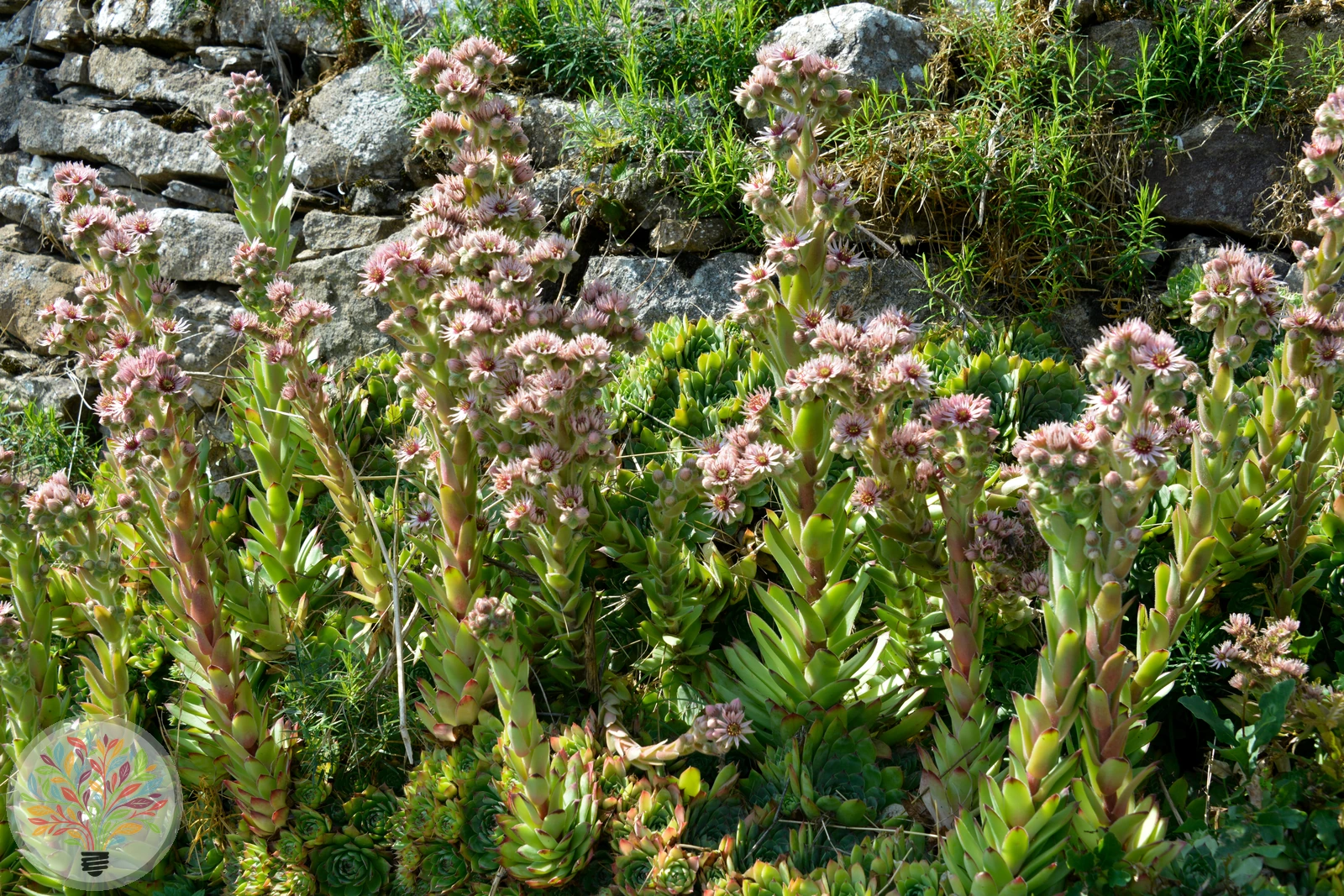
Sempervivum tectorum
Sempervivum tectorum
FamilyGenus: Sempervivumheimisch in Deutschland
About this species
Sempervivum tectorum is an introduced and established succulent in Great Britain, known for its rosettes of broad, fleshy leaves. It favours sunny, dry positions on poor soil and bears flowers from July to September.
Ecological significance
Little is known about the ecological impact of this introduced species in Great Britain. It is not currently recorded as invasive.
Annual cycle
Flowers appear between July and September.
Standort & Merkmale
Light
Sonne
Moisture
Trocken
Soil
Schwachzehrer (Magerer Boden)
Bloom time
Jul – Sep
Soil reaction
Mäßig sauer bis neutral
Bioregion
Continental
Growth form
Sukkulente
Woodiness
Nicht verholzt
Leaf type
Breitblättrig
Plant height
0.265 m
Morphological traits: TRY ID3 (CC BY 3.0) & TRY ID81 (CC BY)
Pflege & Anbau
This succulent thrives in full sun and extremely well-drained, lean soil. Water sparingly, allowing the compost or soil to dry out completely between waterings; it tolerates drought well. It is ideal for rock gardens, green roofs, alpine troughs and containers.
Scientific profile
Sempervivum tectorum, a member of the stonecrop family (Crassulaceae), is a leaf succulent with broad, fleshy leaves arranged in dense rosettes. The plant reaches a height of about 0.27 metres and has a non-woody, terrestrial growth form. Its diaspores (seeds) are very small, with a mass of less than 0.01 milligrams. In Great Britain it is an introduced species that has become established in the wild. Ecological indicator values suggest a strong preference for full sun (light value 8), dry conditions (moisture value 2) and nutrient-poor, neutral to weakly acid soils (reaction value 5, nutrient value 2). It experiences low disturbance severity in its typical habitats. The plant forms arbuscular mycorrhizal associations. Flowering extends from July to September.
Sources & data origin
•TraitCH — CC BY 4.0TraitCH 2.0 contributors; imported as source-preserving NaturKompass taxon evidence.
•FloraWeb / BfN
•EIVE 1.0 — Dengler et al. (2023), DOI: 10.3897/VCS.98324 (CC BY 4.0)
•GBIF Backbone Taxonomy — GBIF Secretariat (2024), DOI: 10.15468/39omei (CC BY 4.0)
•TRY Categorical Traits (ID3) — Kattge et al. (2012), DOI: 10.17871/TRY.3 (CC BY 3.0)
•TRY Global Spectrum (ID81) — Díaz et al. (2016/2021), DOI: 10.17871/TRY.81 (CC BY)
•Checklist Alien Plants Belgium — Verloove F (2023), Botanic Garden Meise (CC BY 4.0)
•Govaerts R et al. (2025) — World Checklist of Vascular Plants (WCVP) v14. Royal Botanic Gardens, Kew. DOI: 10.34885/xs7h-ze42 (CC BY 4.0)
•Foto: © Alain Guerrier / Adobe Stock / AdobeStock_1048506246
All data is licensed under CC BY 4.0, CC0, or compatible. Attribution according to license terms. Full source overview →